

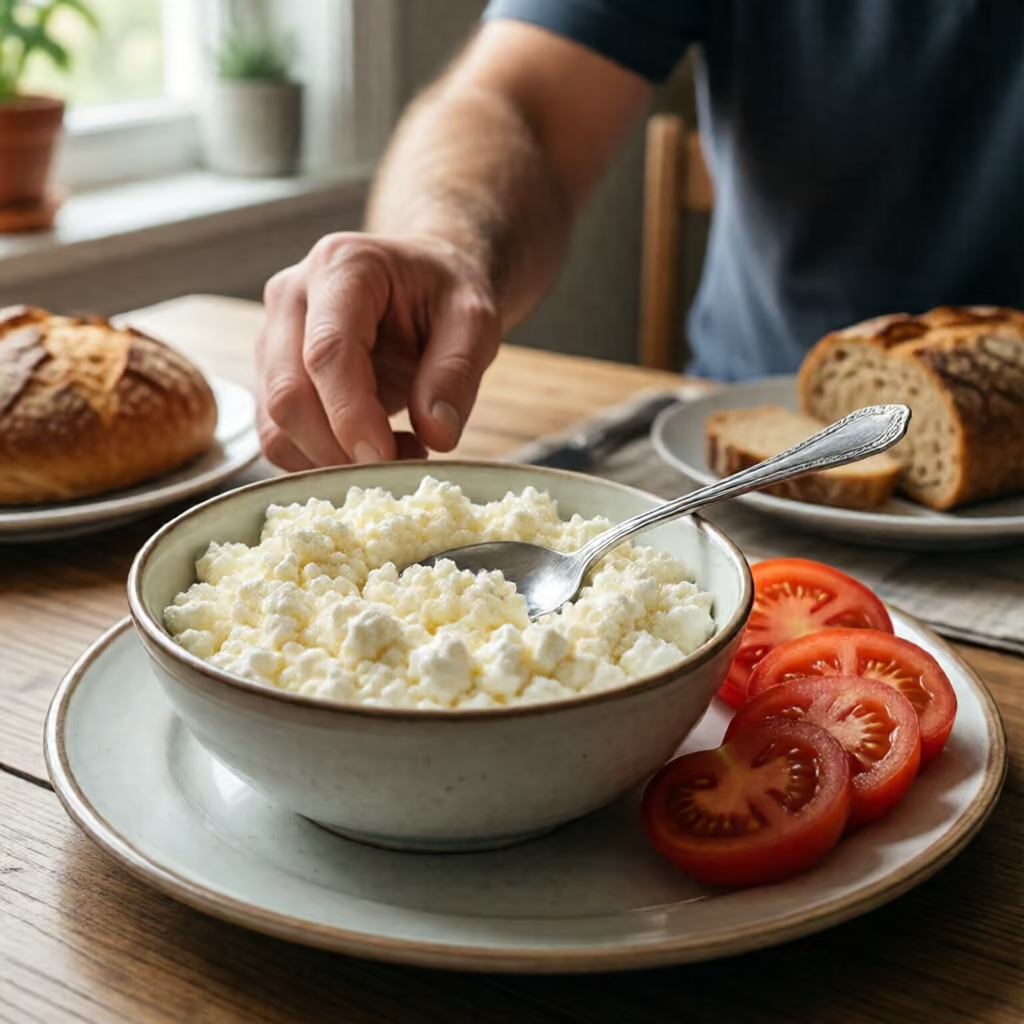
der Hüttenkäse
cottage cheese
A mild fresh cheese with small white curds and a slightly tangy taste.
EXAMPLE
Zum Frühstück esse ich gern Hüttenkäse mit frischen Tomaten.
For breakfast, I like to eat cottage cheese with fresh tomatoes.
cottage cheese
der Hüttenkäse, die Hüttenkäse
Loading your saved state.
cottage cheese
A mild fresh cheese with small white curds and a slightly tangy taste.
Zum Frühstück esse ich gern Hüttenkäse mit frischen Tomaten.
For breakfast, I like to eat cottage cheese with fresh tomatoes.
| gender | masculine der |
|---|---|
| plural | die Hüttenkäse |
| genitive | des Hüttenkäses |
| singular | plural | |
|---|---|---|
| nominative | der Hüttenkäse | die Hüttenkäse |
| accusative | den Hüttenkäse | die Hüttenkäse |
| dative | dem Hüttenkäse | den Hüttenkäsen |
| genitive | des Hüttenkäses | der Hüttenkäse |
The article changes with the case; it is shown in colour.
'Hüttenkäse' (cottage cheese) is made up of 'Hütte' (hut / cottage) and 'Käse' (cheese). This combination helps you remember the name by picturing a rustic type of cheese.
Der Hüttenkäse steht im Kühlschrank neben der Milch.
The cottage cheese is in the fridge next to the milk.
'Hüttenkäse' (cottage cheese) is often combined with fresh vegetables, fruit, or herbs. It is also commonly used as a spread on bread and as an ingredient in salads.
Für den Salat mische ich Hüttenkäse mit Gurken, Paprika und Kräutern.
For the salad, I mix cottage cheese with cucumbers, bell peppers, and herbs.
'Hüttenkäse' (cottage cheese) is usually used as a mass noun. Quantities are therefore typically expressed using 'eine Packung' (a package), 'ein Becher' (a tub), or a weight in grams.
Für das Rezept brauche ich eine Packung Hüttenkäse und zwei Eier.
For the recipe, I need a package of cottage cheese and two eggs.