

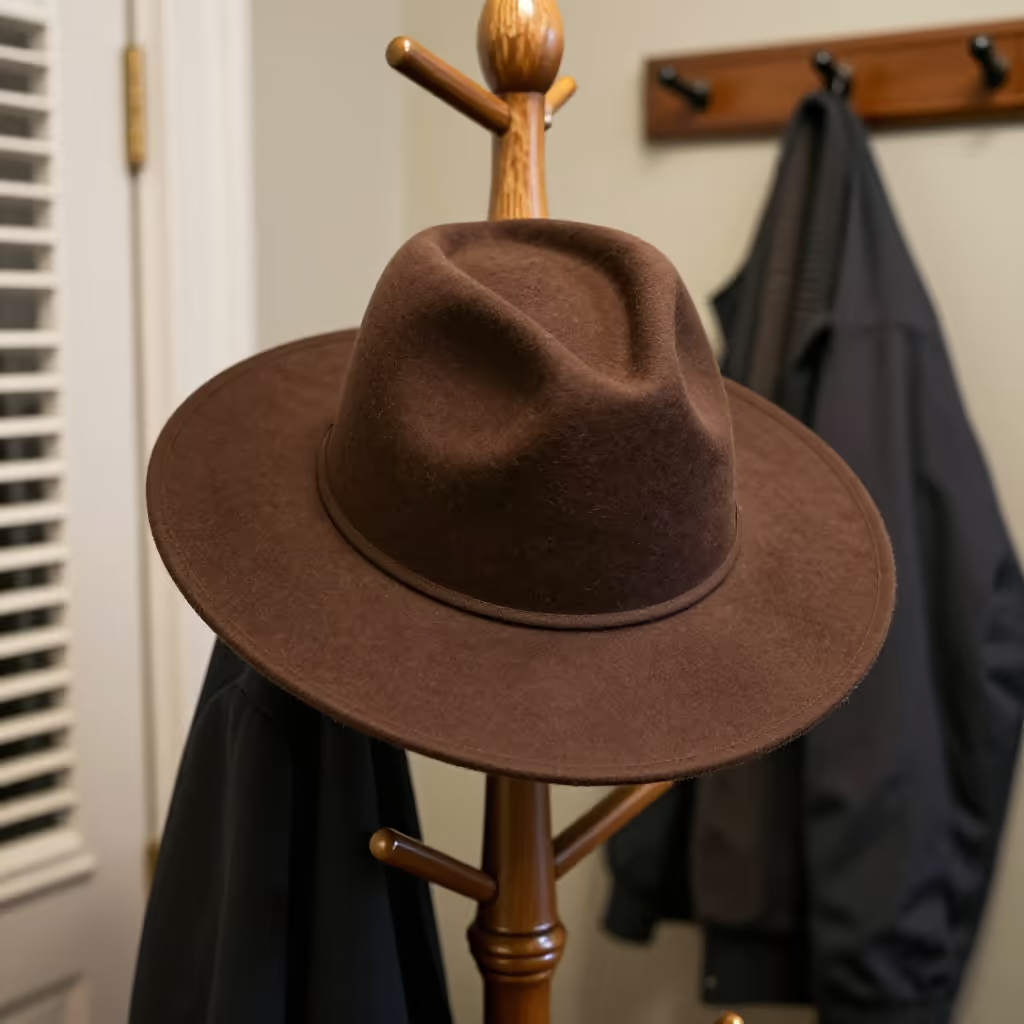
der Hut
hat
A head covering that typically consists of a crown and a brim.
EXAMPLE
An sonnigen Tagen trägt er immer einen großen Strohhut.
On sunny days, he always wears a large straw hat.
hat
Loading your saved state.
hat
A head covering that typically consists of a crown and a brim.
An sonnigen Tagen trägt er immer einen großen Strohhut.
On sunny days, he always wears a large straw hat.

to be on guard
A fixed expression meaning to be careful, watchful, and alert in order to avoid danger or surprise.
In dieser Gegend solltest du nachts auf der Hut sein.
In this area, you should be on guard at night.

to juggle
A fixed expression meaning to successfully reconcile or organize several different or conflicting things.
Es ist nicht leicht, Familie, Hobby und Beruf unter einen Hut zu bringen.
It is not easy to juggle family, hobbies, and work.

to step down
A fixed expression meaning to resign from an office, give up a position, or be dismissed.
Nach dem Skandal musste der Minister seinen Hut nehmen.
After the scandal, the minister had to step down.

to take one's hat off to someone
A fixed expression meaning to express great respect or admiration for someone or their achievement.
Vor ihrer Courage, alles hinter sich zu lassen und neu anzufangen, kann ich nur den Hut ziehen.
I can only take my hat off to her courage in leaving everything behind and starting over.

to be responsible for
A colloquial expression meaning to be responsible for something or to lead a task.
Bei diesem Projekt habe ich die Koordination der externen Partner auf dem Hut.
In this project, I am responsible for coordinating the external partners.
'Der Hut' means 'hat' in English. The English word 'hut' (a small, simple cabin) is 'die Hütte' in German. This is a common mix-up.
Bei diesem kalten Wetter brauchst du einen Hut und Handschuhe.
In this cold weather, you need a hat and gloves.
The word 'Hut' (hat) is related to the verbs 'hüten' and 'behüten' (to protect, to guard). This connection is still easy to recognize in the idiom 'auf der Hut sein' (to be on guard).
Ein Hirte hütet seine Schafe.
A shepherd tends his sheep.
In connection with the head covering, typical verbs such as 'einen Hut tragen' (to wear a hat), 'einen Hut aufsetzen' (to put on a hat), and 'einen Hut abnehmen' (to take off a hat) are used.
Er setzte seinen Hut auf und verließ das Haus.
He put on his hat and left the house.
The expression 'auf der Hut sein' (to be on guard) is often expanded with the preposition 'vor' and the dative to name the danger one should watch out for.
In dieser Stadt musst du vor Taschendieben auf der Hut sein.
In this city, you have to be on guard against pickpockets.
In the expression 'unter einen Hut bringen' (to juggle/reconcile), the things that need to be reconciled are the accusative object of the sentence.
Sie versucht, ihre vielen Termine unter einen Hut zu bringen.
She is trying to juggle her many appointments.
The idiom 'den Hut nehmen' means to give up a position or be dismissed. It is usually used with a possessive pronoun, e.g. 'er musste seinen Hut nehmen' (he had to step down).
Nach der Wahlniederlage musste der Parteivorsitzende seinen Hut nehmen.
After the election defeat, the party chairperson had to step down.
When showing respect for someone, you use the preposition 'vor' with the dative: 'vor jemandem den Hut ziehen' (to take one's hat off to someone).
Vor seiner Leistung kann man wirklich nur den Hut ziehen.
You really can only take your hat off to his achievement.
The idiom 'etwas auf dem Hut haben' (to be responsible for something) is colloquial. It means to be responsible for a task or area.
Wer hat heute den Küchendienst auf dem Hut?
Who is responsible for kitchen duty today?