

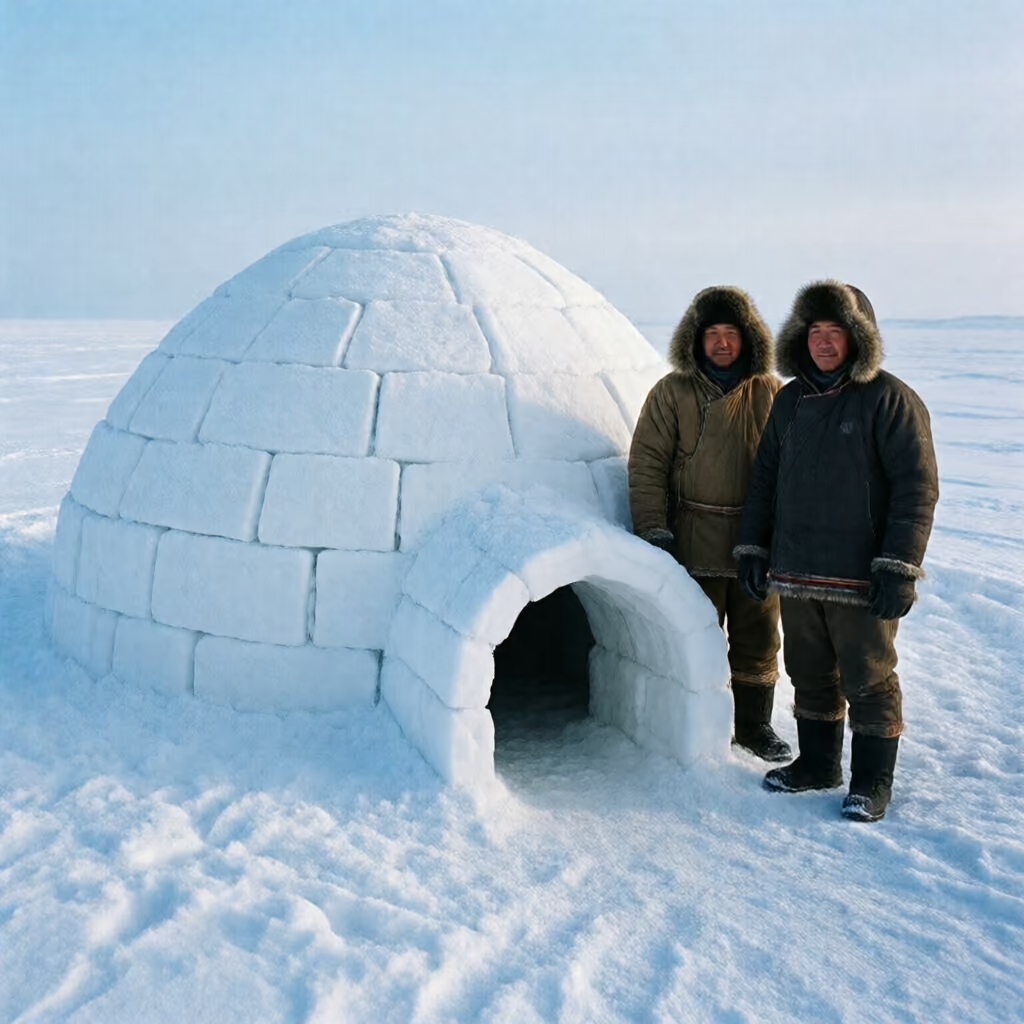
der Iglu
igloo
A dome-shaped house made of snow and ice that is traditionally built by the Inuit as a shelter.
EXAMPLE
Die Inuit bauten im Winter einen Iglu aus festem Schnee.
In winter, the Inuit built an igloo out of packed snow.
igloo
der Iglu, die Iglus
Loading your saved state.
igloo
A dome-shaped house made of snow and ice that is traditionally built by the Inuit as a shelter.
Die Inuit bauten im Winter einen Iglu aus festem Schnee.
In winter, the Inuit built an igloo out of packed snow.
| gender | masculine der |
|---|---|
| plural | die Iglus |
| genitive | des Iglus |
| singular | plural | |
|---|---|---|
| nominative | der Iglu | die Iglus |
| accusative | den Iglu | die Iglus |
| dative | dem Iglu | den Iglus |
| genitive | des Iglus | der Iglus |
The article changes with the case; it is shown in colour.
The verbs 'bauen' (to build), 'errichten' (to construct), and 'übernachten' (to spend the night) are especially often used with 'Iglu'. Common combinations also include 'einen Iglu aus Schnee bauen' (to build an igloo out of snow) and 'in einem Iglu schlafen' (to sleep in an igloo).
Die Reisegruppe wollte selbst einen Iglu aus Schnee bauen.
The tour group wanted to build an igloo out of snow themselves.
When describing a stay, use 'in einem Iglu' or the shortened form 'im Iglu' (in an igloo). Movement into one is expressed with 'in einen Iglu' or 'in den Iglu' (into an igloo).
Nach dem Spaziergang gingen die Kinder in einen Iglu.
After the walk, the children went into an igloo.
In einem Iglu bleibt es trotz des Windes erstaunlich warm.
Despite the wind, it stays surprisingly warm inside an igloo.
In tourist texts, 'Iglu' also refers to a winter accommodation made of snow or ice, for example in an Iglu-Hotel (igloo hotel). Signal words such as 'Übernachtung' (overnight stay), 'Hotel' (hotel), or 'Wellness' (wellness) indicate this modern usage context.
Im Winter kann man in einem Iglu übernachten und am Morgen frühstücken.
In winter, you can spend the night in an igloo and have breakfast in the morning.