

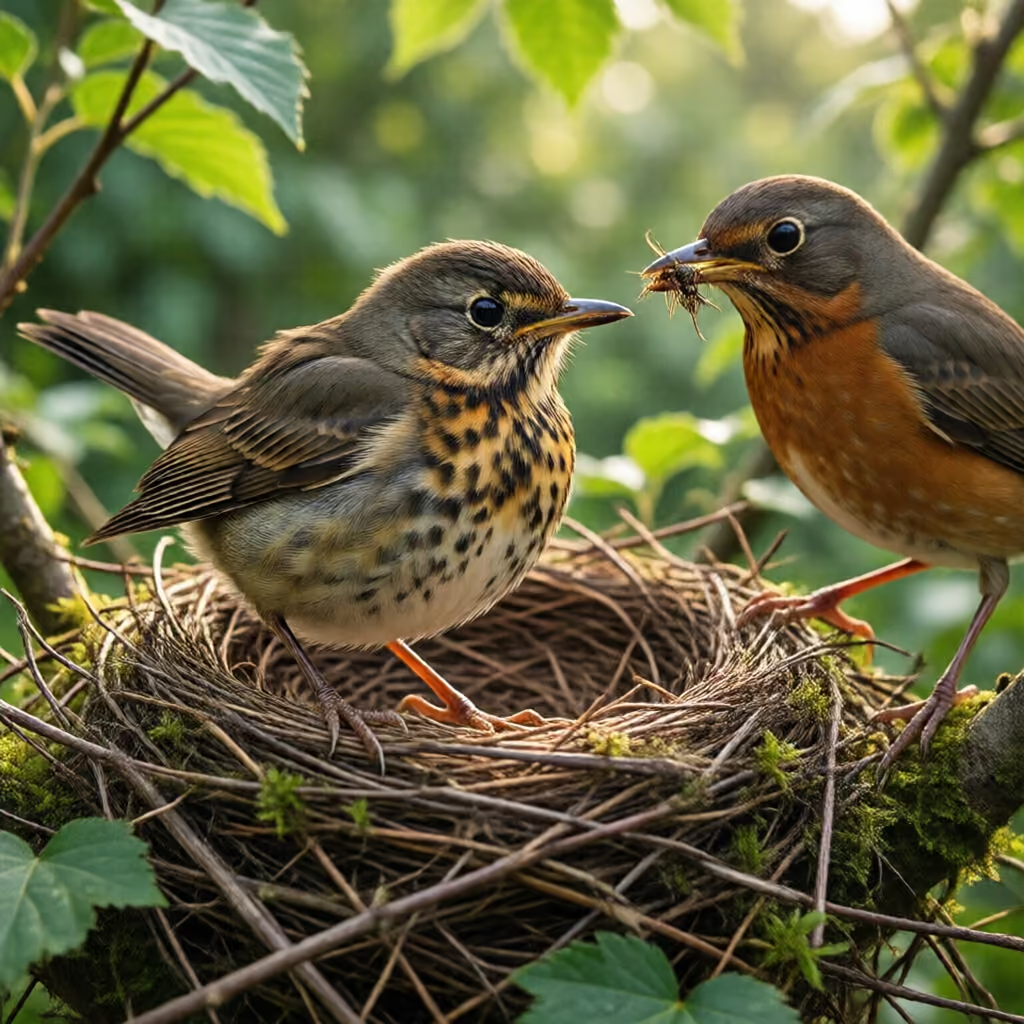
der Jungvogel
fledgling
A young bird that has not yet fully grown and is often still cared for by its parents.
EXAMPLE
Der Jungvogel saß im Nest und wartete auf seine Eltern.
The fledgling sat in the nest and waited for its parents.
fledgling
der Jungvogel, die Jungvögel
Loading your saved state.
fledgling
A young bird that has not yet fully grown and is often still cared for by its parents.
Der Jungvogel saß im Nest und wartete auf seine Eltern.
The fledgling sat in the nest and waited for its parents.
| gender | masculine der |
|---|---|
| plural | die Jungvögel |
| genitive | des Jungvogels |
| singular | plural | |
|---|---|---|
| nominative | der Jungvogel | die Jungvögel |
| accusative | den Jungvogel | die Jungvögel |
| dative | dem Jungvogel | den Jungvögeln |
| genitive | des Jungvogels | der Jungvögel |
The article changes with the case; it is shown in colour.
'Jungvogel' (fledgling) is made up of 'jung' (young) and 'Vogel' (bird). The first part describes the fact that the bird is at an early stage of development.
Der Jungvogel konnte noch nicht selbstständig fliegen.
The fledgling could not yet fly independently.
'Jungvogel' (fledgling) is often used with verbs related to care and observation: 'einen Jungvogel füttern' (to feed a fledgling), 'finden' (to find), 'retten' (to rescue), or 'aufziehen' (to raise). The phrase 'ein verlassener Jungvogel' (an abandoned fledgling) is also common.
Die Tierschutzorganisation zog den verletzten Jungvogel vorsichtig auf.
The animal welfare organization carefully raised the injured fledgling.
Words such as 'Nest' (nest), 'Federn' (feathers), 'Flügel' (wings), 'Eltern' (parents), or 'Futter' (food) often appear in the context of 'Jungvogel' (fledgling). Such words show that the bird is not yet fully independent.
Der Jungvogel flatterte am Boden, während seine Eltern in der Nähe nach Futter suchten.
The fledgling fluttered on the ground while its parents searched for food nearby.