

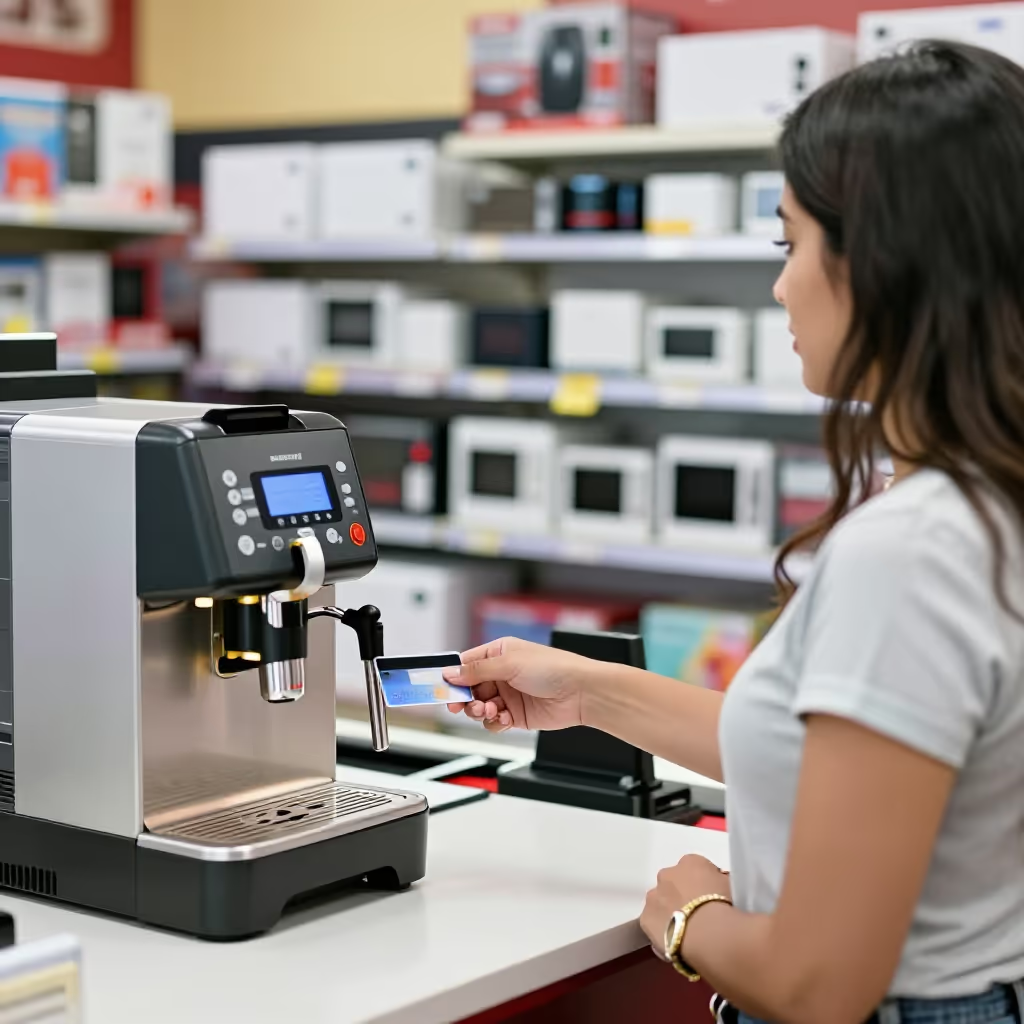
der Käufer
buyer
A person or organization that acquires goods or a service in exchange for payment.
EXAMPLE
Der Käufer des Hauses hat den Vertrag gestern unterschrieben.
The buyer of the house signed the contract yesterday.
buyer
Loading your saved state.
buyer
A person or organization that acquires goods or a service in exchange for payment.
Der Käufer des Hauses hat den Vertrag gestern unterschrieben.
The buyer of the house signed the contract yesterday.

buyer
In an economic context, especially on the stock exchange, a person or institution that buys securities, stocks, or other financial products.
An der Börse fanden sich heute mehr Käufer als Verkäufer für diese Aktie.
On the stock exchange today, there were more buyers than sellers for this stock.
The word 'Käufer' is derived directly from the verb 'kaufen' (to buy). The ending '-er' is often added to verbs in German to indicate the person who performs that action.
Wer ist der Käufer dieses alten Schranks?
Who is the buyer of this old cabinet?
If you want to express what a buyer is being sought for or what was bought, use the preposition 'für' followed by the accusative.
Es ist nicht leicht, einen Käufer für ein so teures Auto zu finden.
It is not easy to find a buyer for such an expensive car.
Common combinations are 'einen Käufer finden' (to find a buyer), 'ein potenzieller Käufer sein' (to be a potential buyer), or contrasting 'Käufer und Verkäufer' (buyer and seller).
Für das renovierte Bauernhaus gibt es bereits mehrere potenzielle Käufer.
There are already several potential buyers for the renovated farmhouse.
The economic meaning can often be recognized by signal words such as 'Börse' (stock exchange), 'Aktien' (stocks), 'Markt' (market), or 'Angebot und Nachfrage' (supply and demand). In this context, the word pair 'Käufer und Verkäufer' (buyers and sellers) occurs especially often.
Wenn es mehr Käufer als Verkäufer gibt, steigt der Preis der Aktie.
If there are more buyers than sellers, the price of the stock rises.
customer
Kunde and Käufer can refer to the same person. Kunde tends to emphasize the business relationship with a provider, while Käufer focuses on the specific acquisition in exchange for payment. Kunde is therefore more suitable for a relationship that has existed for some time, while Käufer is better for a single purchase.

Als Käufer des Autos unterschreibt Herr Weber heute den Vertrag.
As the buyer of the car, Mr. Weber is signing the contract today.
Als langjähriger Kunde erhält Herr Weber im Autohaus einen Rabatt.
As a long-standing customer, Mr. Weber receives a discount at the car dealership.