

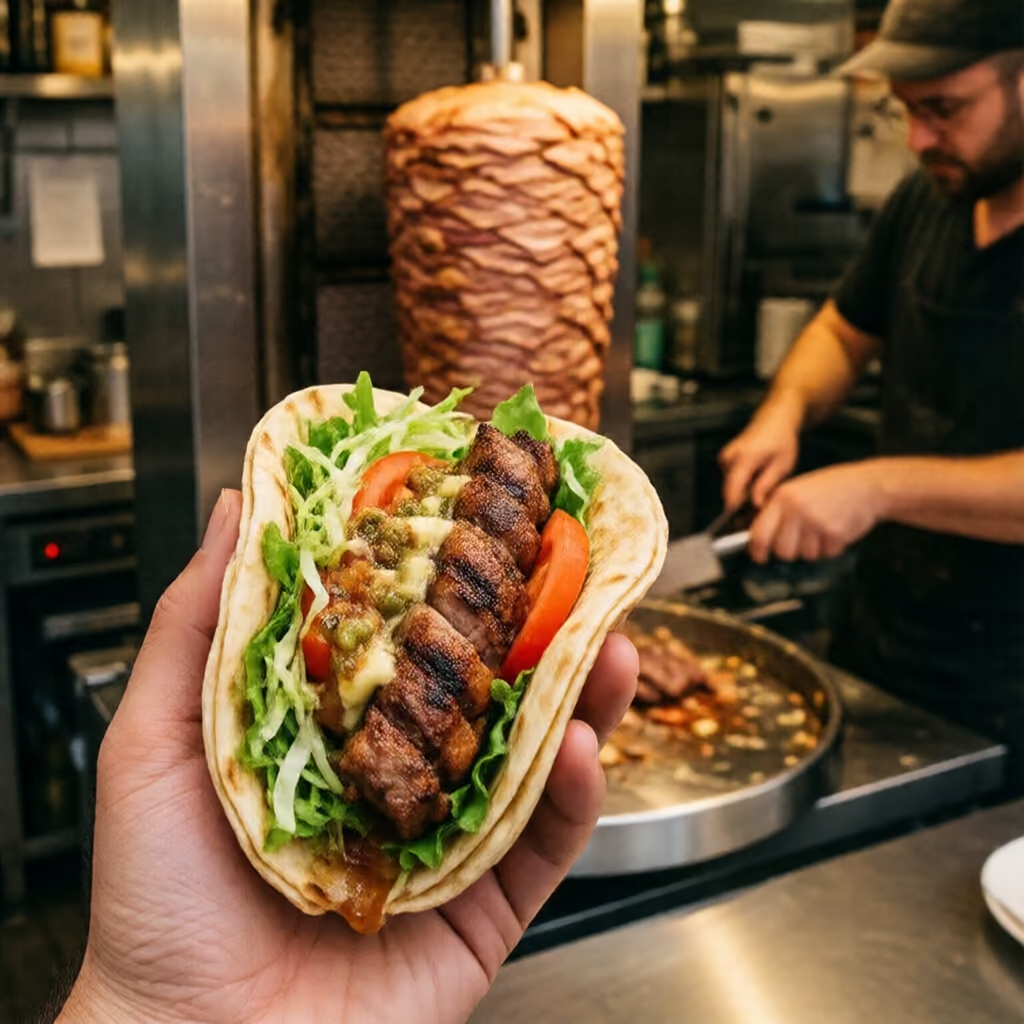
der Kebab
kebab
A dish made of seasoned, grilled meat, usually served with salad and sauce in flatbread or on a skewer.
EXAMPLE
Am Imbiss bestellte ich einen Kebab mit Knoblauchsoße.
At the snack bar, I ordered a kebab with garlic sauce.
kebab
das Kebab, die Kebabs
Loading your saved state.
kebab
A dish made of seasoned, grilled meat, usually served with salad and sauce in flatbread or on a skewer.
Am Imbiss bestellte ich einen Kebab mit Knoblauchsoße.
At the snack bar, I ordered a kebab with garlic sauce.
| gender | masculine der |
|---|---|
| plural | die Kebabs |
| genitive | des Kebabs |
| singular | plural | |
|---|---|---|
| nominative | das Kebab | die Kebabs |
| accusative | das Kebab | die Kebabs |
| dative | dem Kebab | den Kebabs |
| genitive | des Kebabs des Kebab | der Kebabs |
The article changes with the case; it is shown in colour.
The verbs used most often with “Kebab” are related to ordering and eating: you can “einen Kebab bestellen” (order a kebab), “holen” (get), “essen” (eat), or “teilen” (share) one.
Nach der Arbeit holten wir uns gemeinsam einen Kebab.
After work, we got a kebab together.
When ordering, “Kebab” is often used with “mit” (with) followed by an ingredient or sauce. This lets you specify exactly what you would like in it.
Ich nehme einen Kebab mit scharfer Soße und extra Salat.
I’ll have a kebab with spicy sauce and extra salad.
“Kebab” is very common in everyday speech, as well as on menus and at snack bars. The word is especially associated with food and quick meals eaten out.
Vor dem Kino kauften wir noch einen Kebab am Imbiss.
Before the movie, we bought a kebab at the snack bar.