

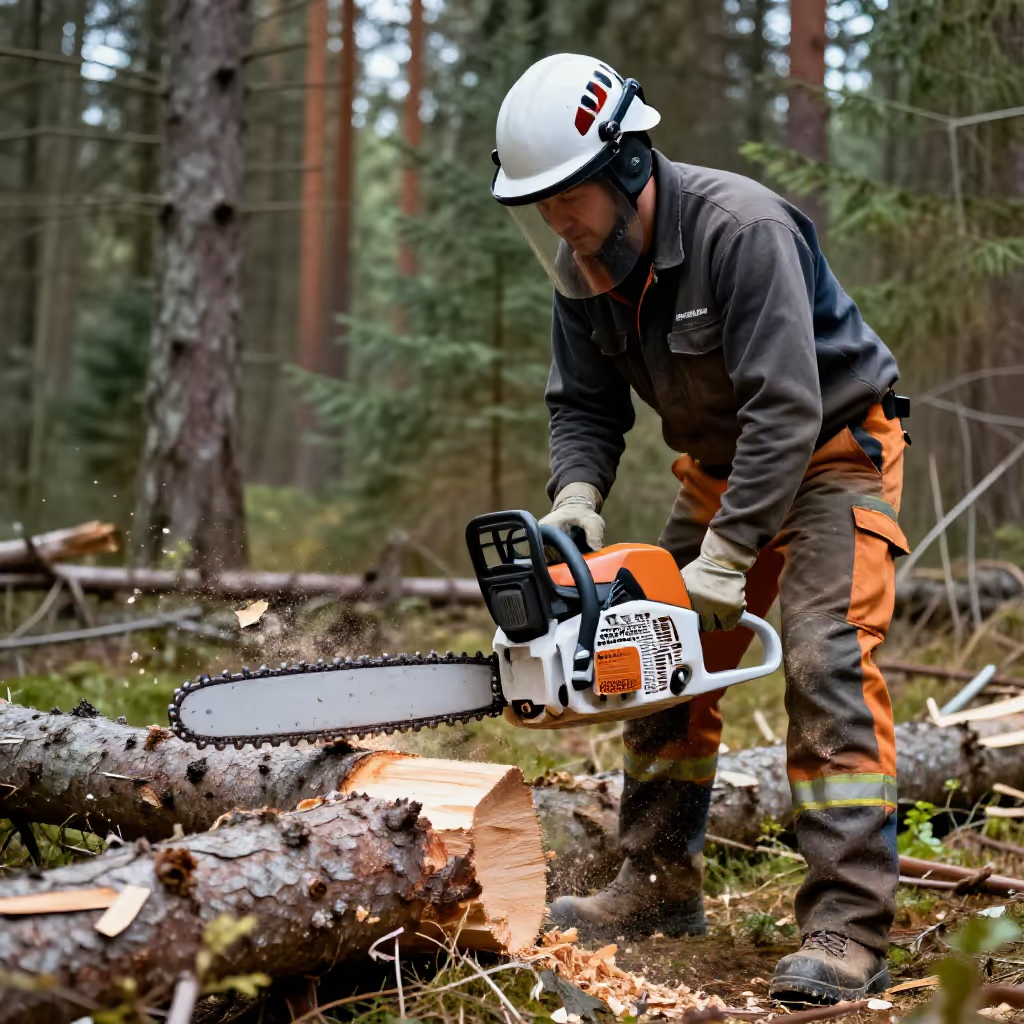
A motor-powered tool for sawing that uses an endless chain fitted with saw teeth, which runs around a guide bar. It is used mainly for forestry work and for cutting down trees.
example
Der Forstarbeiter fällte den Baum mit einer lauten Kettensäge.
The forestry worker cut down the tree with a loud chainsaw.
Usage tips
Compound word
The word is a clear compound of 'Kette' (chain) and 'Säge' (saw). The 'n' is a linking element. So it literally describes a saw that works with a chain.
EXAMPLE
Ohne eine Kettensäge hätten wir den umgefallenen Baum nicht entfernen können.
Without a chainsaw, we would not have been able to remove the fallen tree.
Typical collocations
Common verbs used with a chainsaw are 'starten' (to start) or 'anwerfen' (to fire up/start). The typical sound is often described as 'laut' (loud) or 'kreischend' (screeching).
EXAMPLE
Man hörte das laute Geräusch der Kettensäge aus dem Wald.
You could hear the loud sound of the chainsaw from the forest.
Word family
The component '-säge' always refers to a cutting tool. If you see this word part in other words like 'Handsäge' (hand saw) or 'Stichsäge' (jigsaw), you know that it is a type of saw.
EXAMPLE
Die Kettensäge ist eine motorisierte Säge für grobe Arbeiten.
The chainsaw is a motorized saw for heavy-duty work.
Compare with
near_synonym · confusable
Kettensäge vs Säge
saw
'die Säge' and 'die Kettensäge' are both tools used to cut through things, especially wood. 'die Säge' is the more general term. It can be a simple hand saw or another kind of saw. 'die Kettensäge' is a specific motor-powered saw with a moving chain. It is more likely to be used for thick branches, tree trunks, or work in the forest. Learners may confuse the words because every chainsaw is a saw. But not every saw is a chainsaw.
Kettensäge
Nach dem Sturm zerschnitt der Förster den umgefallenen Baum mit der Kettensäge.
After the storm, the forester cut up the fallen tree with the chainsaw.
Säge
Für das kleine Brett reicht eine einfache Säge aus.