A soft, moldable material often used by children for playing and crafts. It is available in different colors and usually does not harden in the air.
example
Die Kinder haben den ganzen Nachmittag mit bunter Knete Figuren geformt.
The children spent the whole afternoon shaping figures out of colorful modeling clay.

Usage tips
Word family
The noun 'die Knete' is derived directly from the verb 'kneten' (to knead). So it originally describes a material that can be kneaded. This origin is clearest in the meaning 'toy.'
EXAMPLE
Die Knete ist so weich, weil man sie gut kneten soll.
The modeling clay is so soft because it is meant to be kneaded well.
Uncountable noun
In both meanings, 'Knete' is an uncountable noun. It is used without a plural article and combined with words like 'viel' (a lot of), 'etwas' (some), or 'keine' (no/not any).
EXAMPLE
Für den Ausflug brauchen die Kinder viel bunte Knete.
For the outing, the children need a lot of colorful modeling clay.
Context clue
You can easily tell which meaning is intended from the context. If people are talking about children, crafts, or playing, the moldable material is meant. If it is about buying, paying, or costs, it means money.
EXAMPLE
Im Kindergarten spielen wir heute mit Knete.
At kindergarten, we're playing with modeling clay today.
Typical collocations
When referring to the toy, 'Knete' (modeling clay) is often used with verbs like 'spielen' (to play), 'formen' (to shape), or 'basteln' (to do crafts/make things). Common adjectives are 'bunt' (colorful) or 'weich' (soft).
EXAMPLE
Aus der weichen Knete formte er einen kleinen Elefanten.
He shaped a small elephant out of the soft modeling clay.
Register: colloquial
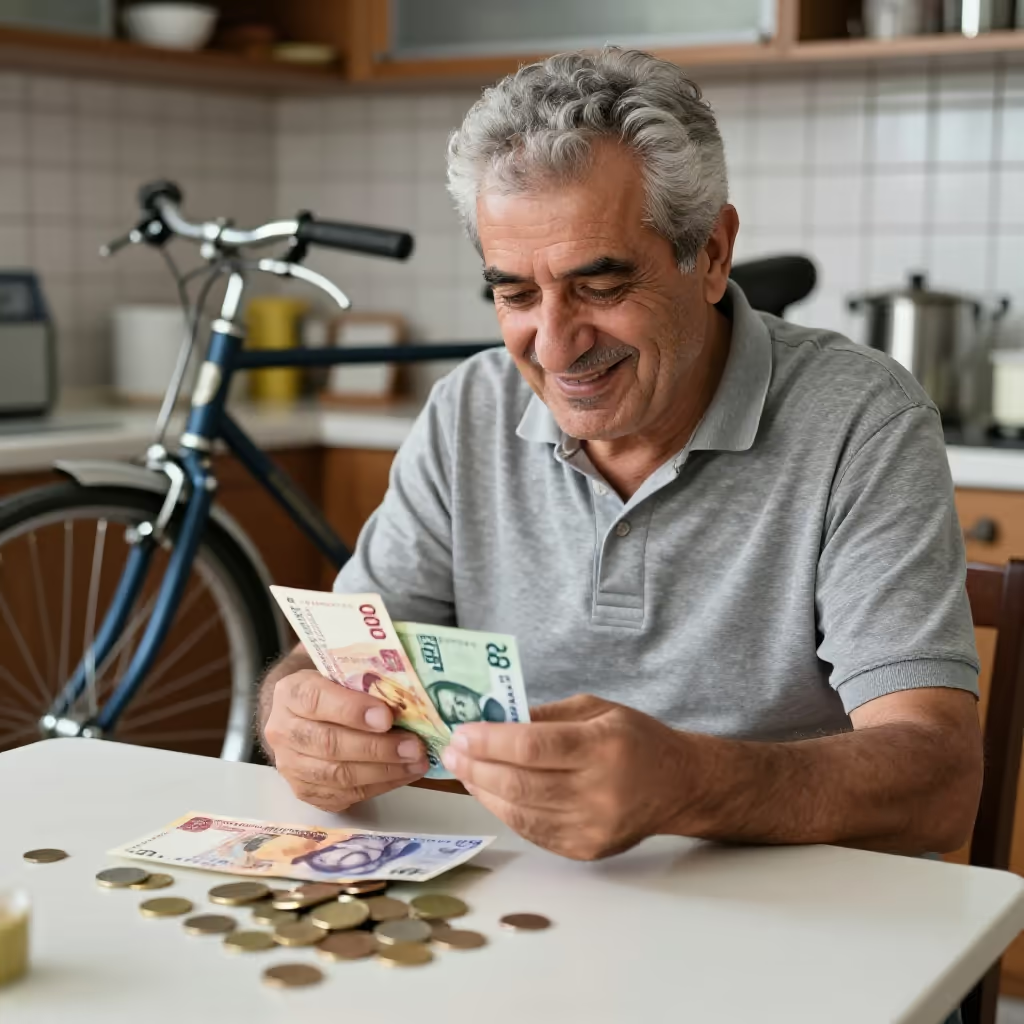
The meaning 'money' is purely colloquial. Use this word only in informal conversations with friends or family, but not in formal or written contexts.
EXAMPLE
Er fragte seinen Freund: „Hast du etwas Knete für mich übrig?“
He asked his friend, 'Do you have some dough left over for me?'
Compare with
near_synonym · confusable
Knete vs Geld
money
'das Geld' and 'die Knete' can both mean financial means. 'Geld' is neutral and fits almost all situations, for example when shopping, saving, or paying. 'Knete' is a casual expression for money and sounds very colloquial. Learners may confuse the words because both can stand for money in everyday sentences. What matters, however, is the tone: with friends you can say 'Knete', but at the bank, at a government office, or at work, 'Geld' is better.
Knete
Für ein neues Handy fehlt mir im Moment einfach die Knete.
Right now, I simply don't have the dough for a new phone.
Geld
Im Supermarkt hat er gemerkt, dass er sein Geld zu Hause vergessen hat.
At the supermarket, he realized that he had forgotten his money at home.