

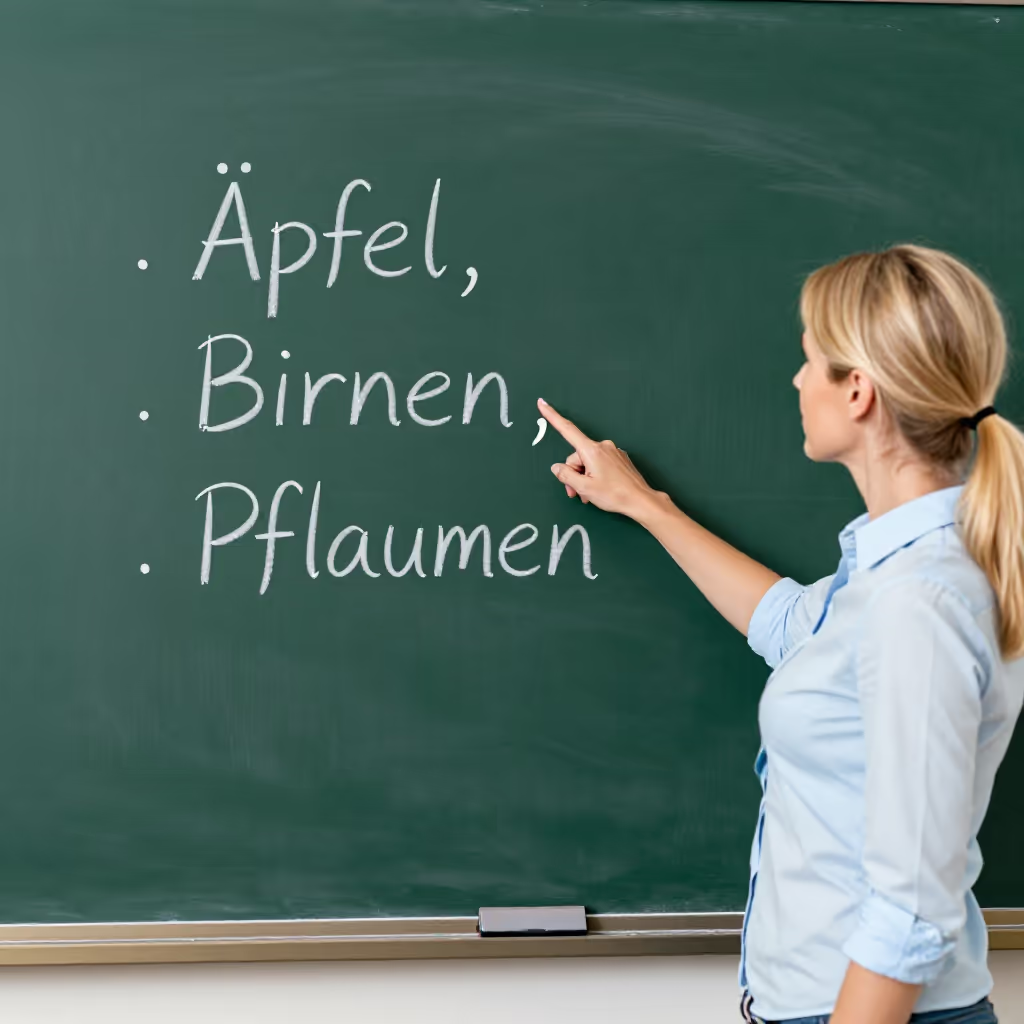
das Komma
comma
A punctuation mark (,) used to structure sentences, separate parts of sentences, or list elements.
EXAMPLE
Vor dem Wort „aber“ steht in diesem Fall ein Komma.
Before the word 'aber' (but), there is a comma in this case.
comma
Loading your saved state.
comma
A punctuation mark (,) used to structure sentences, separate parts of sentences, or list elements.
Vor dem Wort „aber“ steht in diesem Fall ein Komma.
Before the word 'aber' (but), there is a comma in this case.

decimal comma
The symbol that, in German number notation, separates the whole-number part from the fractional part (decimal separator).
Die Rechnung beträgt genau vierundzwanzig Komma neunzig Euro.
The bill comes to exactly twenty-four euros ninety.

to talk nonstop
A fixed expression meaning that someone speaks continuously and very quickly, without taking breaks.
Er war so aufgeregt, dass er ohne Punkt und Komma von seinem Erlebnis erzählte.
He was so excited that he talked nonstop about his experience.
In German, the comma is used as the decimal separator, not the period as in English. This is especially important with prices and units of measurement.
Das Buch kostet 19,95 € (neunzehn Euro fünfundneunzig).
The book costs €19.95 (nineteen euros ninety-five).
When reading a decimal number aloud, you say the word 'Komma' (comma). The number 3,14 is read as 'drei Komma eins vier' (three point one four) or 'drei Komma vierzehn' (three point fourteen).
Pi ist ungefähr drei Komma eins vier.
Pi is approximately three point one four.
When referring to the punctuation mark, the typical verbs are 'ein Komma setzen' (to put/place a comma), 'ein Komma machen' (to make a comma), or 'ein Komma weglassen' (to leave out a comma).
Ich bin unsicher, ob ich hier ein Komma setzen muss.
I'm not sure whether I need to put a comma here.
The idiom 'ohne Punkt und Komma reden' (to talk nonstop) is a fixed unit. It describes someone speaking very quickly and continuously.
Sie war so aufgeregt, dass sie ohne Punkt und Komma redete.
She was so excited that she talked nonstop.
point
Punkt and Komma are both punctuation marks, but they serve different purposes in a sentence. A Punkt ends a sentence, while a Komma separates parts of a sentence or elements in a list. Use Punkt at the end of a sentence and usually Komma for an internal separation.

Zwischen den beiden Satzteilen steht ein Komma.
There is a comma between the two parts of the sentence.
Nach dem letzten Satz steht ein Punkt.
There is a period after the last sentence.