

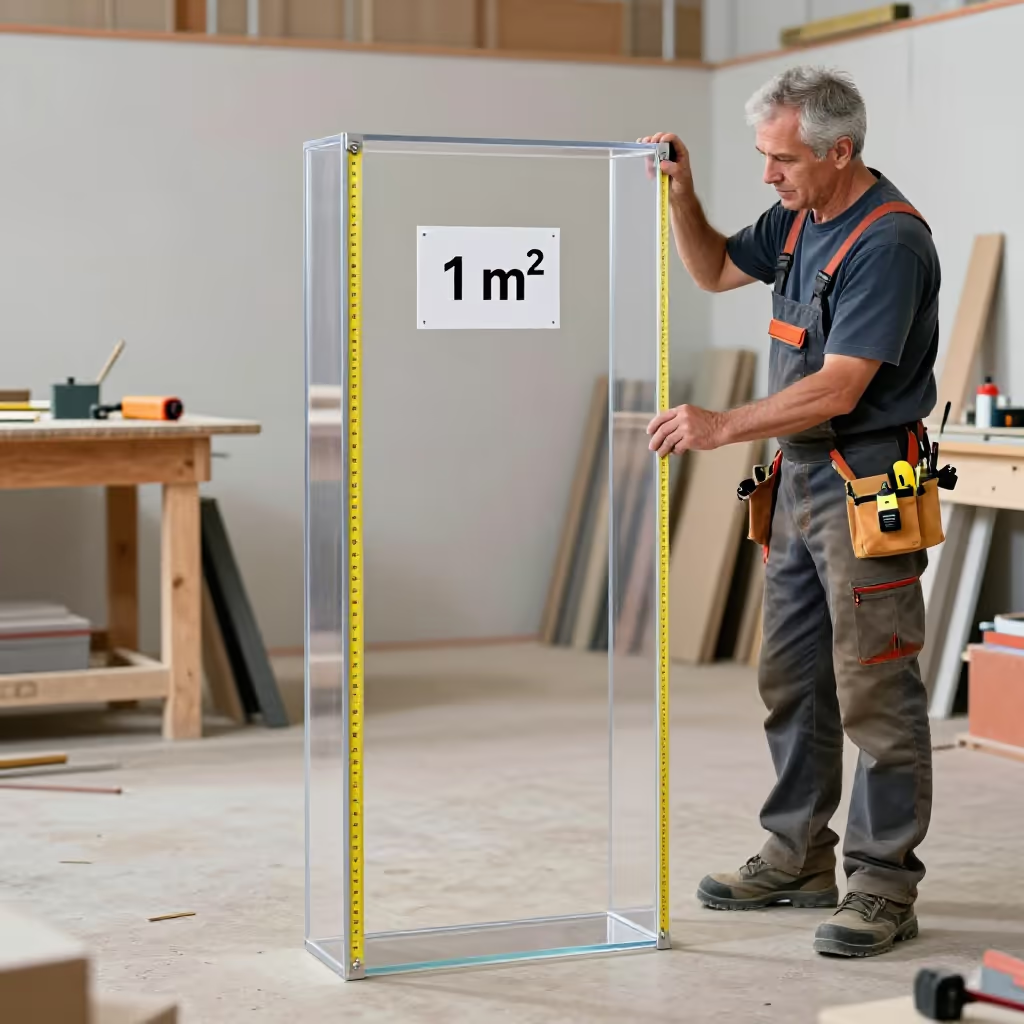
A unit of measurement for volume (spatial capacity) that corresponds to the volume of a cube with an edge length of one meter. The symbol is m³.
example
Für den Umbau benötigen wir etwa fünf Kubikmeter Beton.
For the renovation, we need about five cubic meters of concrete.
Usage tips
Word composition
The word is made up of 'Kubik-' (refers to a cube or the third power) and 'Meter' (meter). It describes the volume of a cube with an edge length of one meter.
EXAMPLE
Ein Kubikmeter ist ein Würfel mit den Maßen 1m x 1m x 1m.
One cubic meter is a cube with dimensions of 1 m x 1 m x 1 m.
Use as a unit of measurement
When a number greater than 1 comes before 'Kubikmeter', the word stays in the singular. You say 'zwei Kubikmeter' (two cubic meters), not 'zwei Kubikmetern'.
EXAMPLE
Der LKW kann bis zu zehn Kubikmeter Sand transportieren.
The truck can transport up to ten cubic meters of sand.
Common abbreviation
In invoices, technical texts, or on signs, the official abbreviation 'm³' is often used. The superscript 3 symbolizes 'Kubik' (cubed / to the power of 3).
EXAMPLE
Der Preis für das Holz beträgt 80 € pro m³.
The price for the wood is €80 per m³.
Typical collocations
'Kubikmeter' is used to measure the volume of gases (natural gas), liquids (water), or bulk materials (sand, wood, concrete).
EXAMPLE
Unsere Wasserrechnung basiert auf der Anzahl der verbrauchten Kubikmeter.
Our water bill is based on the number of cubic meters used.
Compare with
confusable
Kubikmeter vs Meter
meter
'der Meter' and 'der Kubikmeter' are both units of measurement with 'Meter', but they describe different things. 'Meter' measures length, meaning only one direction. 'Kubikmeter' measures volume, meaning how much space something takes up or how much can fit into something. They can be confused because the base word is the same. Remember: length in meters, volume in cubic meters.
Kubikmeter
Für den Umzug brauchen wir ungefähr zehn Kubikmeter Platz im Transporter.
For the move, we need about ten cubic meters of space in the van.