

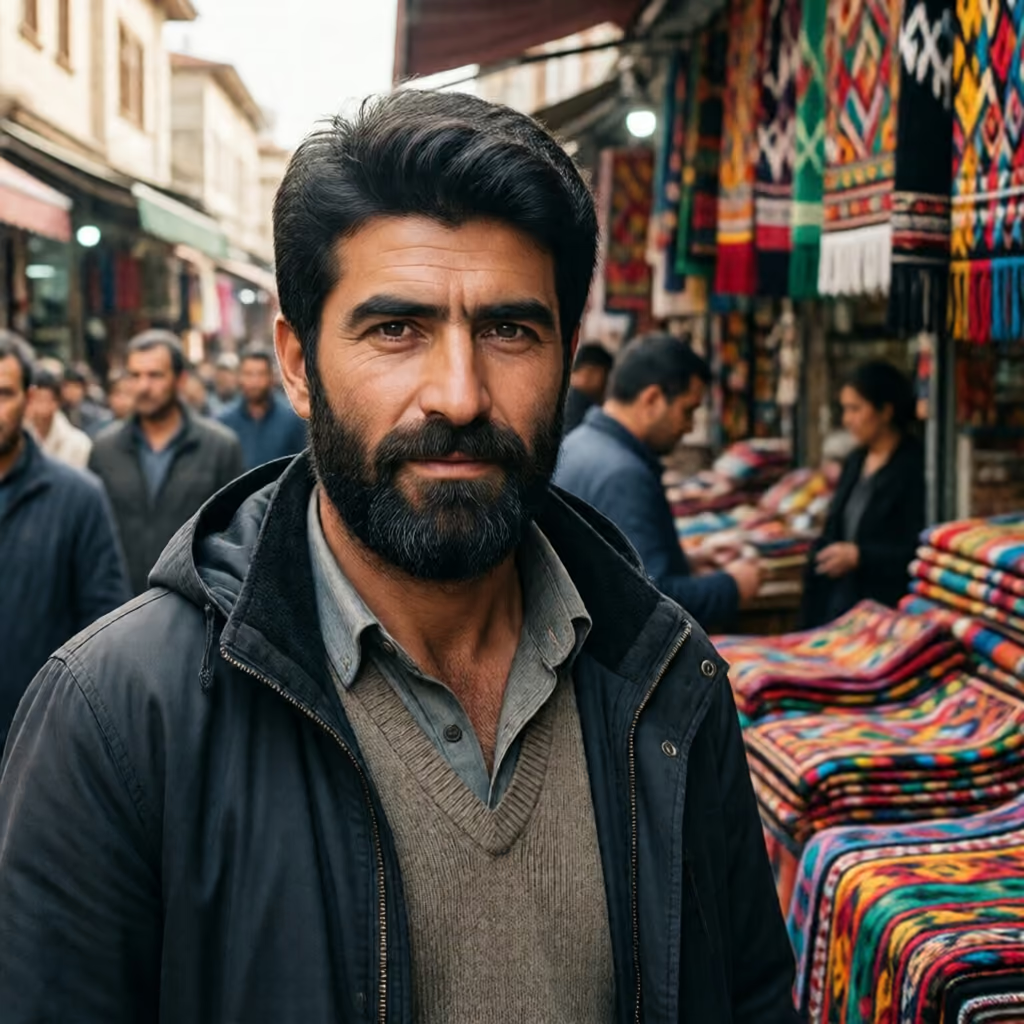
der Kurde
Kurd
A member of the Kurdish people, who live primarily in parts of Turkey, Iran, Iraq, and Syria.
EXAMPLE
Der Kurde stammt aus einer Stadt im Südosten der Türkei.
The Kurd comes from a city in southeastern Turkey.
Kurd
der Kurde, die Kurden
Loading your saved state.
Kurd
A member of the Kurdish people, who live primarily in parts of Turkey, Iran, Iraq, and Syria.
Der Kurde stammt aus einer Stadt im Südosten der Türkei.
The Kurd comes from a city in southeastern Turkey.
| gender | masculine der |
|---|---|
| plural | die Kurden |
| genitive | des Kurden |
| singular | plural | |
|---|---|---|
| nominative | der Kurde | die Kurden |
| accusative | den Kurden | die Kurden |
| dative | dem Kurden | den Kurden |
| genitive | des Kurden | der Kurden |
The article changes with the case; it is shown in colour.
You can recognize the connection to the adjective 'kurdisch' (Kurdish) from the shared stem 'Kurd-'. You often find it in phrases such as 'kurdische Sprache' (Kurdish language) or 'kurdische Kultur' (Kurdish culture).
Er ist Kurde und erzählt uns viel über die kurdische Kultur.
He is a Kurd and tells us a lot about Kurdish culture.
When talking about an individual person, 'Kurde' takes the ending '-n' in the accusative and dative. Pay attention to this in phrases such as 'einen Kurden kennenlernen' (to meet a Kurd) and 'mit einem Kurden sprechen' (to speak with a Kurd).
Auf meiner Reise habe ich einen Kurden kennengelernt.
On my trip, I met a Kurd.
Sie spricht mit einem Kurden über seine Heimat.
She is speaking with a Kurd about his homeland.
When you use 'sein' (to be) to state that a person belongs to the Kurdish people, 'Kurde' often appears without an article. The pattern is 'Person + sein + Kurde' (person + to be + Kurd).
Mein Nachbar ist Kurde und lebt seit vielen Jahren in Hamburg.
My neighbor is a Kurd and has lived in Hamburg for many years.