

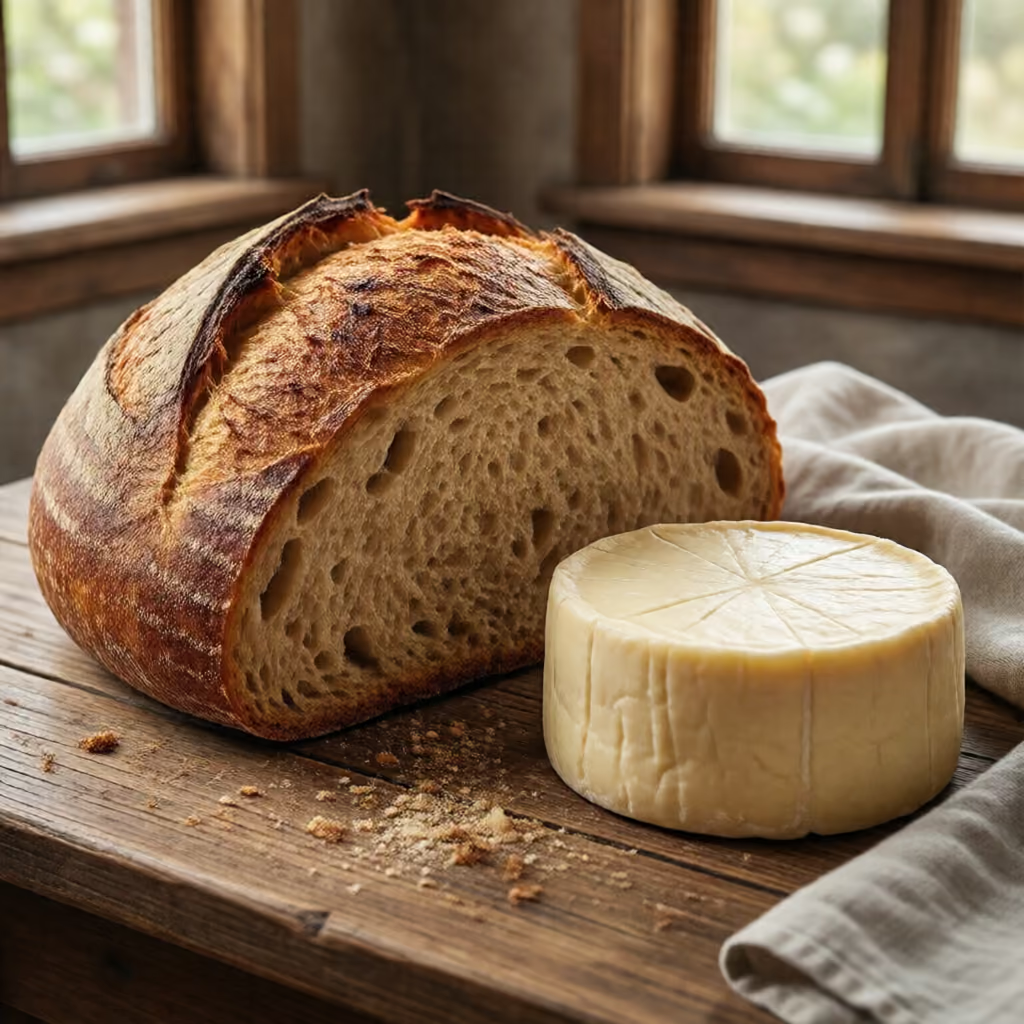
der Laib
loaf / wheel
A piece of bread baked in a particular shape, or a similarly shaped whole piece of cheese.
EXAMPLE
Auf dem Tisch lag ein frischer Laib Brot.
There was a fresh loaf of bread on the table.
loaf / wheel
der Laib, die Laibe
Loading your saved state.
loaf / wheel
A piece of bread baked in a particular shape, or a similarly shaped whole piece of cheese.
Auf dem Tisch lag ein frischer Laib Brot.
There was a fresh loaf of bread on the table.
| gender | masculine der |
|---|---|
| plural | die Laibe |
| genitive | des Laibs |
| singular | plural | |
|---|---|---|
| nominative | der Laib | die Laibe |
| accusative | den Laib | die Laibe |
| dative | dem Laib | den Laiben |
| genitive | des Laibs des Laibes | der Laibe |
The article changes with the case; it is shown in colour.
'Laib' (loaf / wheel) can be followed directly by 'Brot' (bread) or 'Käse' (cheese), without a preposition or an additional article. This specifies which food is being referred to.
Für das Abendessen kaufen wir einen Laib Brot.
We're buying a loaf of bread for dinner.
Common phrases include 'einen Laib anschneiden' (to cut into a loaf) and 'einen Laib in Scheiben schneiden' (to slice a loaf). Here, 'anschneiden' (to cut into) refers to making the first cut into a loaf that is still whole.
Zum Frühstück schnitt sie einen frischen Laib an.
For breakfast, she cut into a fresh loaf.
'Vom Laib' (from the loaf / wheel) indicates that a portion comes from a larger, whole piece. You will encounter this phrase especially when buying cheese; 'vom' is short for 'von dem' (from the).
An der Käsetheke ließ ich mir 200 Gramm direkt vom Laib abschneiden.
At the cheese counter, I had 200 grams cut directly from the wheel.