


zu Lebzeiten
during one's lifetime
A fixed expression meaning that something happens while a person is still alive.
EXAMPLE
Schon zu seinen Lebzeiten war der Maler weltberühmt.
Even during his lifetime, the painter was world-famous.
lifetime
Loading your saved state.
during one's lifetime
A fixed expression meaning that something happens while a person is still alive.
Schon zu seinen Lebzeiten war der Maler weltberühmt.
Even during his lifetime, the painter was world-famous.

lifetime
The entire duration of the life of an individual or a species. Often used in the singular to describe the average lifespan.
Die durchschnittliche Lebzeit von Hauskatzen hat sich in den letzten Jahrzehnten deutlich erhöht.
The average lifetime of domestic cats has increased significantly in recent decades.
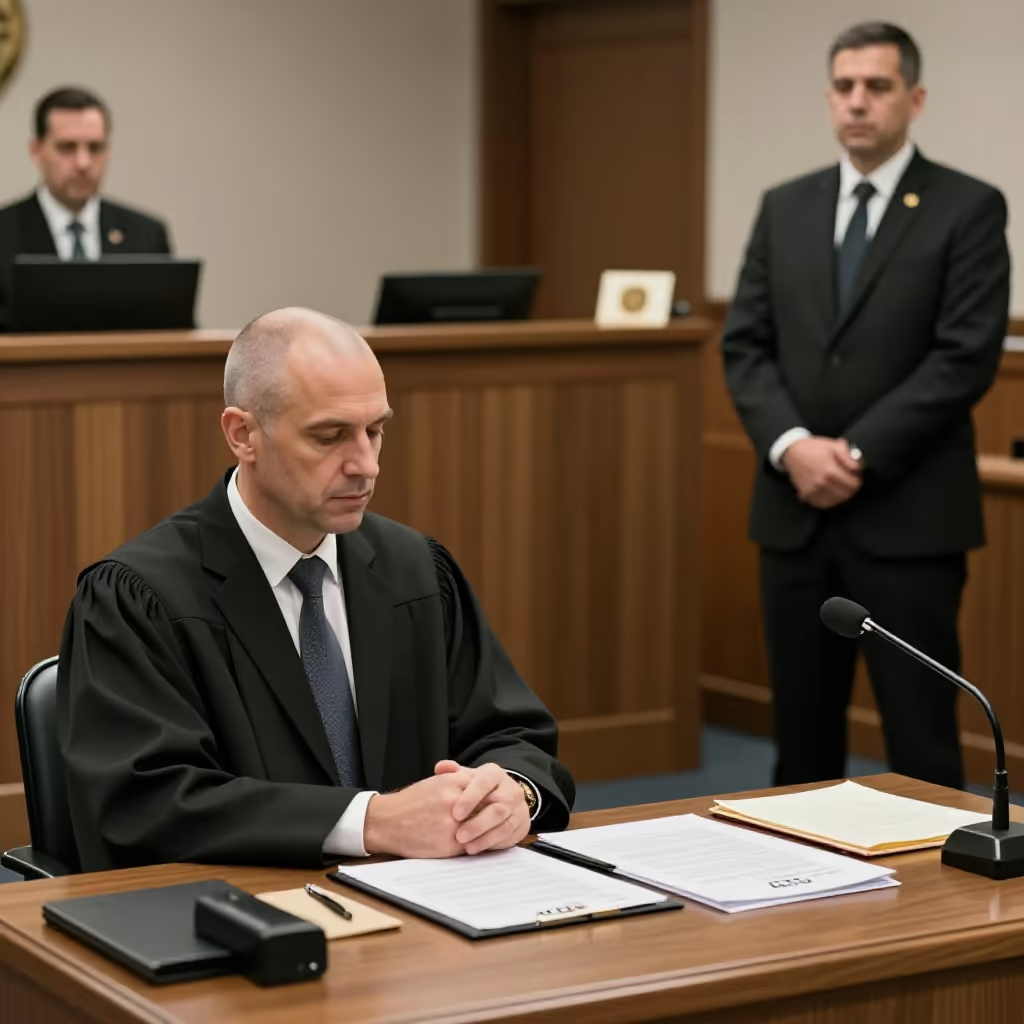
for life
A fixed expression meaning that something applies for the entire remaining life of a person.
Der Richter wurde auf Lebzeiten in sein Amt berufen.
The judge was appointed to his office for life.
The word 'Lebzeit' (lifetime) is a compound of the stem of the verb 'leben' (to live) and the noun 'die Zeit' (time). So it literally means 'life-time'.
Die Lebzeit eines Schmetterlings ist oft nur wenige Wochen lang.
The lifetime of a butterfly is often only a few weeks.
This word is used almost exclusively in fixed expressions with prepositions. The most important ones are 'zu Lebzeiten' (during one's lifetime/while one is or was alive) and 'auf Lebzeiten' (for the rest of one's life).
Zu seinen Lebzeiten wurde der Künstler kaum beachtet.
During his lifetime, the artist received little attention.
The expression 'zu Lebzeiten' (during one's lifetime) needs a complement that shows whose life is meant. This is usually done with a possessive pronoun or a genitive.
Zu Lebzeiten meiner Großmutter sah die Stadt ganz anders aus.
During my grandmother's lifetime, the city looked completely different.
Without a preposition, 'die Lebzeit' (lifetime) is often used in the singular in a scientific or statistical context to refer to lifespan. Typical collocations are 'durchschnittliche Lebzeit' (average lifetime) or 'erwartete Lebzeit' (expected lifetime).
Forscher untersuchen die durchschnittliche Lebzeit dieser Tierart.
Researchers are studying the average lifetime of this animal species.
The expression 'auf Lebzeiten' (for life) is often used in a legal or official context. It describes that a right, an office, or an obligation applies until a person's death.
Der Vertrag garantiert ihm eine Rente auf Lebzeiten.
The contract guarantees him a pension for life.
lifetime
Lebenszeit is the neutral term for the entire time a person is alive. Learners mainly encounter Lebzeit in the fixed expression zu Lebzeiten, when something happens during a person's life. For the general span of time, Lebenszeit is therefore the better choice.

Zu Lebzeiten veröffentlichte der Autor viele Romane.
The author published many novels during his lifetime.
Während seiner langen Lebenszeit schrieb der Autor viele Romane.
During his long lifetime, the author wrote many novels.