

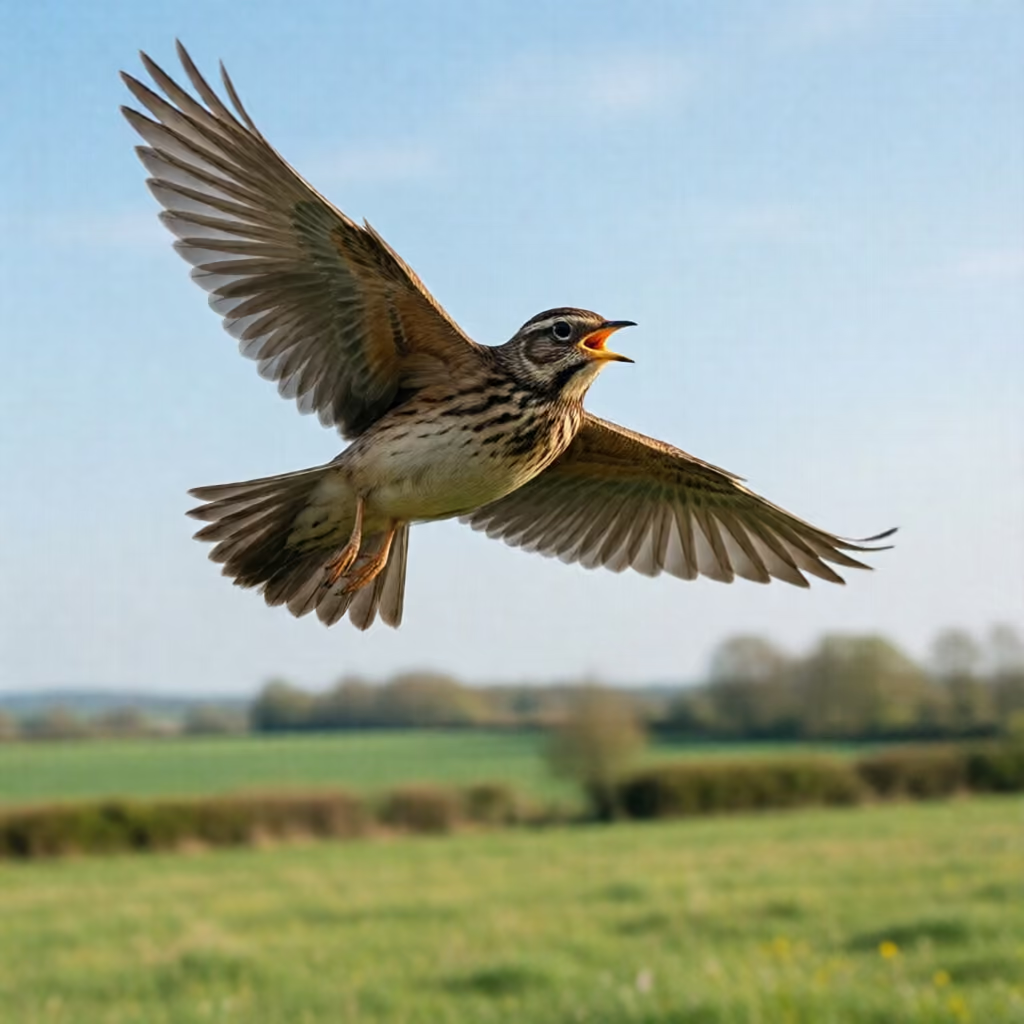
die Lerche
lark
A small songbird that usually lives on the ground and is especially known for its sustained, melodious song while flying.
EXAMPLE
Über den Feldern sang eine Lerche in großer Höhe.
A lark sang high above the fields.
lark
die Lerche, die Lerchen
Loading your saved state.
lark
A small songbird that usually lives on the ground and is especially known for its sustained, melodious song while flying.
Über den Feldern sang eine Lerche in großer Höhe.
A lark sang high above the fields.

early bird
A person who likes getting up early and is especially alert and productive in the morning.
Meine Schwester ist eine echte Lerche und geht schon um sechs Uhr joggen.
My sister is a real early bird and goes jogging as early as six o’clock.
| gender | feminine die |
|---|---|
| plural | die Lerchen |
| genitive | der Lerche |
| singular | plural | |
|---|---|---|
| nominative | die Lerche | die Lerchen |
| accusative | die Lerche | die Lerchen |
| dative | der Lerche | den Lerchen |
| genitive | der Lerche | der Lerchen |
The article changes with the case; it is shown in colour.
“Lerche” (lark) is often used with verbs and compounds from descriptions of nature: a lark sings or rises into the air, and its song is called “Lerchengesang” (lark song).
Plötzlich stieg die Lerche über dem Feld auf und begann zu singen.
Suddenly, the lark rose above the field and began to sing.
Clues such as fields, meadows, early morning, and the high sky often show that “Lerche” (lark) refers to the bird. In descriptions, the bird is usually identified by its song and flight.
Am frühen Morgen hörte man über den Wiesen eine Lerche.
Early in the morning, you could hear a lark above the meadows.
“Lerche” (lark) is a generally understandable word, but it occurs especially often in descriptions of nature and in literary and poetic texts.
Im Gedicht wird die Lerche als Zeichen des beginnenden Tages beschrieben.
In the poem, the lark is described as a sign of the beginning of the day.