

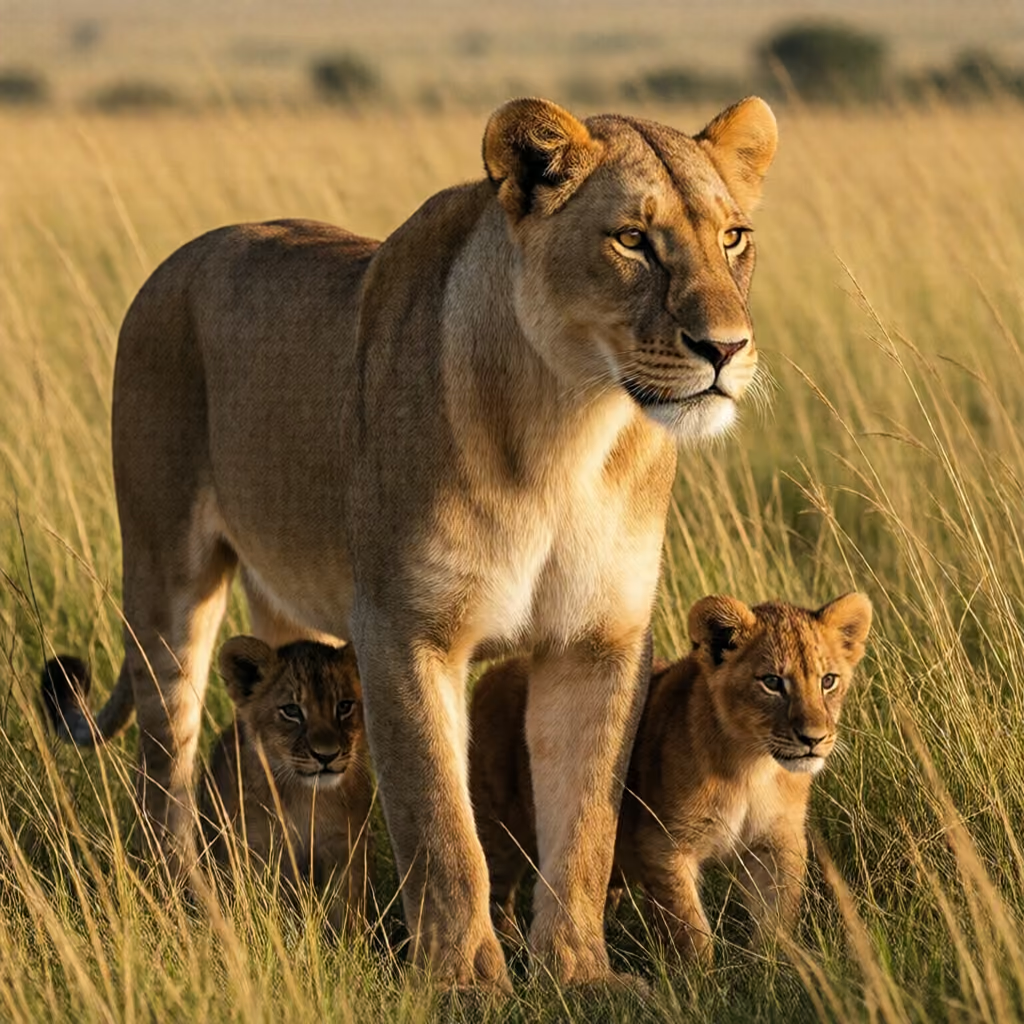
die Löwin
lioness
A female animal from the cat family and the female form of a lion.
EXAMPLE
Die Löwin beobachtete ihre Jungen im hohen Gras.
The lioness watched her cubs in the tall grass.
lioness
die Löwin, die Löwinnen
Loading your saved state.
lioness
A female animal from the cat family and the female form of a lion.
Die Löwin beobachtete ihre Jungen im hohen Gras.
The lioness watched her cubs in the tall grass.

lioness
A woman who stands up for something or someone in an energetic, brave, and combative way.
Die Anwältin gilt als Löwin, die für ihre Mandanten alles gibt.
The lawyer is regarded as a lioness who gives everything for her clients.
| gender | feminine die |
|---|---|
| plural | die Löwinnen |
| genitive | der Löwin |
| singular | plural | |
|---|---|---|
| nominative | die Löwin | die Löwinnen |
| accusative | die Löwin | die Löwinnen |
| dative | der Löwin | den Löwinnen |
| genitive | der Löwin | der Löwinnen |
The article changes with the case; it is shown in colour.
In descriptions of animals, phrases such as 'die Löwin jagt' (the lioness hunts), 'die Löwin lebt im Rudel' (the lioness lives in a pride), and 'die Löwin säugt ihre Jungen' (the lioness nurses her cubs) are typical. You can use these phrases to describe the animal's behavior.
Die Löwin säugt ihre Jungen im Schatten eines Baumes.
The lioness nurses her cubs in the shade of a tree.
The figurative meaning often appears in the comparison 'wie eine Löwin kämpfen' (to fight like a lioness). With 'für' (for) and the accusative, you can add who or what the woman is standing up for.
Sie kämpft wie eine Löwin für die Rechte ihrer Kinder.
She fights like a lioness for her children's rights.
The expression 'zur Löwin werden' (to become a lioness) emphasizes that a woman reacts in a particularly combative way in a specific situation. A subordinate clause with 'wenn' (when/if) often explains what triggers this reaction.
Wenn jemand ihre Tochter bedroht, wird sie zur Löwin.
If someone threatens her daughter, she becomes a lioness.