

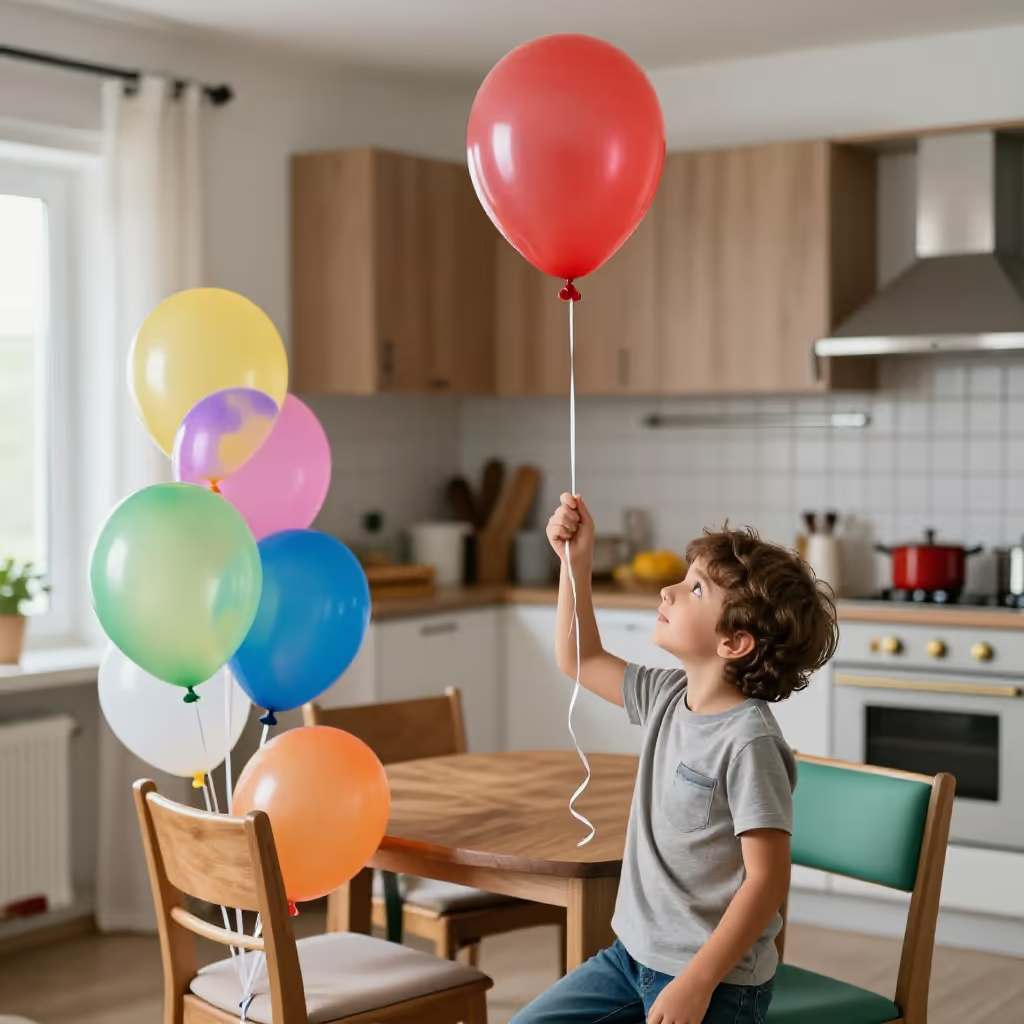
A thin, inflatable casing made of rubber or latex that is filled with air or a light gas and used as a toy or decoration.
example
Zum Geburtstag haben wir das ganze Zimmer mit bunten Luftballons geschmückt.
For the birthday party, we decorated the whole room with colorful balloons.
Usage tips
Compound word
The word is made up of 'die Luft' (air) and 'der Ballon' (balloon). So it literally describes a balloon that is filled with air.
EXAMPLE
Pass auf, dass der Luftballon nicht wegfliegt!
Be careful that the balloon doesn't fly away!
Typical verbs
Common verbs used with 'Luftballon' (balloon) are 'einen Luftballon aufblasen' (to inflate a balloon) or 'aufpusten' (to blow up), 'platzen lassen' (to pop), and 'steigen lassen' (to let rise/release).
EXAMPLE
Die Kinder ließen die Luftballons in den Himmel steigen.
The children released the balloons into the sky.
Typical context
Balloons are strongly associated with celebrations. They are typically found at parties, children's birthday parties, fairs, or as decorations at festivals.
EXAMPLE
Auf dem Stadtfest gab es für jedes Kind einen Luftballon.
At the town festival, every child got a balloon.
Compare with
synonym · near_synonym · confusable
Luftballon vs Ballon
balloon
'Ballon' and 'Luftballon' can both mean the small inflatable thing made of rubber or plastic that you use at parties or as a toy. In this sense, they are very similar. However, 'Luftballon' is more precise and often clearer in everyday language when you mean the small decoration. 'Ballon' is more general and can also mean other things, for example a hot-air balloon, a speech bubble in a comic, or a glass vessel. This can lead to confusion. If you definitely mean the small party balloon, 'Luftballon' is especially clear.
Luftballon
Zum Geburtstag bekommt jedes Kind einen bunten Luftballon.
For the birthday party, each child gets a colorful balloon.
Ballon
Der rote Ballon hängt über dem Tisch und passt gut zur Dekoration.
The red balloon is hanging above the table and goes well with the decorations.