

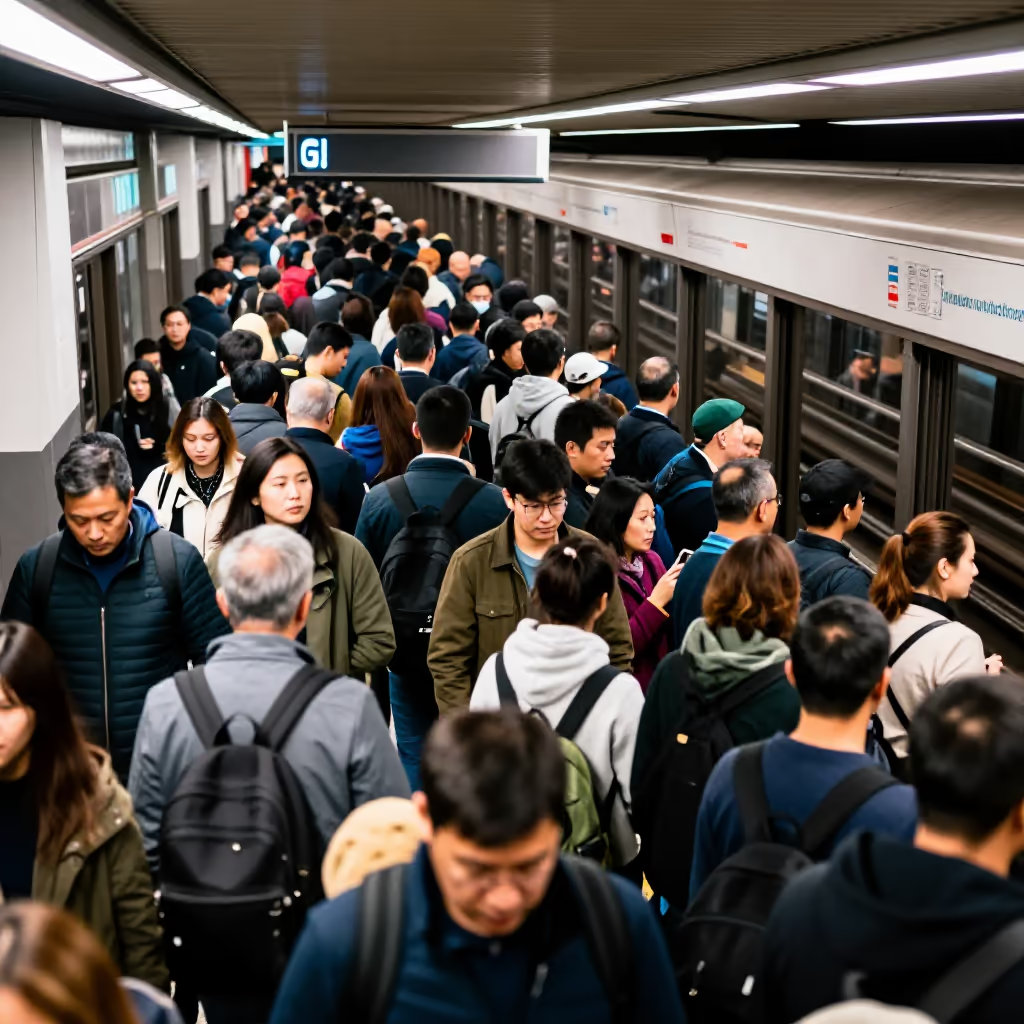
In a very large number or amount; occurring in masses. It emphasizes a large, often unmanageable quantity.
example
Nach dem Konzert lag massenweise Müll auf dem Festivalgelände.
After the concert, there was a huge amount of trash lying around the festival grounds.

Usage tips
Word structure
The word is made up of 'Masse' (large quantity / mass) and the ending '-weise'. The ending '-weise' forms adverbs and means 'in the manner of'. So 'massenweise' literally means 'in the manner of a mass'.
EXAMPLE
Im Herbst fallen die Blätter massenweise von den Bäumen.
In autumn, leaves fall from the trees in large quantities.
Invariable form
An important point: 'massenweise' (in large quantities) is not declined, even when it comes directly before a noun. It always keeps the same form.
EXAMPLE
Wir haben massenweise Äpfel im Garten.
We have apples in large quantities in the garden.
Register and style
'Massenweise' (in large quantities) is more colloquial and often has a slightly exaggerated effect. It emphasizes a very large, barely countable amount.
EXAMPLE
Nach der Party hatten wir massenweise Flaschen zu entsorgen.
After the party, we had tons of bottles to dispose of.
Compare with
antonym
massenweise vs einzeln
individual / separate
'einzeln' and 'massenweise' express opposite quantities. 'einzeln' is used when something occurs separately, piece by piece, or only rarely. 'massenweise' is used when something is present in very large numbers or quantities. 'massenweise' often sounds stronger than just 'viele' (many). In practical terms: 'einzeln' fits a few or separate things, while 'massenweise' fits very many things at once or within a short time.
massenweise
Nach dem starken Regen liegen massenweise Blätter auf der Straße.
After the heavy rain, there are masses of leaves lying on the street.
einzeln
Die Chefin hat die Bestellungen heute einzeln kontrolliert.