

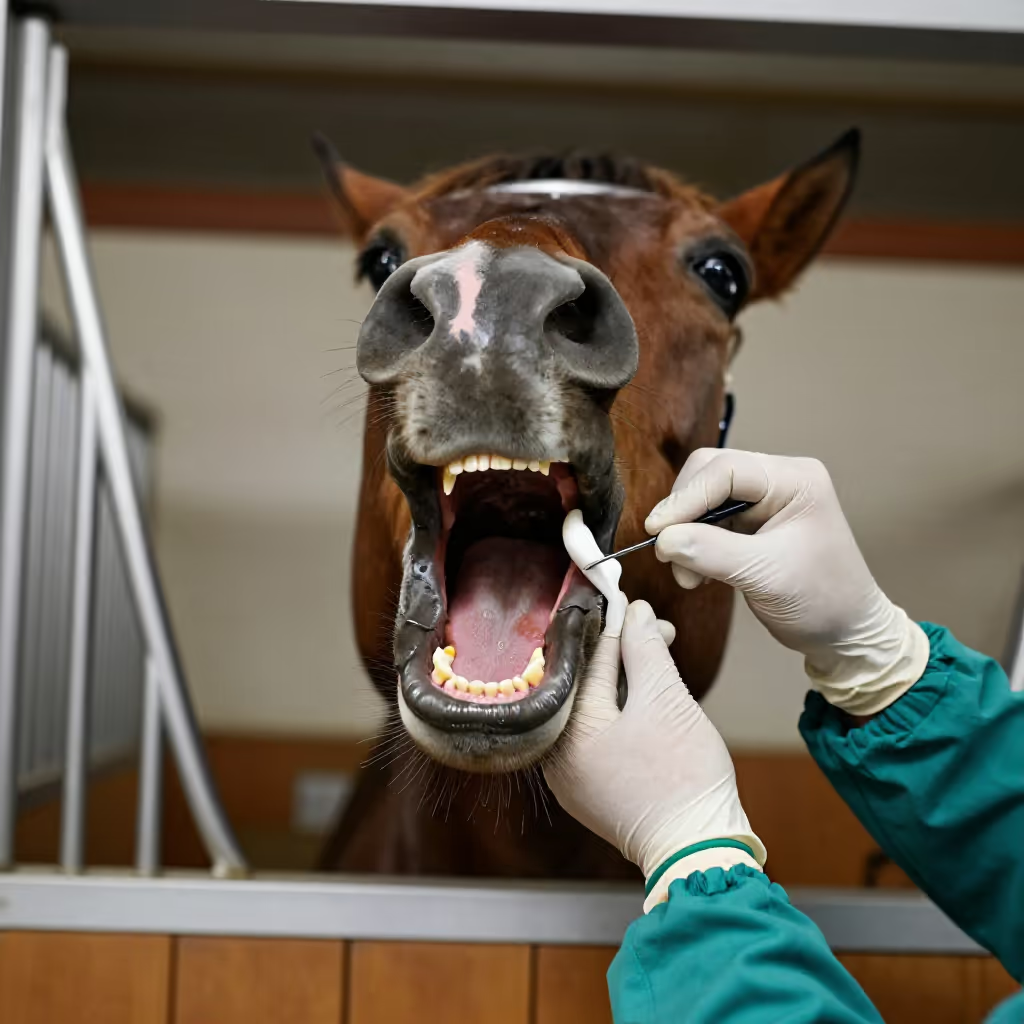
das Maul
mouth / snout
The mouth opening of animals.
EXAMPLE
Der Löwe riss sein riesiges Maul auf.
The lion opened its huge mouth wide.
mouth / snout
Loading your saved state.
mouth / snout
The mouth opening of animals.
Der Löwe riss sein riesiges Maul auf.
The lion opened its huge mouth wide.

mouth
A coarse, colloquial, or derogatory term for a person's mouth.
Halt endlich dein Maul, ich will schlafen!
Shut your mouth already, I want to sleep!

to gossip about
To speak disparagingly and badly about someone or something; to gossip.
Die Nachbarn zerreißen sich das Maul über das neue Auto von Müllers.
The neighbors are gossiping about the Müllers' new car.

to not mince words
To state one's opinion very directly and without beating around the bush, even if it is unpleasant.
Er ist dafür bekannt, bei Kritik kein Blatt vors Maul zu nehmen.
He is known for not mincing words when giving criticism.
When 'das Maul' (mouth/snout) refers to an animal, it is a neutral, factual word. It simply describes the mouth area of the animal without any negative judgment.
Der Hund hielt den Stock fest in seinem Maul.
The dog held the stick firmly in its mouth.
Using 'Maul' (mouth) for a person's mouth is very colloquial and is often perceived as impolite or even insulting. It should only be used in very informal contexts and with caution.
Er hat ein großes Maul, aber dahinter steckt nicht viel.
He has a big mouth, but there's not much behind it.
A very common but impolite command is 'Halt dein Maul!' (Shut your mouth!) or the short form 'Halt's Maul!' (Shut up!). It means that someone should stop talking immediately.
Halt dein Maul, ich kann mich nicht konzentrieren!
Shut your mouth, I can't concentrate!
The idiom 'sich das Maul über jemanden zerreißen' (to gossip about someone) is reflexive. The person who is gossiping needs a reflexive pronoun in the dative, e.g. 'er zerreißt sich das Maul' (he is gossiping).
Im Dorf zerreißen sich die Leute das Maul über den neuen Nachbarn.
In the village, people are gossiping about the new neighbor.
In the idiom 'kein Blatt vor das Maul nehmen' (to not mince words), the expression 'kein Blatt vor das Maul' remains unchanged. Only the verb 'nehmen' (to take) is conjugated and adapted to the person.
Meine Chefin ist sehr direkt und nimmt nie ein Blatt vor das Maul.
My boss is very direct and never minces words.
mouth
Mund is the neutral term for this body opening in humans and animals. Maul refers specifically to an animal's mouth; when used for a person, it sounds coarse or insulting. Maul is usual for an animal, while Mund is generally appropriate for a person.

Der Hund öffnete das Maul, um das Leckerli zu fressen.
The dog opened its mouth to eat the treat.
Der Hund öffnete den Mund, um das Leckerli zu fressen.
The dog opened its mouth to eat the treat.