

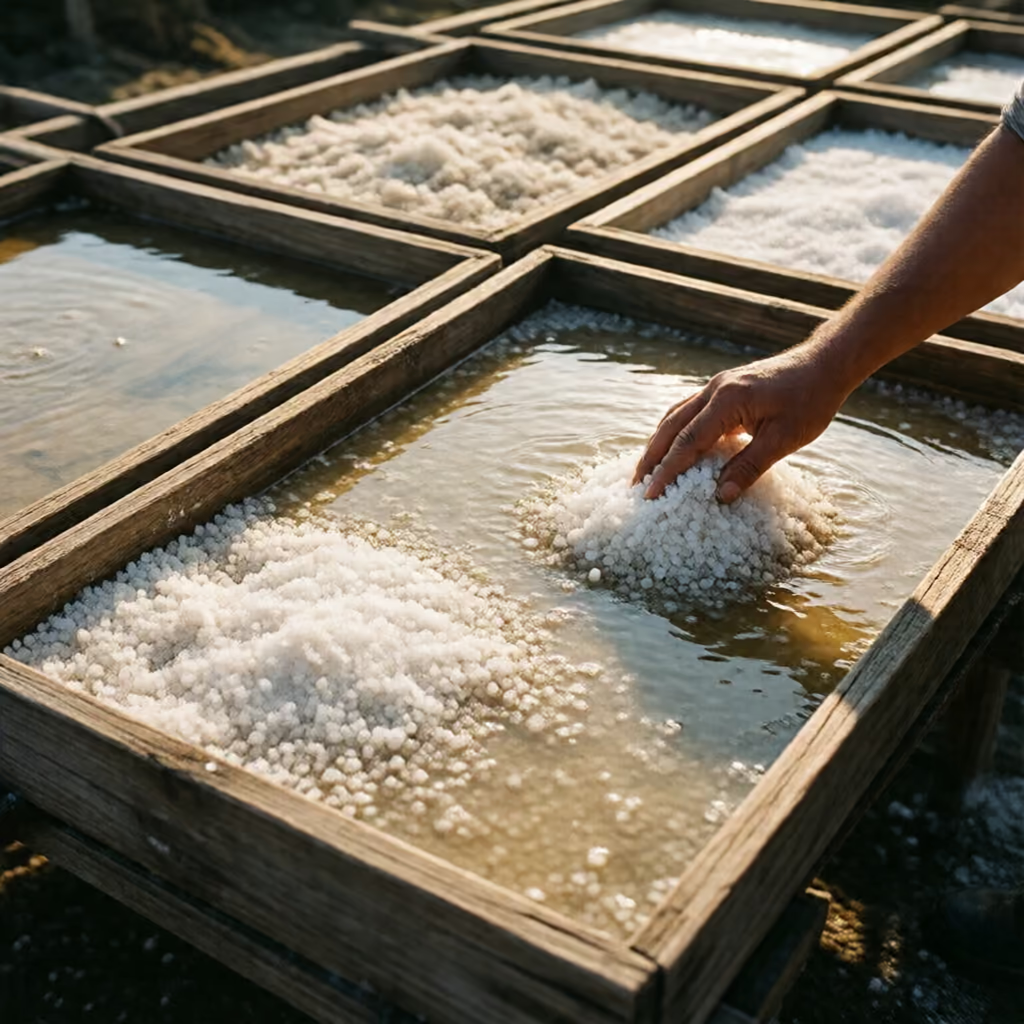
das Meersalz
sea salt
Salt obtained from seawater by allowing the water to evaporate.
EXAMPLE
Sie würzt den Salat mit grobem Meersalz.
She seasons the salad with coarse sea salt.
sea salt
das Meersalz, die Meersalze
Loading your saved state.
sea salt
Salt obtained from seawater by allowing the water to evaporate.
Sie würzt den Salat mit grobem Meersalz.
She seasons the salad with coarse sea salt.
| gender | neuter das |
|---|---|
| plural | die Meersalze |
| genitive | des Meersalzes |
| singular | plural | |
|---|---|---|
| nominative | das Meersalz | die Meersalze |
| accusative | das Meersalz | die Meersalze |
| dative | dem Meersalz | den Meersalzen |
| genitive | des Meersalzes | der Meersalze |
The article changes with the case; it is shown in colour.
'Meersalz' (sea salt) is made up of 'Meer' (sea) and 'Salz' (salt). The first component indicates the origin of the salt here.
Für das Gericht habe ich etwas Meersalz gekauft.
I bought some sea salt for the dish.
Common collocations with 'Meersalz' (sea salt) include 'grobes Meersalz' (coarse sea salt), 'feines Meersalz' (fine sea salt), and 'Meersalz zum Würzen' (sea salt for seasoning). The grain size is often mentioned because it plays a role in cooking and use.
Für die Suppe nehme ich feines Meersalz.
I use fine sea salt for the soup.
When seasoning, 'Meersalz' (sea salt) often follows the preposition 'mit' (with). Typical sentence patterns are 'etwas mit Meersalz würzen' (to season something with sea salt) or 'mit Meersalz abschmecken' (to adjust the seasoning with sea salt).
Die Köchin schmeckt die Sauce mit Meersalz ab.
The chef adjusts the sauce's seasoning with sea salt.