

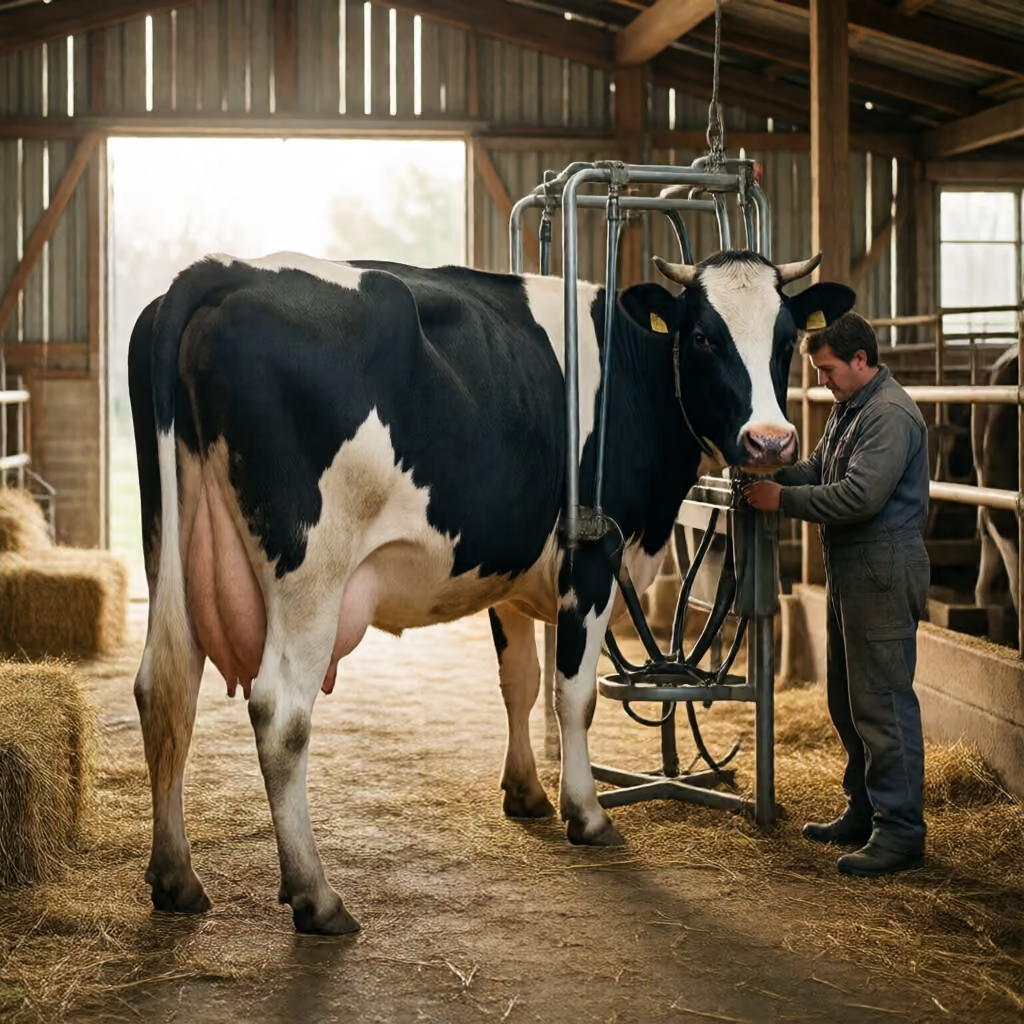
die Milchkuh
dairy cow
A cow kept for milk production.
EXAMPLE
Der Bauer stellt die Milchkuh morgens auf die Weide.
The farmer puts the dairy cow out to pasture in the morning.
dairy cow / cash cow
die Milchkuh, die Milchkühe
Loading your saved state.
dairy cow
A cow kept for milk production.
Der Bauer stellt die Milchkuh morgens auf die Weide.
The farmer puts the dairy cow out to pasture in the morning.

cash cow
A person, company, or thing from which someone continually derives benefits or money.
Für den Konzern ist die alte Produktlinie eine echte Milchkuh.
For the corporation, the old product line is a real cash cow.
| gender | feminine die |
|---|---|
| plural | die Milchkühe |
| genitive | der Milchkuh |
| singular | plural | |
|---|---|---|
| nominative | die Milchkuh | die Milchkühe |
| accusative | die Milchkuh | die Milchkühe |
| dative | der Milchkuh | den Milchkühen |
| genitive | der Milchkuh | der Milchkühe |
The article changes with the case; it is shown in colour.
'Milchkuh' (dairy cow / cash cow) is made up of 'Milch' (milk) and 'Kuh' (cow). Literally, it refers to a cow that produces milk; this also gives rise to the figurative idea of a steady source of income.
Der Hof hält mehrere Milchkühe für die tägliche Milchproduktion.
The farm keeps several dairy cows for daily milk production.
In its literal sense, 'Milchkuh' (dairy cow) is often used with farming verbs, for example 'eine Milchkuh halten' (to keep a dairy cow), 'eine Milchkuh füttern' (to feed a dairy cow), or 'eine Milchkuh melken' (to milk a dairy cow).
Der Landwirt füttert die Milchkühe schon früh am Morgen.
The farmer feeds the dairy cows early in the morning.
The figurative meaning is especially common in business and everyday texts. A person, product, or company can be described as a 'Milchkuh' (cash cow) if it regularly generates money or some other benefit.
Viele Autofahrer fühlen sich vom Staat als Milchkuh behandelt.
Many drivers feel that the government treats them as cash cows.