

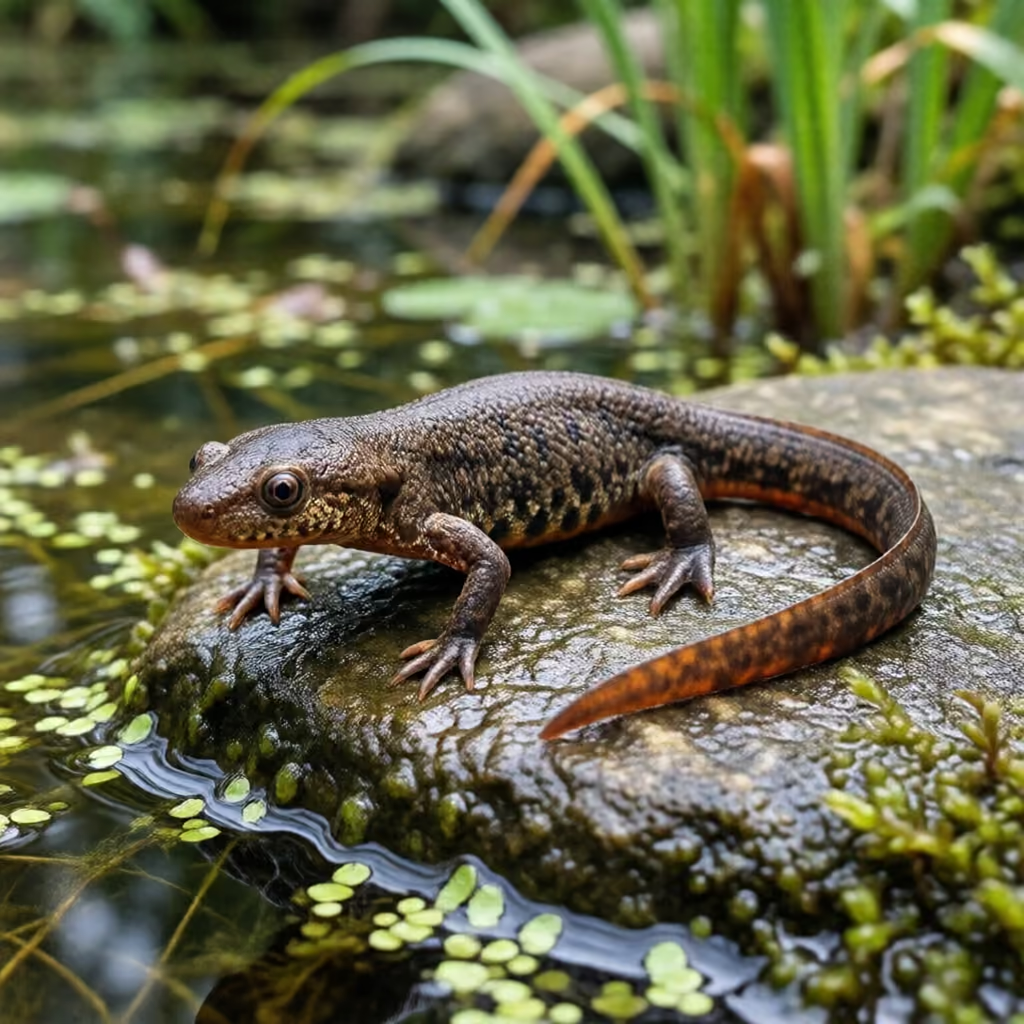
der Molch
newt
A small amphibian with a long tail that lives in water and on land and resembles a salamander.
EXAMPLE
Im Gartenteich haben wir einen Molch entdeckt.
We discovered a newt in the garden pond.
newt
der Molch, die Molche
Loading your saved state.
newt
A small amphibian with a long tail that lives in water and on land and resembles a salamander.
Im Gartenteich haben wir einen Molch entdeckt.
We discovered a newt in the garden pond.
| gender | masculine der |
|---|---|
| plural | die Molche |
| genitive | des Molchs |
| singular | plural | |
|---|---|---|
| nominative | der Molch | die Molche |
| accusative | den Molch | die Molche |
| dative | dem Molch | den Molchen |
| genitive | des Molchs des Molches | der Molche |
The article changes with the case; it is shown in colour.
'Molch' (newt) is the head word in several names for particular species, such as 'Teichmolch' (smooth newt), 'Bergmolch' (alpine newt), and 'Kammmolch' (crested newt). The first component often refers to the habitat or a distinctive feature.
Der Molch im Teich war wahrscheinlich ein Teichmolch.
The newt in the pond was probably a smooth newt.
'Molch' (newt) is especially common with verbs related to observing and finding: you can 'einen Molch entdecken' (discover a newt), 'beobachten' (observe one), 'fotografieren' (photograph one), or 'bestimmen' (identify one).
Die Kinder beobachteten einen Molch am Rand des Teichs.
The children observed a newt at the edge of the pond.
In texts about nature and bodies of water, words such as 'Teich' (pond), 'Ufer' (bank or shore), 'Laichgewässer' (breeding waters), or 'Feuchtigkeit' (moisture) provide important clues that 'Molch' (newt) is meant.
Nach dem Regen fanden wir einen Molch unter einem feuchten Stein am Ufer.
After the rain, we found a newt under a damp stone on the bank.