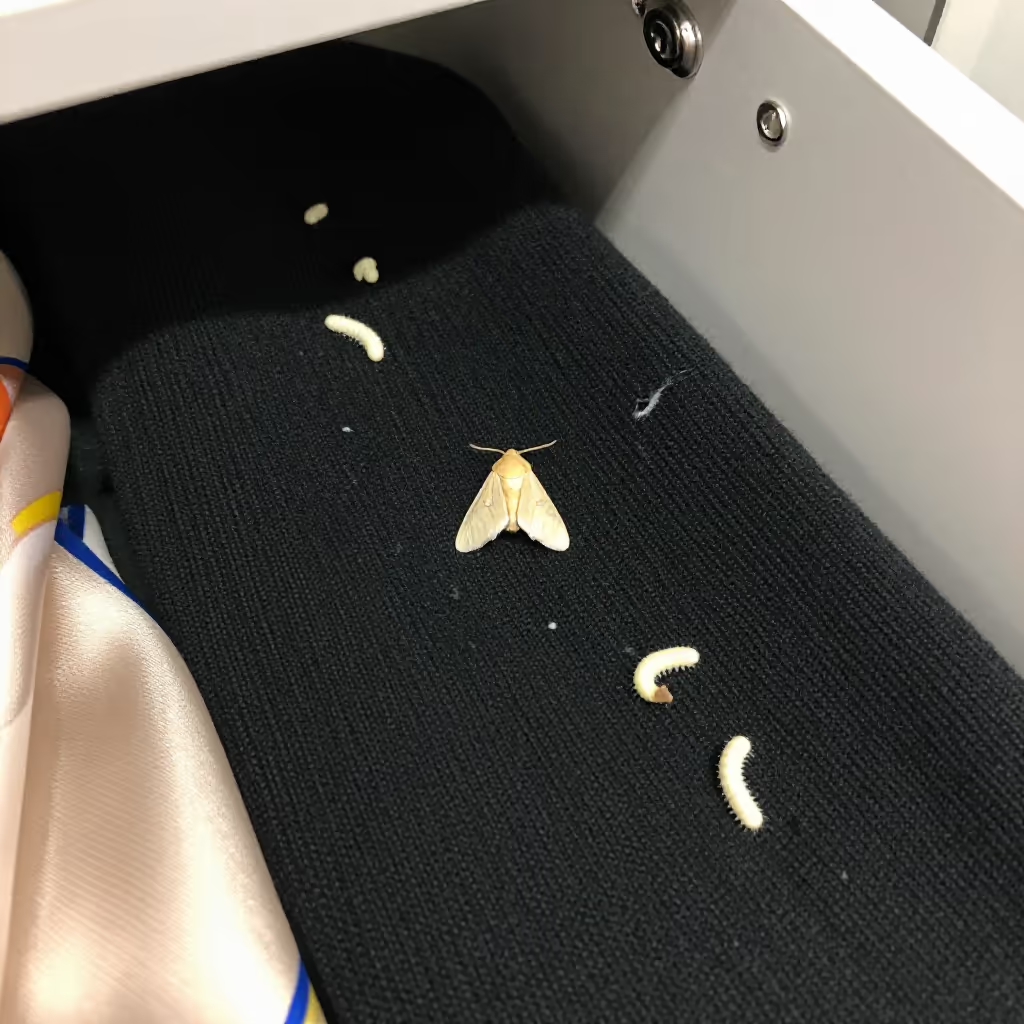
A nocturnal insect that resembles a butterfly. In everyday language, this often refers to clothes moths, whose larvae eat holes in textiles made of wool or silk.
example
Ich habe eine Motte in meinem Kleiderschrank entdeckt und fürchte nun um meine Wollpullover.
I discovered a moth in my wardrobe and now fear for my wool sweaters.

Usage tips
Context clue
Whether a clothes moth (m01) or a pantry moth (m02) is meant is revealed by the context. Words like 'Kleiderschrank' (wardrobe) or 'Wolle' (wool) point to clothes moths, while 'Küche' (kitchen) or 'Mehl' (flour) point to pantry moths.
EXAMPLE
Ich habe alle meine Wollschals kontrolliert, nachdem ich eine Motte im Schrank sah.
I checked all my wool scarves after I saw a moth in the wardrobe.
Precise terms
In everyday language, the more precise compound words 'Kleidermotte' (clothes moth) and 'Lebensmittelmotte' (pantry moth) are often used to avoid misunderstandings.
EXAMPLE
Gegen Kleidermotten helfen oft Zedernholz oder Lavendelsäckchen.
Cedar wood or little lavender bags often help against clothes moths.
Fixed expression
The expression 'etwas in die Mottenkiste packen' means to consider something old-fashioned and no longer relevant. The 'Mottenkiste' (moth box) is a symbolic place for outdated things.
EXAMPLE
Diese alten Ideen kannst du wirklich in die Mottenkiste packen.
You can really put those old ideas in the moth box.
Fixed expression
The expression 'die Motten kriegen' (to go crazy) is a fixed unit. It expresses that someone is becoming extremely angry, annoyed, or impatient.
EXAMPLE
Bei dieser lauten Musik kriege ich die Motten!
This loud music is driving me crazy!
Register and style
The expression 'die Motten kriegen' (to go crazy) clearly belongs to colloquial language. You would not use it in formal situations or in written language.
EXAMPLE
Ich warte schon eine Stunde auf den Bus. Langsam kriege ich die Motten.
I've been waiting for the bus for an hour. I'm slowly going crazy.
Compare with
near_synonym · confusable
Motte vs Schmetterling
butterfly
'Schmetterling' and 'Motte' refer to similar winged insects. In everyday language, 'Schmetterling' usually means a beautiful, often colorful insect that you see outside during the day. 'Motte' more often means a nocturnal insect. In everyday language, people often think of animals that can damage clothing or food when they hear 'Motte'. The words are easy to confuse because moths look similar to butterflies. If you mean a colorful insect in the garden, 'Schmetterling' is more natural. If it flies around the lamp at night or causes problems in the wardrobe or in food, 'Motte' fits better.
Motte
In der Küche haben wir eine Motte in der Mehltüte gefunden.
In the kitchen, we found a moth in the bag of flour.
Schmetterling
Im Sommer fliegt oft ein Schmetterling über die Wiese.
In summer, a butterfly often flies over the meadow.