

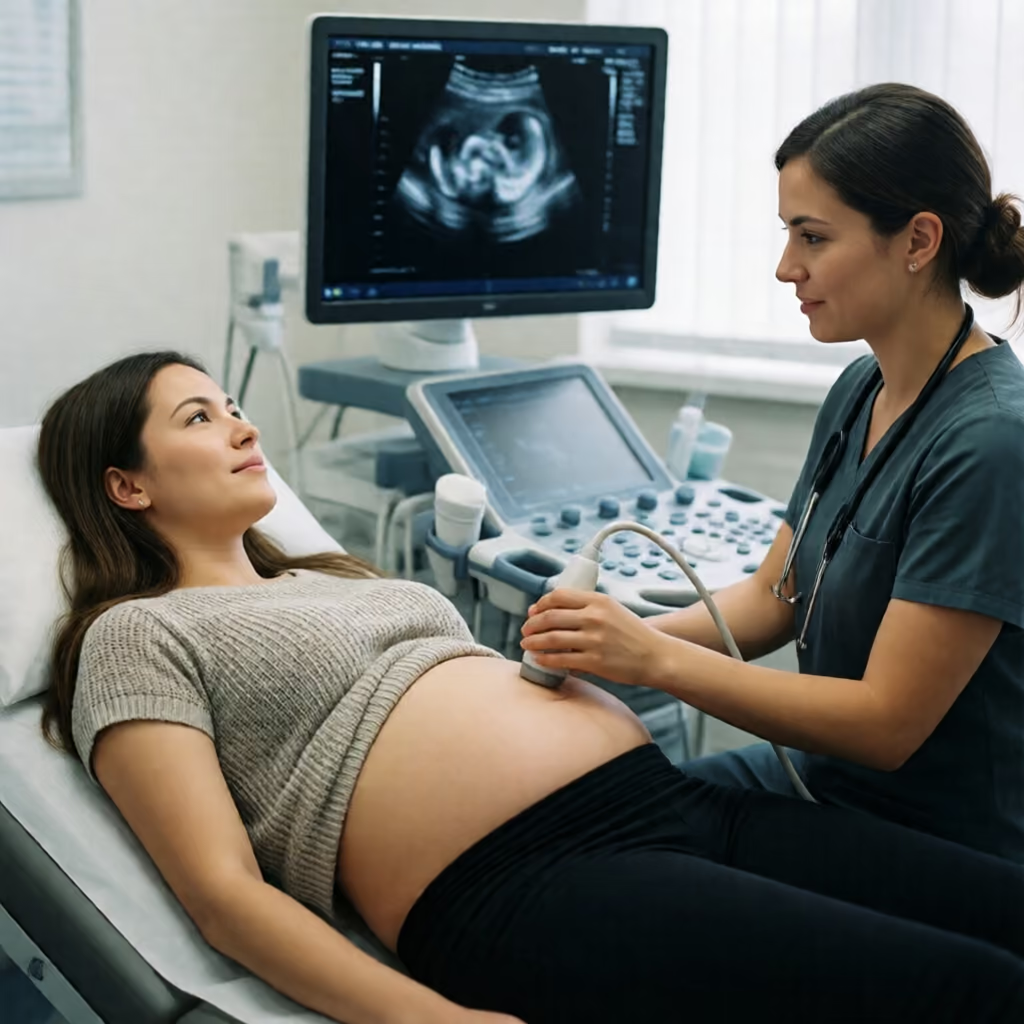
der Mutterleib
womb
A woman's uterus, where an unborn child develops during pregnancy.
EXAMPLE
Der Mutterleib schützt das ungeborene Kind während der Schwangerschaft.
The womb protects the unborn child during pregnancy.
womb
der Mutterleib
Loading your saved state.
womb
A woman's uterus, where an unborn child develops during pregnancy.
Der Mutterleib schützt das ungeborene Kind während der Schwangerschaft.
The womb protects the unborn child during pregnancy.
| gender | masculine der |
|---|---|
| genitive | des Mutterleibs |
| singular | plural | |
|---|---|---|
| nominative | der Mutterleib | – |
| accusative | den Mutterleib | – |
| dative | dem Mutterleib | – |
| genitive | des Mutterleibs des Mutterleibes | – |
The article changes with the case; it is shown in colour.
'Mutterleib' (womb) is made up of 'Mutter' (mother) and 'Leib' (body). Here, 'Leib' refers to the body, so the compound refers to the mother's body.
Das Kind wächst neun Monate lang im Mutterleib heran.
The child grows in the womb for nine months.
'Mutterleib' (womb) is particularly often used with the preposition 'in': 'im Mutterleib' (in the womb) indicates location, as in 'Das Kind bewegt sich im Mutterleib' (The child moves in the womb). 'Aus dem Mutterleib' (out of the womb) indicates origin or movement from inside to outside.
Viele wichtige Entwicklungen finden bereits im Mutterleib statt.
Many important developments take place while the child is still in the womb.
Das Baby erhält im Mutterleib alle Nährstoffe über die Nabelschnur.
In the womb, the baby receives all its nutrients through the umbilical cord.
'Mutterleib' (womb) often has an elevated or matter-of-fact tone and is particularly common in texts about pregnancy, birth, and the development of unborn children.
Die Ärztin erklärte, wie sich das Gehör im Mutterleib entwickelt.
The doctor explained how hearing develops in the womb.