

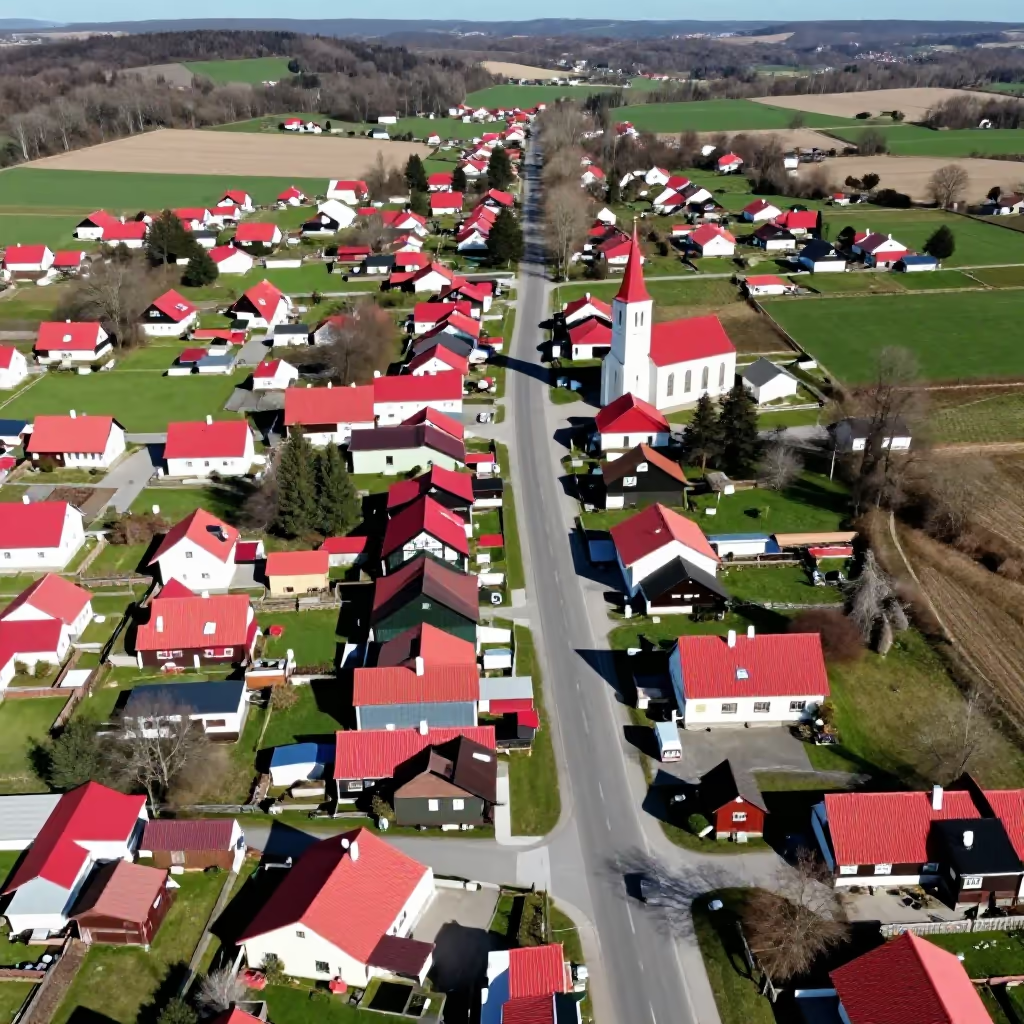
A village or smaller municipality that lies directly next to another place or is located in its immediate vicinity.
example
Wir fahren oft zum Einkaufen in den Nachbarort, weil es dort mehr Geschäfte gibt.
We often drive to the neighboring village to go shopping because there are more stores there.

Usage tips
Compound word
The word is a simple and logical compound made up of 'der Nachbar' (the neighbor) and 'der Ort' (the place/town). So it literally describes a place that lies next to your own like a neighbor.
EXAMPLE
Unser Nachbarort hat ein sehr schönes Freibad.
Our neighboring village has a very nice outdoor swimming pool.
Correct preposition
Pay attention to the case after the preposition 'in': you say 'in den Nachbarort' (to the neighboring village; accusative for direction), but you are or live 'im Nachbarort' (in the neighboring village; dative for location).
EXAMPLE
Morgen fahre ich zum Markt in den Nachbarort.
Tomorrow I’m going to the market in the neighboring village.
Typical collocations
'Nachbarort' is often combined with verbs of movement or everyday life. Typical phrases are 'in den Nachbarort fahren' (to drive/go to the neighboring village), 'aus dem Nachbarort kommen' (to come from the neighboring village), or 'im Nachbarort arbeiten' (to work in the neighboring village).
EXAMPLE
Viele Schüler aus dem Nachbarort besuchen unsere Schule.
Many students from the neighboring village attend our school.
Compare with
confusable
Nachbarort vs Vorort
suburb
'der Vorort' and 'der Nachbarort' can both refer to a place near another place. The difference lies in the relationship to the city. A 'Vorort' belongs spatially or practically to a larger city and lies on its edge. A 'Nachbarort' is simply another place nearby or right next to it. It does not have to be part of a larger city. Learners may confuse the words because both express closeness. As a guide: think of 'Vorort' from the center of a large city outward, and 'Nachbarort' from one place to the next place.
Nachbarort
Morgen fahre ich in den Nachbarort, weil dort der Arzttermin ist.
Tomorrow I’m going to the neighboring village because my doctor’s appointment is there.
Vorort
Frau Schneider lebt in einem Vorort von Hamburg, aber sie arbeitet in der Innenstadt.
Ms. Schneider lives in a suburb of Hamburg, but she works in the city center.