To persistently follow, harass, or lie in wait for someone in an unwanted way. This is often referred to as stalking.
example
Sie hat ihn angezeigt, weil er ihr seit Monaten nachstellt.
She reported him because he has been stalking her for months.

Usage tips
Separable verb
'Nachstellen' is a separable verb. The prefix 'nach-' goes to the end in a main clause. In subordinate clauses and in the infinitive with 'zu', the verb stays together.
EXAMPLE
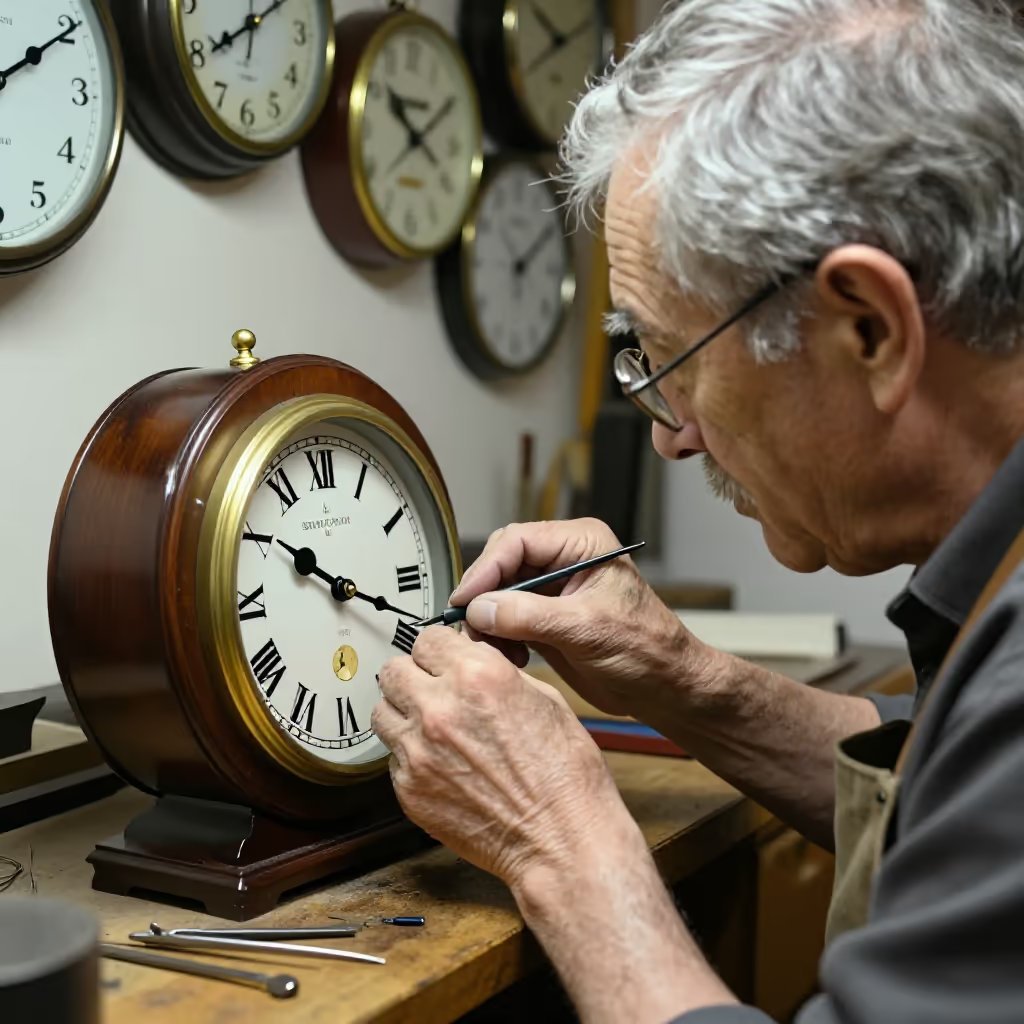
Er stellt die Uhr eine Stunde nach.
He sets the clock back one hour.
Context clue
You can recognize the meaning from the object: if a person in the dative follows, it means 'verfolgen' (to pursue/stalk). If a thing (scene, accident) in the accusative follows, it means 'rekonstruieren' (to reconstruct). If a clock in the accusative follows, it means 'einstellen' (to set/adjust).
EXAMPLE
Der Detektiv stellte dem Verdächtigen nach.
The detective stalked the suspect.
Dative construction
In the meaning 'verfolgen/belästigen' (to pursue/harass), 'nachstellen' is always used with a dative object. You stalk 'jemandem' (someone, dative), not 'jemanden' (someone, accusative).
EXAMPLE
Der Mann wurde verurteilt, weil er seiner Ex-Freundin nachgestellt hat.
The man was convicted because he had stalked his ex-girlfriend.
Typical collocations
When it is about reconstructing something, the verb is often combined with words like 'eine Szene' (a scene), 'einen Unfall' (an accident), 'ein Verbrechen' (a crime), or 'eine Schlacht' (a battle).
EXAMPLE
Die Ermittler haben den Tathergang am Tatort nachgestellt.
The investigators recreated the sequence of events at the crime scene.
Typical collocations
In the meaning 'justieren' (to adjust), 'nachstellen' almost always refers to timekeeping devices. Typical objects are 'die Uhr' (the clock/watch), 'den Wecker' (the alarm clock), or 'den Timer' (the timer).
EXAMPLE
Meine Armbanduhr geht falsch, ich muss sie nachstellen.
My wristwatch is showing the wrong time; I have to adjust it.
Compare with
near_synonym · confusable
nachstellen vs stellen
to put / to set
'stellen' and 'nachstellen' can both be used with clocks or devices. You use 'stellen' when you set a clock, an alarm, or a device to a specific time or function. You use 'nachstellen' when the time is already wrong and you correct it. The words are easy to confuse because 'nachstellen' looks like a form of 'stellen'. The practical difference is: when setting something up for the first time, you are more likely to say 'stellen'; when correcting a clock that is wrong, you are more likely to say 'nachstellen'.
nachstellen
Die Küchenuhr geht fünf Minuten nach, deshalb muss ich sie nachstellen.
The kitchen clock is five minutes slow, so I have to adjust it.
stellen
Er stellt den Wecker vor dem Schlafengehen auf sechs Uhr.
He sets the alarm for six o'clock before going to bed.