

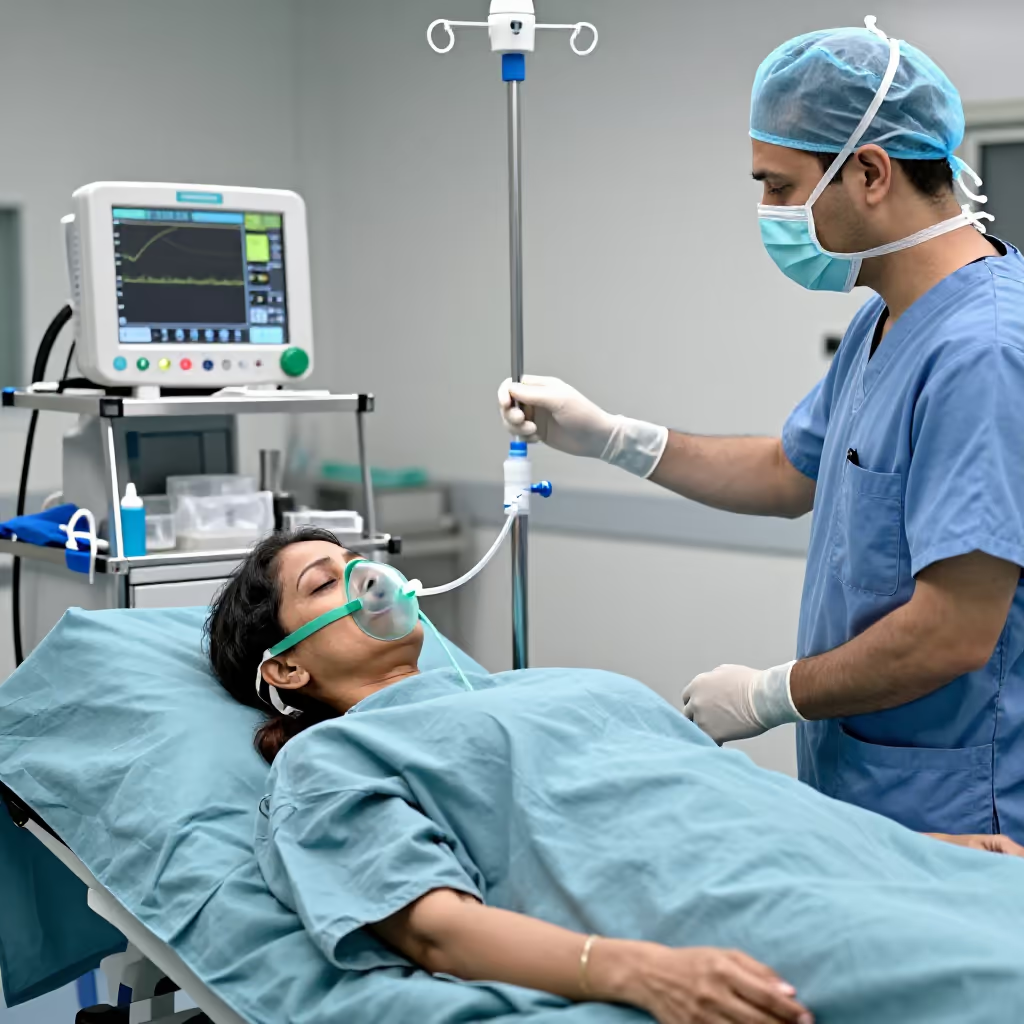
A medically induced state of unconsciousness and freedom from pain that is used for operations or other painful procedures. A distinction is made between Vollnarkose (general anesthesia) and Teilnarkose (regional anesthesia).
example
Der Patient wurde für die Operation in eine tiefe Narkose versetzt.
The patient was put under deep anesthesia for the operation.

Usage tips
Typical verbs
Certain verbs are often used in connection with 'Narkose' (anesthesia). You can 'Narkose bekommen' or 'Narkose erhalten' (receive anesthesia). A doctor can put a patient 'in Narkose' (under anesthesia), and after the operation the patient 'wacht aus der Narkose auf' (wakes up from anesthesia).
EXAMPLE
Vor der Operation bekommen Sie eine leichte Narkose.
Before the operation, you will receive light anesthesia.
Preposition and case
The preposition 'in' is frequently used with 'Narkose' (anesthesia). To express an action, you use the accusative, e.g. 'jemanden in Narkose versetzen' (to put someone under anesthesia). To describe a state, you use the dative, e.g. 'in Narkose liegen' (to be under anesthesia).
EXAMPLE
Der Chirurg versetzt den Patienten in eine Vollnarkose.
The surgeon puts the patient under general anesthesia.
Typical compounds
'Narkose' (anesthesia) is often combined with the prefixes 'Voll-' and 'Teil-' to specify the type of anesthesia. A 'Vollnarkose' (general anesthesia) affects the whole body, while a 'Teilnarkose' (regional anesthesia) numbs only a specific area.
EXAMPLE
Für die Zahn-OP reichte eine Teilnarkose aus.
Regional anesthesia was sufficient for the dental operation.
Compare with
confusable
Narkose vs Koma
coma
'das Koma' and 'die Narkose' can be confused because in both states a person is not normally awake and often does not respond. The difference lies in the cause and the control. 'Die Narkose' is deliberately induced by doctors so that an operation or procedure can take place without pain. 'Das Koma' is caused by a serious illness or injury and is not a planned state. So for an operation, you say 'Narkose'. For a serious, long-lasting state of unconsciousness, you say 'Koma'.
Narkose
Vor der Operation erklärte die Ärztin dem Patienten die Narkose.
Before the operation, the doctor explained the anesthesia to the patient.
Koma
Nach der schweren Krankheit lag Frau Wagner im Koma.
After the serious illness, Mrs. Wagner was in a coma.