

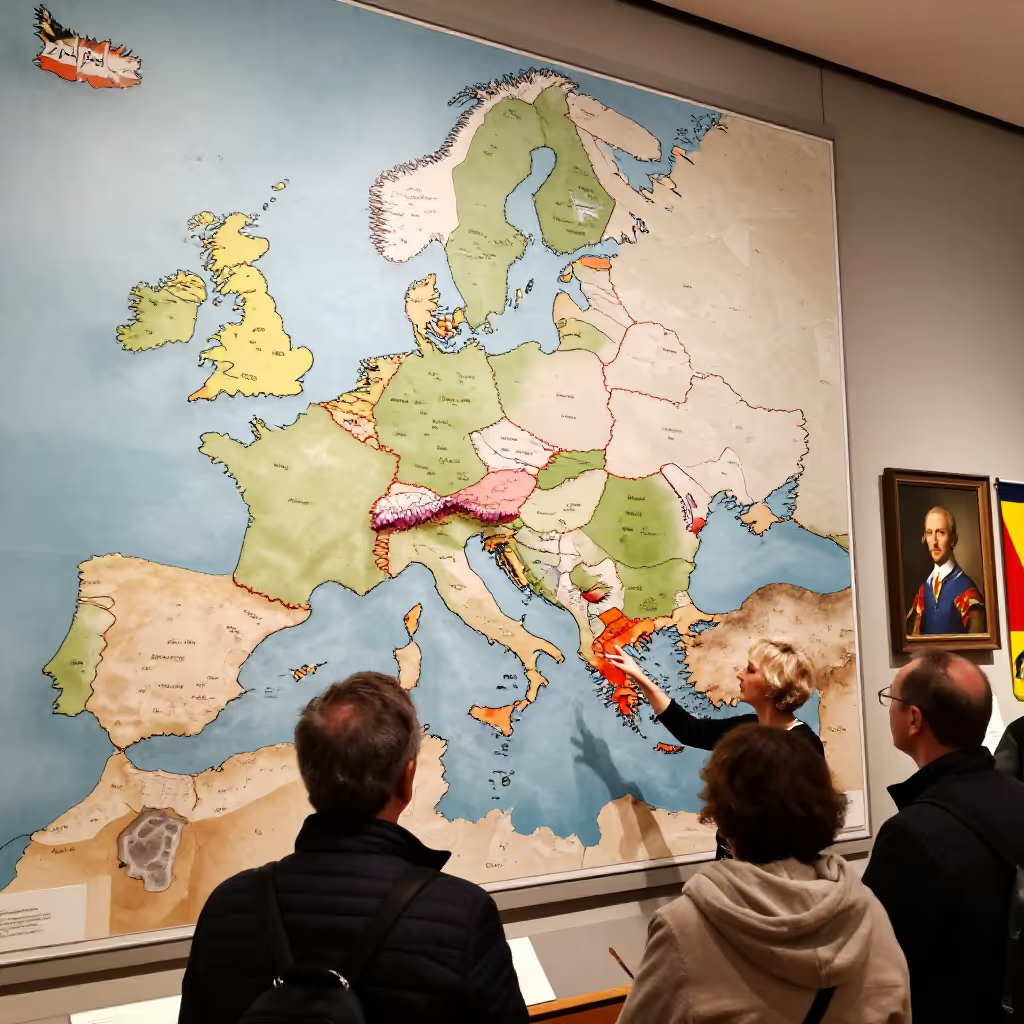
A state whose territory and population largely correspond to a nation, that is, a group of people with a shared language, culture, and history. The modern concept of the nation-state emerged in Europe in the 18th and 19th centuries.
example
Die Gründung des Deutschen Reiches 1871 gilt als ein entscheidender Schritt zur Bildung eines deutschen Nationalstaats.
The founding of the German Empire in 1871 is considered a decisive step toward the formation of a German nation-state.

Usage tips
Compound word
The word is made up of 'National-' (from the noun 'die Nation' — the nation) and 'Staat' (state). It describes a political concept in which a state is based on a shared nation (culture, language, history).
EXAMPLE
Die Idee des Nationalstaats prägte das 19. Jahrhundert in Europa.
The idea of the nation-state shaped the 19th century in Europe.
Register and context
'Nationalstaat' (nation-state) is a technical term from history and political science. It is usually used when talking about the emergence and development of states or about political theories.
EXAMPLE
Im Geschichtsunterricht diskutierten wir die Vor- und Nachteile des Nationalstaats.
In history class, we discussed the advantages and disadvantages of the nation-state.
Typical collocations
Since it is an abstract concept, the word is often combined with other abstract nouns. Common phrases are 'die Entstehung des Nationalstaats' (the emergence of the nation-state), 'das Konzept des Nationalstaats' (the concept of the nation-state), or 'ein souveräner Nationalstaat' (a sovereign nation-state).
EXAMPLE
Viele Historiker erforschen die Entstehung der europäischen Nationalstaaten.
Many historians research the emergence of European nation-states.
Compare with
near_synonym · confusable
Nationalstaat vs Staat
state
'der Staat' and 'der Nationalstaat' both belong to the area of politics and countries. 'der Staat' is the general term for a political organization with a government, laws, and territory. 'der Nationalstaat' is a specific form of state: it is connected with a nation, meaning people who see themselves as belonging together through language, culture, or history. Learners may confuse the words because every nation-state is a state. But not every state is meaningfully described as a nation-state. In everyday language, 'Staat' is often enough. 'Nationalstaat' is used more in history, politics, or social discussions.
Nationalstaat
Im Geschichtsunterricht sprechen wir über die Entstehung des Nationalstaats in Europa.
In history class, we talk about the emergence of the nation-state in Europe.
Staat
Der Staat erhebt Steuern und finanziert damit viele öffentliche Aufgaben.
The state collects taxes and uses them to fund many public tasks.