

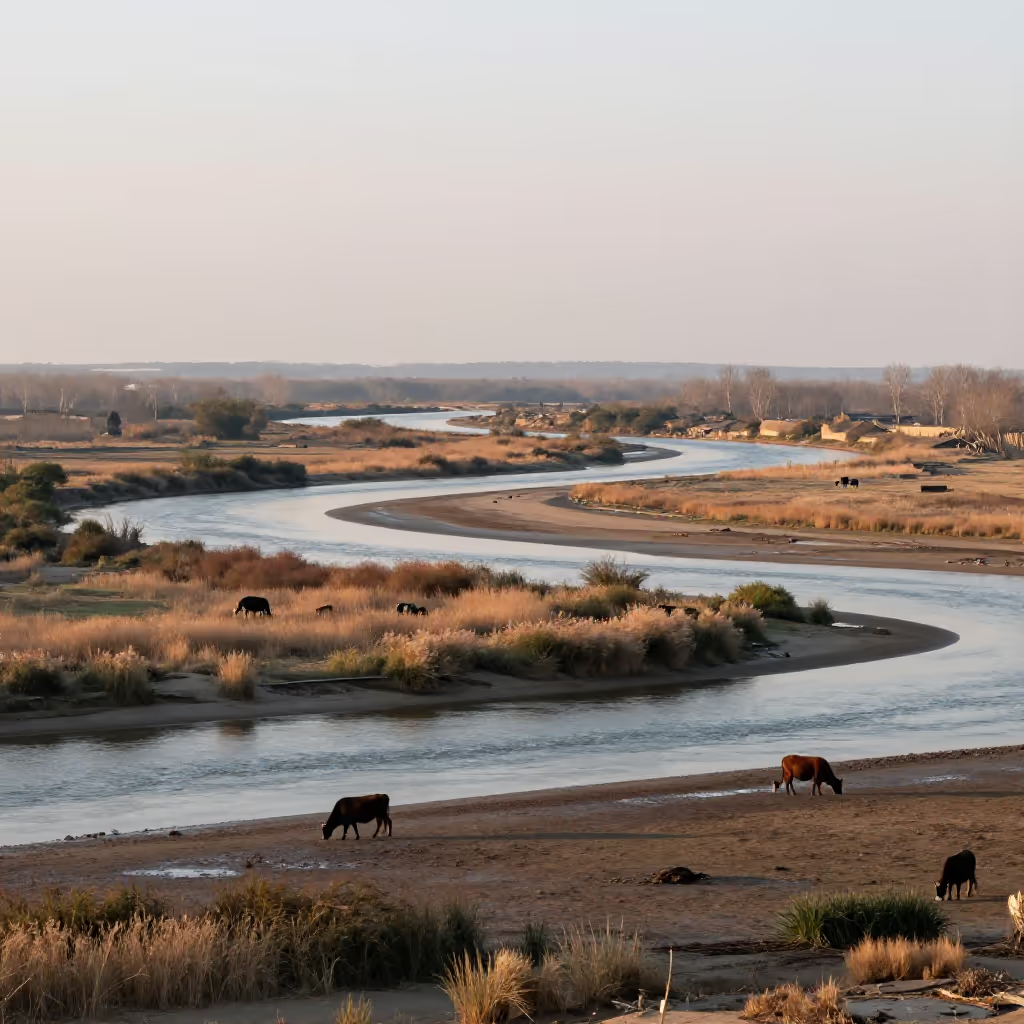
die Niederung
lowland
An extensive, flat, low-lying area, often near rivers or coasts.
In der feuchten Niederung des Amazonasgebiets gibt es eine riesige Artenvielfalt.
In the humid lowlands of the Amazon region, there is enormous biodiversity.

lowland
Loading your saved state.
lowland
An extensive, flat, low-lying area, often near rivers or coasts.
In der feuchten Niederung des Amazonasgebiets gibt es eine riesige Artenvielfalt.
In the humid lowlands of the Amazon region, there is enormous biodiversity.

The word 'Niederung' is derived from the adjective 'nieder', which means 'low' or 'down below'. So a Niederung (lowland) is literally low-lying land.
Das Dorf liegt geschützt in einer kleinen Niederung.
The village lies protected in a small lowland area.
You can recognize the figurative meaning by the fact that it is connected with abstract terms like 'Alltag' (everyday life), 'Politik' (politics), or 'menschliche Existenz' (human existence). The literal meaning, by contrast, is used in geographical contexts.
Er wollte den Niederungen der Bürokratie entfliehen.
He wanted to escape the depths of bureaucracy.
The figurative meaning of 'Niederung' (depths) for banal or negative aspects of life belongs to elevated written language. It is rarely used in everyday conversation.
In seinem Roman beschreibt er die Niederungen der menschlichen Seele.
In his novel, he describes the depths of the human soul.
In the figurative meaning, fixed combinations are often found. Especially common are 'die Niederungen des Alltags' (the depths of everyday life) or 'die Niederungen der Politik' (the depths of politics).
Nach dem Urlaub holten ihn die Niederungen des Alltags schnell wieder ein.
After the vacation, the depths of everyday life quickly caught up with him again.
plain / level
'die Ebene' and 'die Niederung' can both describe a flat area. 'Ebene' mainly says that the land is flat. 'Niederung' additionally says that the area is low-lying, often near a river or on the coast. That is why 'Niederung' sounds more precise when water, moisture, or lower-lying terrain is important. The words can be confused because both describe land that is not mountainous. The difference is: an 'Ebene' is flat; a 'Niederung' is flat and low-lying.

Nach starkem Regen steht in der Niederung am Fluss viel Wasser.
After heavy rain, there is a lot of water in the lowland by the river.
Hinter dem Wald beginnt eine breite Ebene ohne Hügel.
Behind the forest, a wide plain without hills begins.