


der Nordosten
northeast
The compass direction that lies exactly between north and east.
EXAMPLE
Der Kompass zeigt nach Nordosten.
The compass points northeast.
northeast
Loading your saved state.
northeast
The compass direction that lies exactly between north and east.
Der Kompass zeigt nach Nordosten.
The compass points northeast.
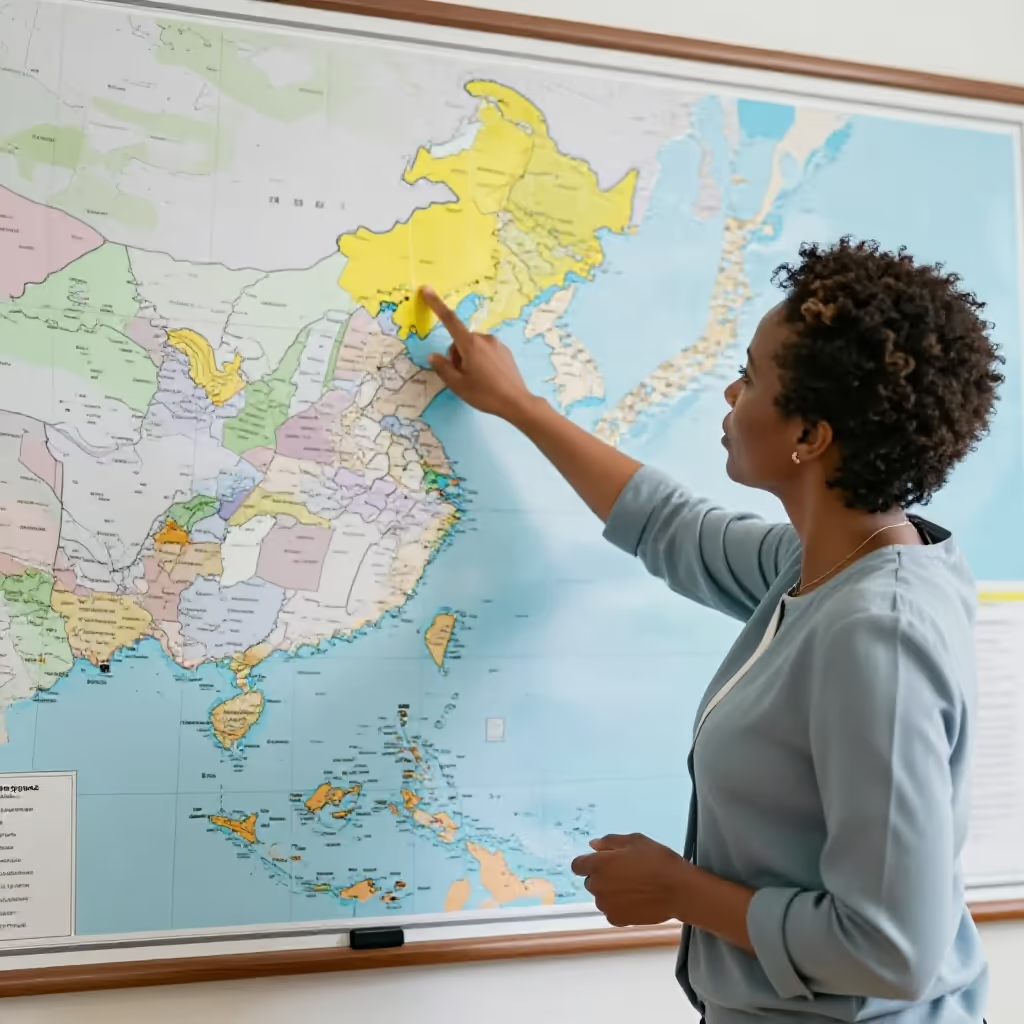
northeast
The northeastern part of a geographical area, such as a country, region, or island.
Der Nordosten Brasiliens ist für seine schönen Strände bekannt.
The northeast of Brazil is known for its beautiful beaches.
'Nordosten' (northeast) is simply formed from the two compass directions 'Nord' (north) and 'Osten' (east). This pattern applies to all intermediate compass directions, such as 'Südwesten' (southwest) or 'Südosten' (southeast).
Die Vögel fliegen im Herbst Richtung Südwesten.
The birds fly southwest in the fall.
The preposition indicates the function. 'Nach Nordosten' (to the northeast) describes movement in that direction, while 'im Nordosten' (in the northeast) describes a fixed location.
Wir fahren morgen nach Nordosten an die Küste.
We're driving northeast to the coast tomorrow.
To describe the northeastern part of an area, you use the structure 'im Nordosten von [Land]' (in the northeast of [country]) or the genitive 'im Nordosten [Landes]' (in the northeast of [country]).
Die Strände im Nordosten Brasiliens sind wunderschön.
The beaches in the northeast of Brazil are beautiful.
northeast
“Der Nordosten” and “der Nordost” can both refer to the direction between north and east or to a northeastern area. “Nordosten” is especially common for an area, for example after “im”, while “Nordost” is often used as a concise directional indication. Both forms are possible depending on the context.

Das Dorf liegt im Nordosten des Landes, nahe der Grenze.
The village is in the northeast of the country, near the border.
Der Wind kommt heute aus Nordost und bringt kühlere Luft.
The wind is coming from the northeast today and bringing cooler air.