


neigen zu
to tend to
To have a tendency or disposition to do something specific or to show a certain quality.
EXAMPLE
Bei Stress neige ich dazu, zu viel Schokolade zu essen.
When I'm stressed, I tend to eat too much chocolate.
to tend / to tilt
Loading your saved state.
to tend to
To have a tendency or disposition to do something specific or to show a certain quality.
Bei Stress neige ich dazu, zu viel Schokolade zu essen.
When I'm stressed, I tend to eat too much chocolate.

to tilt
To bend or tilt something, especially the head or upper body, in a certain direction.
Er neigte den Kopf zur Seite, um besser hören zu können.
He tilted his head to the side so he could hear better.

to draw to a close
A fixed expression meaning that something will soon end or stop.
Das Schuljahr neigt sich langsam dem Ende zu.
The school year is slowly drawing to a close.
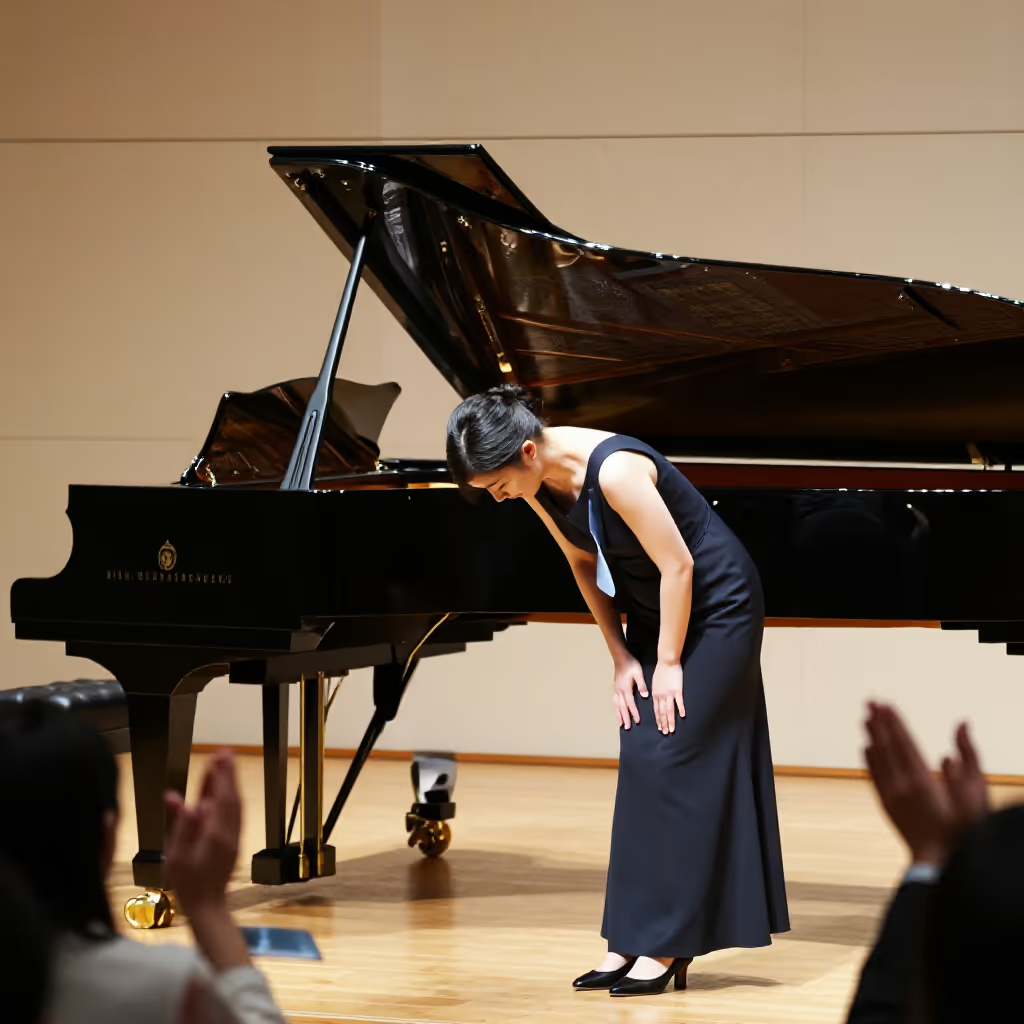
to bow
To bow; to lower the upper body as a sign of respect, thanks, or humility.
Der Schauspieler neigte sich vor dem applaudierenden Publikum.
The actor bowed before the applauding audience.
To express a tendency, 'neigen' (to tend) is used with the preposition 'zu' (to). If a noun follows, it is in the dative. If an action follows, you use the construction 'dazu neigen, etwas zu tun' (to tend to do something).
Er neigt zu Übertreibungen.
He tends to exaggerate.
The expression 'sich dem Ende neigen' (to draw to a close) is fixed. It always requires the reflexive pronoun 'sich' and the dative object 'dem Ende'. The subject is the thing that will soon end.
Der Sommer neigt sich langsam dem Ende zu.
Summer is slowly drawing to a close.
In the meaning 'etwas beugen' (to bend something), 'neigen' (to tilt) is almost always used with body parts as the object. The most common combinations are 'den Kopf neigen' (to tilt one's head) and 'den Oberkörper neigen' (to bend one's upper body).
Sie neigte den Kopf und hörte aufmerksam zu.
She tilted her head and listened attentively.
In the meaning 'sich verbeugen' (to bow), the verb is always reflexive ('sich neigen'). Often, 'vor' plus the dative is used to indicate whom someone is bowing to.
Nach dem Konzert neigten sich die Musiker vor dem Publikum.
After the concert, the musicians bowed before the audience.
to lean
With lehnen, the body is positioned at an angle against something and finds support there. Neigen only refers to bending or tilting in a direction; a supporting surface is not necessary. That is why you lean against a wall but tilt your upper body forward.

Sie neigt den Oberkörper leicht nach vorn.
She tilts her upper body slightly forward.
Sie lehnt sich mit dem Oberkörper gegen die Wand.
She is leaning her upper body against the wall.