

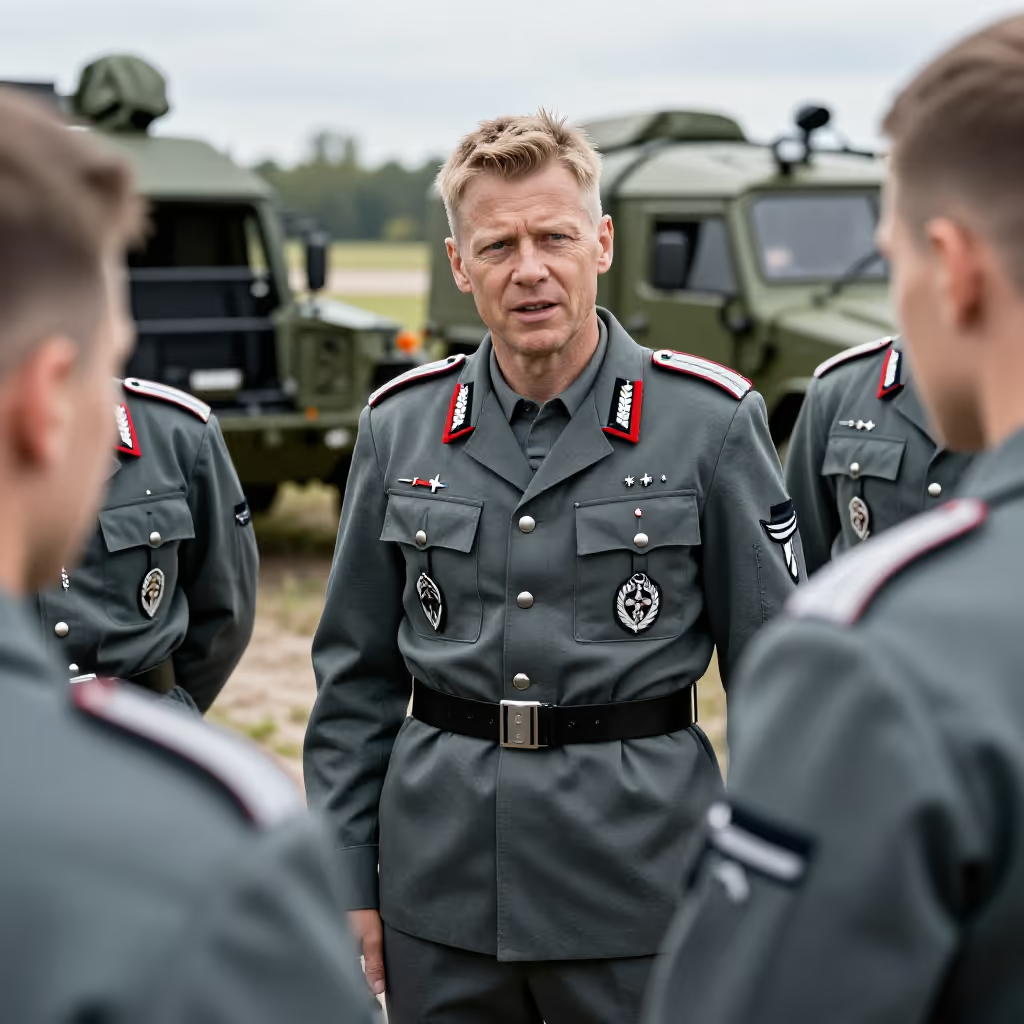
der Oberstleutnant
lieutenant colonel
An officer rank in the Bundeswehr and other armies that stands between major and colonel.
EXAMPLE
Der Oberstleutnant gab den Befehl zum Aufbruch.
The lieutenant colonel gave the order to move out.
lieutenant colonel
Loading your saved state.
lieutenant colonel
An officer rank in the Bundeswehr and other armies that stands between major and colonel.
Der Oberstleutnant gab den Befehl zum Aufbruch.
The lieutenant colonel gave the order to move out.
The rank 'Oberstleutnant' (lieutenant colonel) is composed of the ranks 'Oberst' (colonel) and 'Leutnant' (lieutenant). It refers to a single officer rank that is hierarchically below colonel.
Er wurde nach langjährigem Dienst zum Oberstleutnant befördert.
After many years of service, he was promoted to lieutenant colonel.
In written usage, especially in official or military documents, the abbreviation 'OTL' is often used for 'Oberstleutnant' (lieutenant colonel).
Auf dem Dienstplan stand: OTL Schmidt, Tagesoffizier.
The duty roster said: OTL Schmidt, duty officer.
In direct address, the full rank is used. The correct form of address is 'Herr Oberstleutnant' (Mr. Lieutenant Colonel) for a man and 'Frau Oberstleutnant' (Ms. Lieutenant Colonel) for a woman.
Herr Oberstleutnant, Ihr Befehl wurde ausgeführt.
Lieutenant Colonel, your order has been carried out.
topmost
Both words can refer to a high position in a military hierarchy. However, „der Oberstleutnant“ is a specific rank below colonel, while „oberst“ as an adjective refers to the highest position. Use „Oberstleutnant“ for the specific person or rank, and „oberst“ for the rank level.

Der Oberstleutnant begrüßte die neuen Soldaten.
The lieutenant colonel welcomed the new soldiers.
Der oberste Offizier begrüßte die neuen Soldaten.
The top-ranking officer welcomed the new soldiers.