


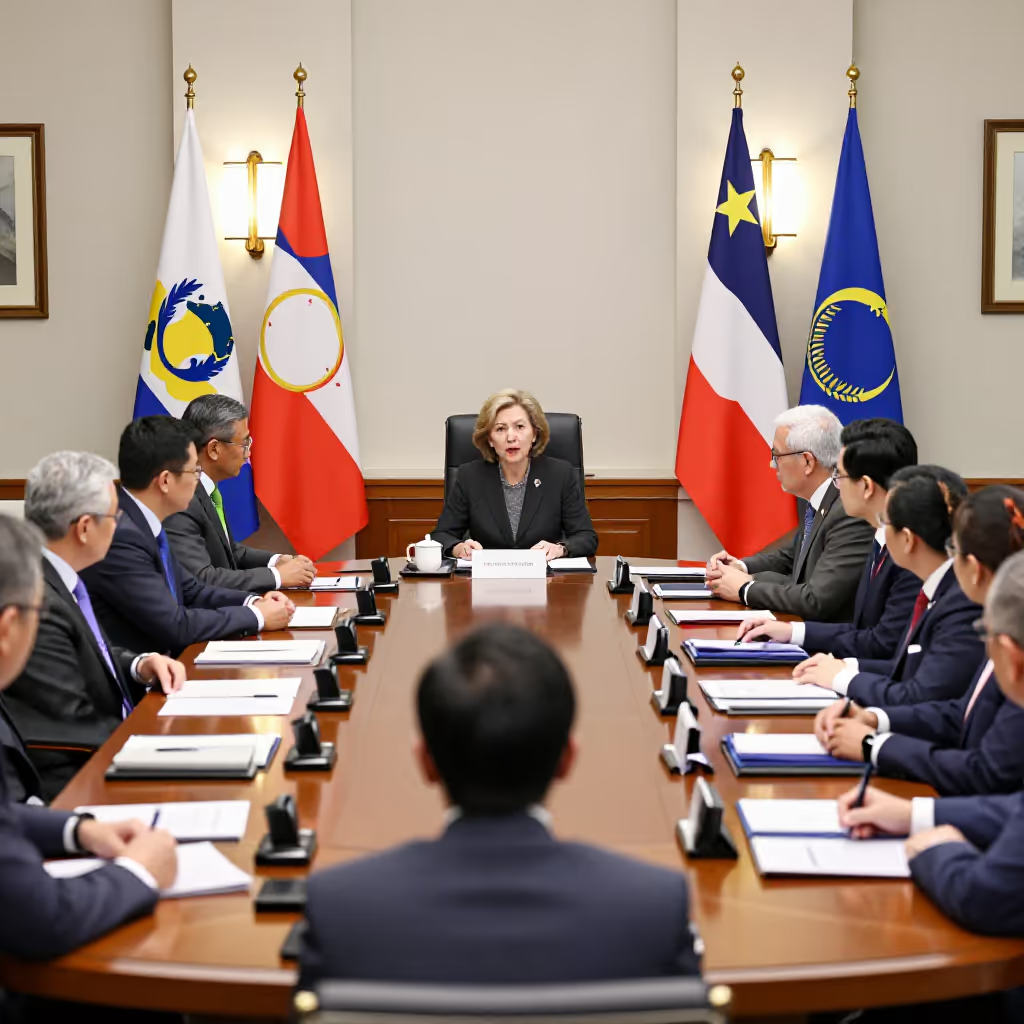
Refers collectively to the state, official, or church institutions that exercise power over citizens. The term is often used to describe the government or administration from the perspective of a subject or citizen, and today it often has a slightly old-fashioned or critical undertone.
example
Die Dorfbewohner legten sich aus Protest gegen die neuen Steuern mit der Obrigkeit an.
The villagers challenged the authorities in protest against the new taxes.
Usage tips
Word family
The word 'Obrigkeit' (authorities) is derived from the adjective 'ober' (upper/higher). So it literally refers to 'die Oberen' (those above) or the institutions that stand above ordinary citizens.
EXAMPLE
Historisch gesehen musste man den Anweisungen der Obrigkeit Folge leisten.
Historically, people had to follow the instructions of the authorities.
Use and style
'Obrigkeit' (authorities) is not a neutral word for 'Regierung' (government). It has an old-fashioned or critical sound and is often used to express a distant or submissive relationship to power.
EXAMPLE
In seinen Schriften kritisierte er die Willkür der Obrigkeit.
In his writings, he criticized the arbitrariness of the authorities.
Only in the singular
'Obrigkeit' (authorities) is a collective term and is used almost exclusively in the singular. One speaks of 'der Obrigkeit' (the authorities) as a whole, not of individual 'Obrigkeiten' (authorities).
EXAMPLE
Der Respekt vor der Obrigkeit hat in den letzten Jahrzehnten abgenommen.
Respect for the authorities has decreased in recent decades.
Typical collocations
Common verbs used with 'Obrigkeit' (authorities) describe a relationship to it. Typical phrases are 'sich der Obrigkeit widersetzen' (to resist the authorities), 'sich mit der Obrigkeit anlegen' (to challenge the authorities), or 'die Obrigkeit fürchten' (to fear the authorities).
EXAMPLE
Er war bekannt dafür, sich der Obrigkeit zu widersetzen.
He was known for resisting the authorities.
Compare with
near_synonym · confusable
Obrigkeit vs Regierung
government
'die Regierung' and 'die Obrigkeit' can both refer to people or institutions that have power over citizens. 'Die Regierung' is a neutral and normal word for the political leadership of a country. 'Die Obrigkeit' sounds rather old-fashioned or critical today. It describes state, official, or even church institutions from the perspective of the people who have to obey them. The words can be confused because the government can be part of the authorities. When speaking objectively about politics, you usually use 'Regierung'. When you want to express distance, criticism, or an old power relationship, 'Obrigkeit' is more appropriate.
Obrigkeit
Im Dorf vertrauten viele Menschen der Obrigkeit nicht mehr.
In the village, many people no longer trusted the authorities.
Regierung
Die Regierung hat nach der Krise schnelle Hilfe versprochen.
After the crisis, the government promised quick help.