

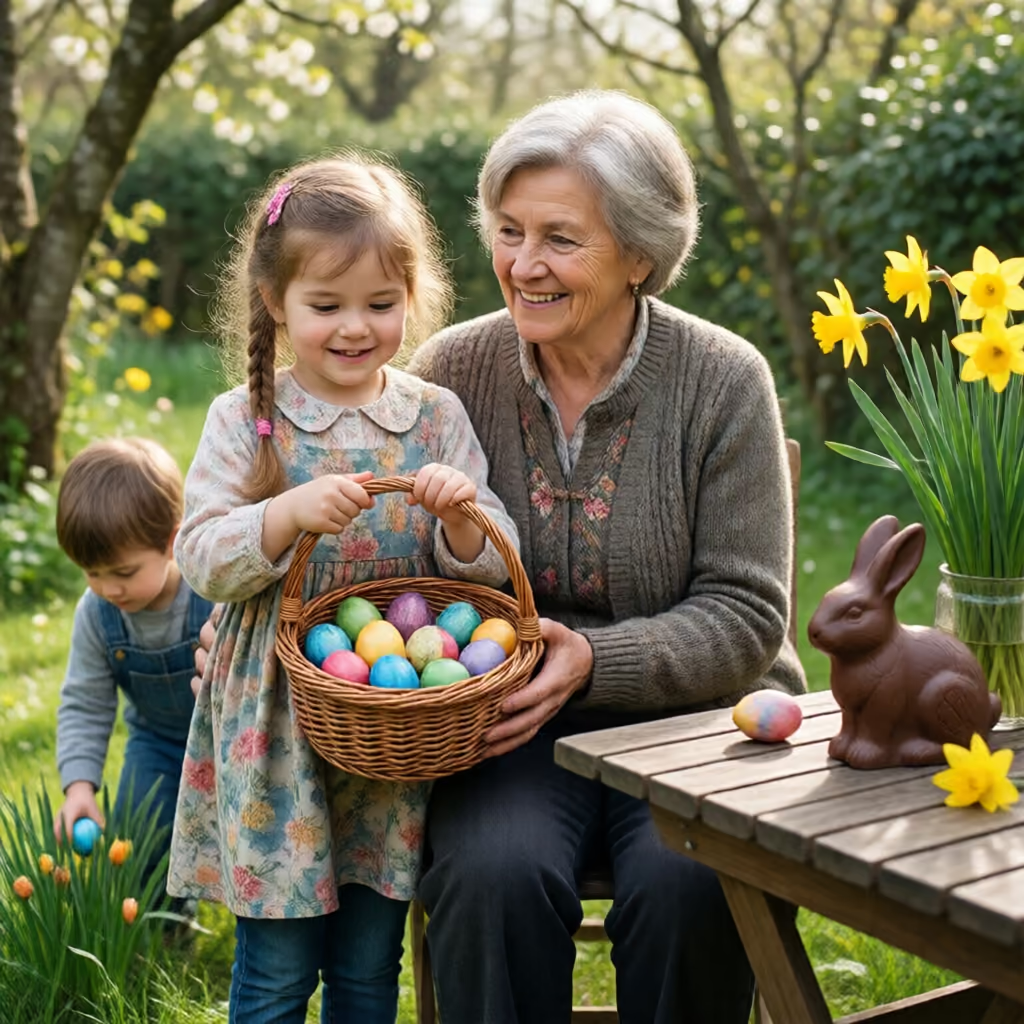
das Ostern
Easter
The Christian holiday commemorating the resurrection of Jesus Christ, as well as the period around this holiday.
Letztes Jahr haben wir Ostern bei meinen Großeltern verbracht.
Last year, we spent Easter at my grandparents' house.
Easter
das Ostern, die Ostern
Loading your saved state.

Easter
The Christian holiday commemorating the resurrection of Jesus Christ, as well as the period around this holiday.
Letztes Jahr haben wir Ostern bei meinen Großeltern verbracht.
Last year, we spent Easter at my grandparents' house.
| gender | neuter das |
|---|---|
| plural | die Ostern |
| genitive | des Ostern |
| singular | plural | |
|---|---|---|
| nominative | das Ostern | die Ostern |
| accusative | das Ostern | die Ostern |
| dative | dem Ostern | den Ostern |
| genitive | des Ostern | der Ostern |
The article changes with the case; it is shown in colour.
When speaking about the holiday in general, “Ostern” is normally used without an article, as in “Ostern feiern” (to celebrate Easter). An article can be used with a more specific description.
Wir feiern Ostern dieses Jahr mit Freunden.
We're celebrating Easter with friends this year.
Das erste Ostern in unserer neuen Wohnung war sehr ruhig.
The first Easter in our new apartment was very peaceful.
“Zu Ostern” (at Easter) is a common expression for the holiday period. “Vor Ostern” (before Easter) and “nach Ostern” (after Easter) place events in time around the holiday.
Zu Ostern besuchen uns unsere Enkel.
Our grandchildren are coming to visit us at Easter.
Wir fahren erst nach Ostern in den Urlaub.
We're not going on vacation until after Easter.
“Frohe Ostern!” (Happy Easter!) is a fixed greeting used in person and in messages. It also fits the pattern “jemandem frohe Ostern wünschen” (to wish someone a happy Easter), in which the person is in the dative case.
Ich wünsche dir und deiner Familie frohe Ostern!
I wish you and your family a happy Easter!