

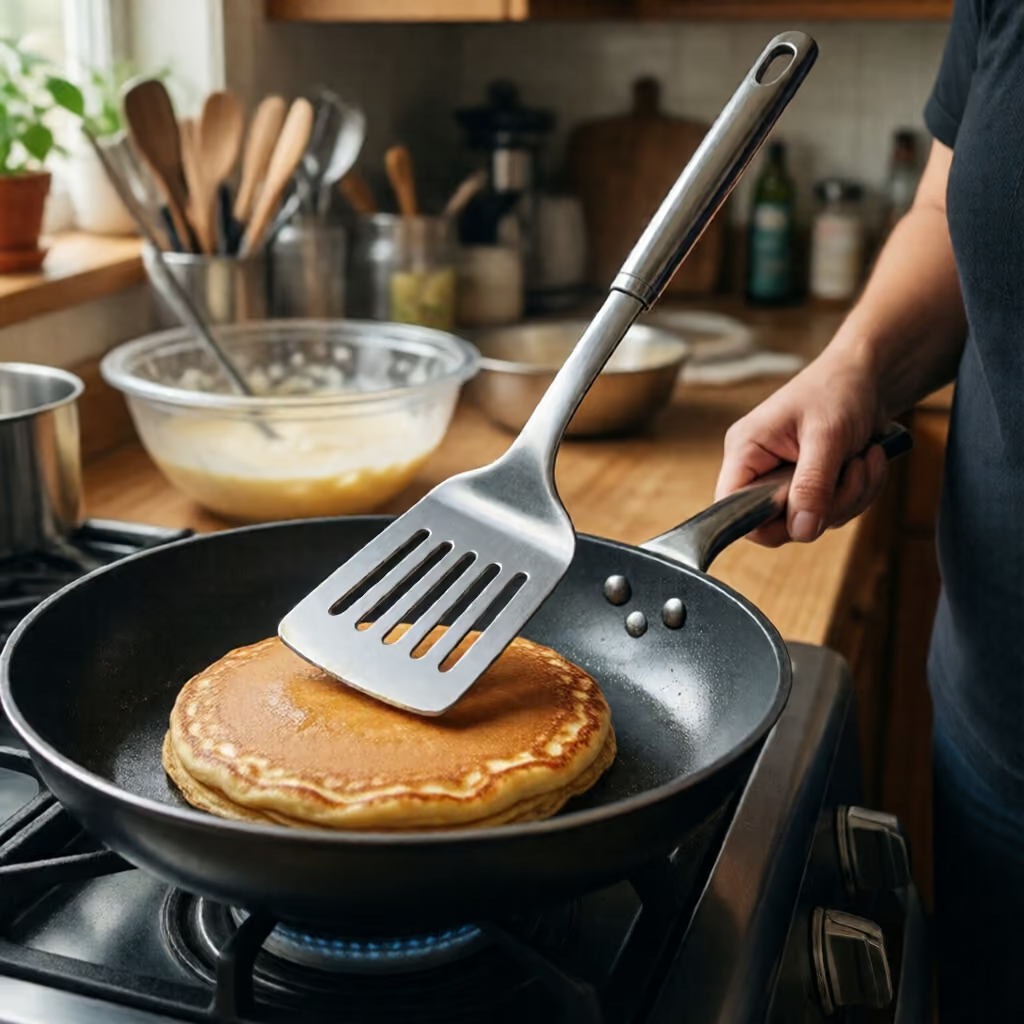
der Pfannenwender
spatula
A kitchen utensil with a handle and a wide, flat surface used to turn or lift food in a pan.
EXAMPLE
Sie drehte den Pfannkuchen vorsichtig mit dem Pfannenwender um.
She carefully flipped the pancake with the spatula.
spatula
der Pfannenwender, die Pfannenwender
Loading your saved state.
spatula
A kitchen utensil with a handle and a wide, flat surface used to turn or lift food in a pan.
Sie drehte den Pfannkuchen vorsichtig mit dem Pfannenwender um.
She carefully flipped the pancake with the spatula.
| gender | masculine der |
|---|---|
| plural | die Pfannenwender |
| genitive | des Pfannenwenders |
| singular | plural | |
|---|---|---|
| nominative | der Pfannenwender | die Pfannenwender |
| accusative | den Pfannenwender | die Pfannenwender |
| dative | dem Pfannenwender | den Pfannenwendern |
| genitive | des Pfannenwenders | der Pfannenwender |
The article changes with the case; it is shown in colour.
'Pfannenwender' is made up of 'Pfannen-' and 'Wender'. The first part is related to 'Pfanne' (pan), and the second to the verb 'wenden' (to turn): The structure shows where and what the utensil is used for.
Mit diesem Pfannenwender lassen sich auch große Pfannkuchen leicht wenden.
This spatula can also be used to turn large pancakes easily.
When you mention the 'Pfannenwender' as a tool in a sentence, 'mit' (with) plus the dative is often used. Typical phrases include 'mit dem Pfannenwender wenden' (to turn with a spatula), 'anheben' (to lift), or 'aus der Pfanne nehmen' (to take out of the pan).
Er nahm die Bratlinge mit dem Pfannenwender aus der Pfanne.
He took the fritters out of the pan with the spatula.
In recipes and product descriptions, phrases such as 'Pfannenwender aus Holz' (wooden spatula), 'aus Kunststoff' (made of plastic), or 'aus Edelstahl' (made of stainless steel) are common. Here, 'aus' (made of) indicates the material the utensil is made from.
Für ihre neue Pfanne kaufte sie einen Pfannenwender aus Holz.
She bought a wooden spatula for her new pan.