

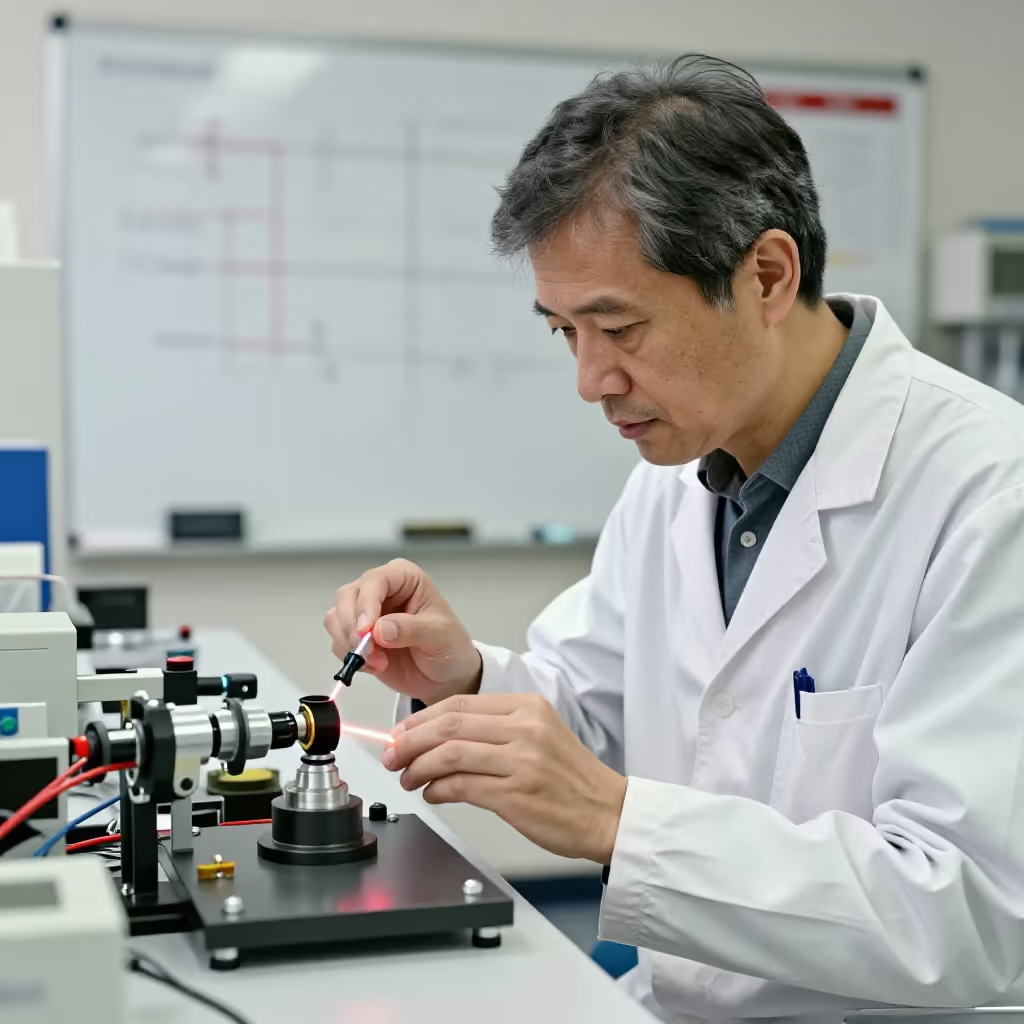
A male person who has studied physics and works professionally in this scientific field, whether in research, teaching, or application.
example
Albert Einstein war einer der bedeutendsten Physiker des 20. Jahrhunderts.
Albert Einstein was one of the most important physicists of the 20th century.
Usage tips
Word family
The word 'Physiker' (physicist) is derived from the field of study 'die Physik' (physics). The ending '-er' here refers to a male person who works professionally in that field.
EXAMPLE
Er studiert Physik, um später als Physiker zu arbeiten.
He is studying physics in order to work as a physicist later.
Grammar trap: N-declension
'Physiker' is a noun of the N-declension. This means it takes the ending '-n' in the accusative, dative, and genitive singular. In the plural, the form remains unchanged.
EXAMPLE
Die Journalistin interviewt einen berühmten Physiker.
The journalist is interviewing a famous physicist.
Typical adjectives
'Physiker' is often combined with adjectives that describe the field or level of fame, for example 'theoretischer Physiker' (theoretical physicist), 'Experimentalphysiker' (experimental physicist), or 'berühmter Physiker' (famous physicist).
EXAMPLE
Er arbeitet als theoretischer Physiker an der Universität.
He works as a theoretical physicist at the university.
Compare with
near_synonym · confusable
Physiker vs Wissenschaftler
scientist
'der Wissenschaftler' and 'der Physiker' can both mean a person who researches, teaches, or works academically as a profession. However, 'Wissenschaftler' is the general term. It only says that someone works in academia or science. 'Physiker' is more specific and names the field: physics. So a physicist is a Wissenschaftler, but not every Wissenschaftler is a physicist. Learners may confuse the words because both have to do with research and universities. If the exact field is unknown or unimportant, you use 'Wissenschaftler'. If the topic is physics, 'Physiker' is more precise.
Physiker
Ida stellt dem Physiker nach dem Vortrag eine Frage zum Licht.
After the lecture, Ida asks the physicist a question about light.
Wissenschaftler
Ein Wissenschaftler erklärt im Radio, warum sich das Klima verändert.
A scientist explains on the radio why the climate is changing.