

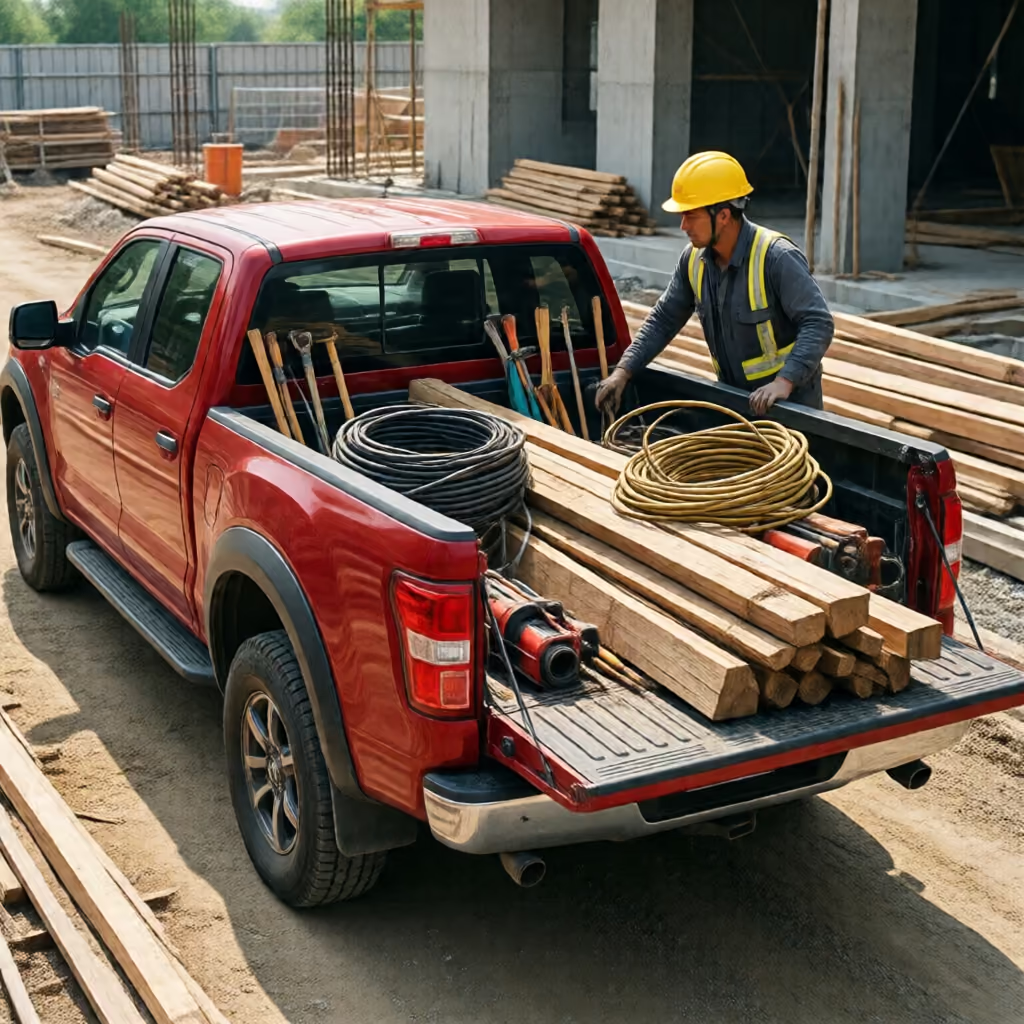
der Pick-up
pickup truck
A small truck or off-road vehicle with an open cargo bed behind the cab.
EXAMPLE
Der Pick-up transportierte die Werkzeuge zur Baustelle.
The pickup truck transported the tools to the construction site.
pickup truck
der Pick-up, die Pick-ups
Loading your saved state.
pickup truck
A small truck or off-road vehicle with an open cargo bed behind the cab.
Der Pick-up transportierte die Werkzeuge zur Baustelle.
The pickup truck transported the tools to the construction site.
| gender | masculine der |
|---|---|
| plural | die Pick-ups |
| genitive | des Pick-ups |
| singular | plural | |
|---|---|---|
| nominative | der Pick-up | die Pick-ups |
| accusative | den Pick-up | die Pick-ups |
| dative | dem Pick-up | den Pick-ups |
| genitive | des Pick-ups | der Pick-ups |
The article changes with the case; it is shown in colour.
Common collocations include „einen Pick-up fahren“ (to drive a pickup truck), „einen Pick-up mieten“ (to rent a pickup truck), and „einen Pick-up kaufen“ (to buy a pickup truck). With „fahren“, the pickup truck can directly stand as the object in the accusative.
Für die Fahrt über die schlechten Straßen haben wir einen Pick-up gemietet.
We rented a pickup truck for the journey over the bad roads.
A typical pattern for transport is „einen Pick-up mit etwas beladen“ (to load a pickup truck with something). „Der Pick-up“ is in the accusative; the load following „mit“ is in the dative.
Wir haben den Pick-up mit schweren Holzbalken beladen.
We loaded the pickup truck with heavy wooden beams.
The phrase „auf der Ladefläche des Pick-ups“ (in the pickup truck's cargo bed) is typical for describing where transported items are located. This specifies exactly where the load is.
Die Fahrräder liegen gut gesichert auf der Ladefläche des Pick-ups.
The bicycles are securely fastened in the pickup truck's cargo bed.