

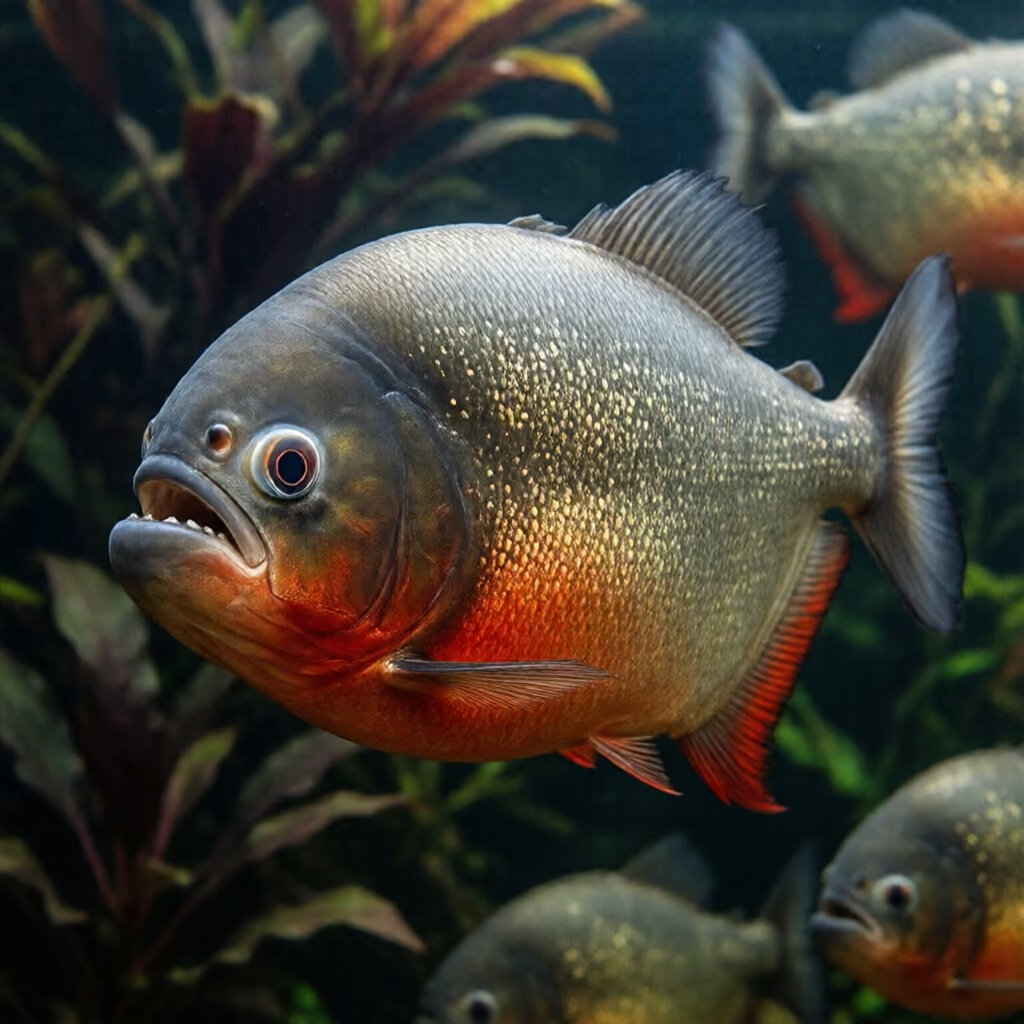
der Piranha
piranha
A predatory fish with sharp teeth that usually lives in South American freshwater.
EXAMPLE
Der Piranha kann mit seinen scharfen Zähnen tiefe Wunden verursachen.
The piranha can cause deep wounds with its sharp teeth.
piranha
der Piranha, die Piranhas
Loading your saved state.
piranha
A predatory fish with sharp teeth that usually lives in South American freshwater.
Der Piranha kann mit seinen scharfen Zähnen tiefe Wunden verursachen.
The piranha can cause deep wounds with its sharp teeth.
| gender | masculine der |
|---|---|
| plural | die Piranhas |
| genitive | des Piranha |
| singular | plural | |
|---|---|---|
| nominative | der Piranha | die Piranhas |
| accusative | den Piranha | die Piranhas |
| dative | dem Piranha | den Piranhas |
| genitive | des Piranha des Piranhas | der Piranhas |
The article changes with the case; it is shown in colour.
'Piranha' is often used in phrases such as 'ein Schwarm Piranhas' (a school of piranhas), 'von Piranhas gebissen werden' (to be bitten by piranhas), and 'ein Becken voller Piranhas' (a tank full of piranhas). These phrases are especially common in nonfiction texts and documentaries.
Ein Schwarm Piranhas bewegte sich durch das trübe Wasser.
A school of piranhas moved through the murky water.
When describing its habitat, 'der Piranha' (the piranha) is often used with 'in' (in) and a place expression. The focus is on bodies of water, rivers, or regions.
Der Piranha lebt in warmen Flüssen Südamerikas.
The piranha lives in the warm rivers of South America.
The word is especially common in zoological texts, animal documentaries, and reports about dangerous animals. In everyday life, it is usually used when talking specifically about this species of fish.
In der Dokumentation wurde erklärt, wie der Piranha seine Beute findet.
The documentary explained how the piranha finds its prey.