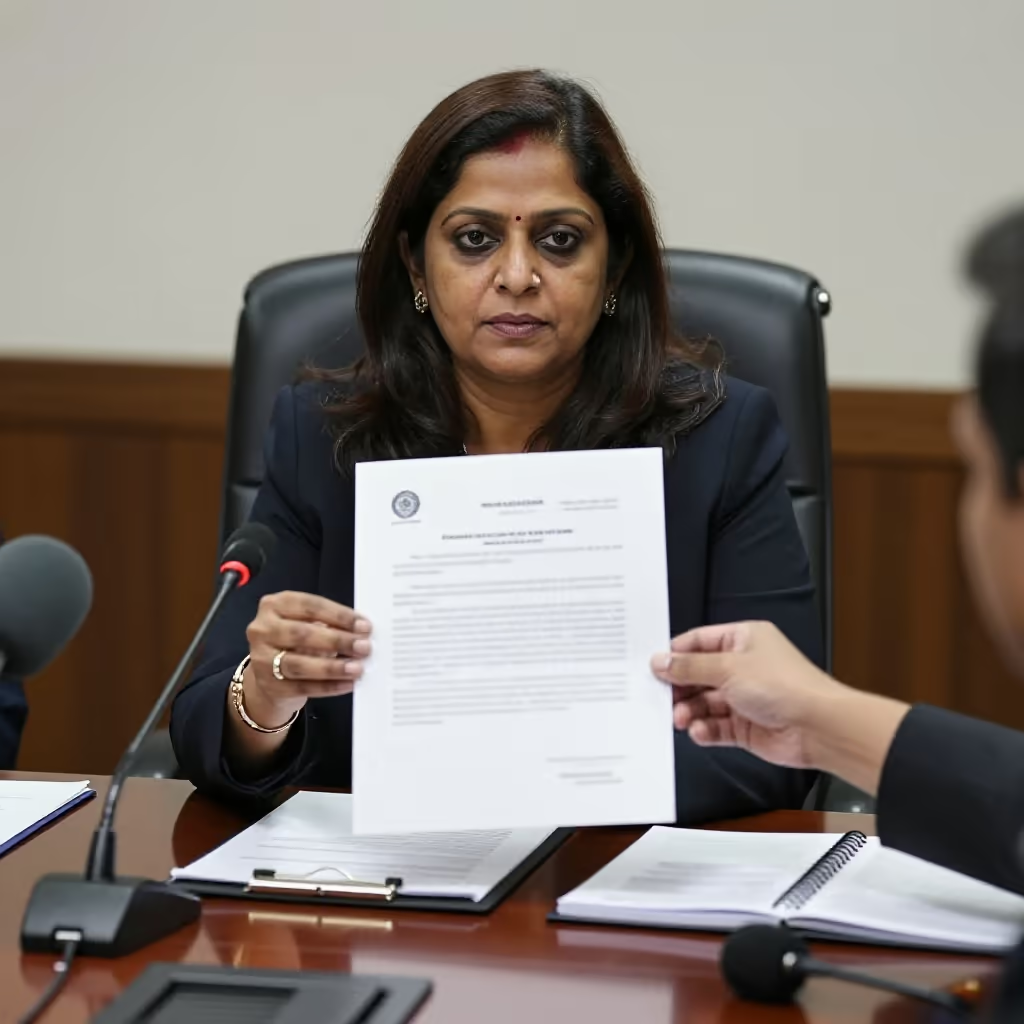
In a legal context, the summarizing closing statement by the prosecution or defense in a court case. The word is a noun (das Plädoyer).
example
In seinem Plädoyer forderte der Staatsanwalt die Höchststrafe für den Angeklagten.
In his closing argument, the prosecutor demanded the maximum sentence for the defendant.

Usage tips
Sentence structure with a preposition
A Plädoyer (plea/argument) is often made for or against something. For this, you use the prepositions 'für' (for) or 'gegen' (against), followed by the accusative.
EXAMPLE
Der Anwalt hielt ein emotionales Plädoyer für seinen Mandanten.
The lawyer made an emotional plea for his client.
Part of speech: noun
Even if it is listed differently in the input, 'Plädoyer' (plea/argument) is always a neuter noun in German: das Plädoyer. It is not used as an adjective.
EXAMPLE
Das Plädoyer der Staatsanwältin dauerte fast eine Stunde.
The prosecutor's closing argument lasted almost an hour.
Context clue
You can recognize the legal meaning from words like 'Gericht' (court), 'Anklage' (prosecution), or 'Verteidigung' (defense). The figurative meaning usually refers to social or personal topics such as 'Umweltschutz' (environmental protection), 'Gerechtigkeit' (justice), or 'Freiheit' (freedom).
EXAMPLE
Das Plädoyer der Verteidigung überzeugte das Gericht nicht.
The defense's closing argument did not convince the court.
Typical collocations
In a legal context, the phrase 'ein Plädoyer halten' (to make a closing argument) is often used. People also speak of the 'Plädoyer der Anklage' (the prosecution's closing argument) or the 'Plädoyer der Verteidigung' (the defense's closing argument).
EXAMPLE
Am Ende des Prozesses hielten beide Seiten ihre Plädoyers.
At the end of the trial, both sides made their closing arguments.
Typical adjectives
In the figurative meaning, 'Plädoyer' (plea/argument) is often combined with strong adjectives to emphasize passion, e.g. 'ein leidenschaftliches Plädoyer' (a passionate plea), 'ein eindringliches Plädoyer' (an urgent plea), or 'ein flammendes Plädoyer' (an impassioned plea).
EXAMPLE
Die Rede der Präsidentin war ein leidenschaftliches Plädoyer für den Frieden.
The president's speech was a passionate plea for peace.
Compare with
near_synonym · confusable
Plädoyer vs Verteidigung
defense
'die Verteidigung' and 'das Plädoyer' can both occur in court. There, 'die Verteidigung' means the lawyers or the side that represents the defendant. 'Das Plädoyer', on the other hand, is the summarizing speech at the end of a trial, which can also come from the defense. The words can be confused because both have to do with arguments in court. In practical terms: the defense acts or speaks; the 'Plädoyer' is the speech.
Plädoyer
Nach der Verhandlung hielt die Anwältin ein ruhiges Plädoyer.
After the hearing, the lawyer gave a calm closing argument.
Verteidigung
Die Verteidigung stellte dem Zeugen mehrere genaue Fragen.
The defense asked the witness several precise questions.