das Porzellan
porcelain
A fine, white, and hard ceramic material that can be translucent and is used to make tableware, art objects, or insulators.
Diese Vase ist aus echtem Meißner Porzellan.
This vase is made of genuine Meissen porcelain.
porcelain
Loading your saved state.
porcelain
A fine, white, and hard ceramic material that can be translucent and is used to make tableware, art objects, or insulators.
Diese Vase ist aus echtem Meißner Porzellan.
This vase is made of genuine Meissen porcelain.

'Porzellan' (porcelain) is almost always used as an uncountable noun, both for the material and for the tableware. As a rule, there is no plural form.
Vorsicht, die Tasse ist aus Porzellan und sehr zerbrechlich.
Careful, the cup is made of porcelain and is very fragile.
The idiom 'Porzellan zerschlagen' (to break porcelain) means to cause serious damage in a relationship or situation through clumsy behavior. The meaning is purely metaphorical.
Mit seiner Kritik hat er bei den Geschäftspartnern viel Porzellan zerschlagen.
With his criticism, he broke a lot of porcelain with the business partners.
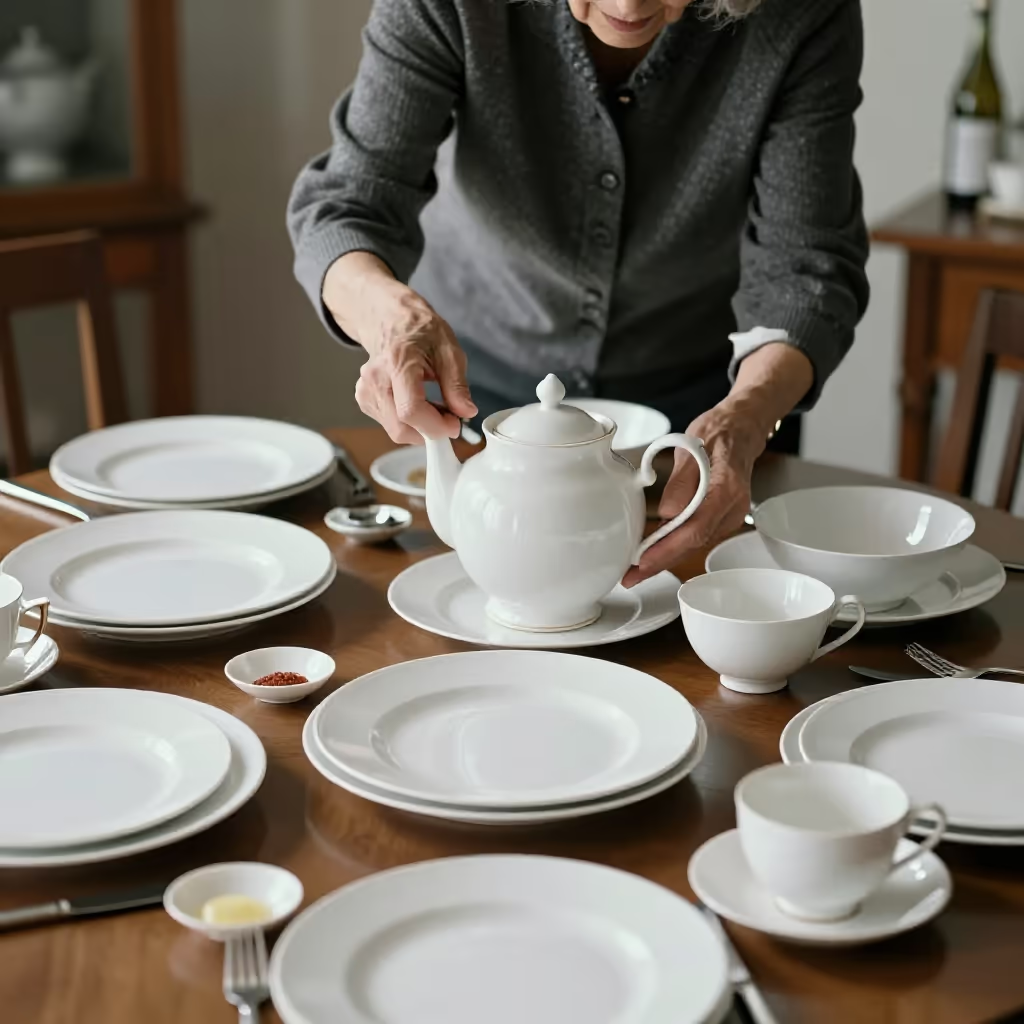
The phrase 'das gute Porzellan' (the good porcelain) refers to a special, high-quality set of tableware that is used only on festive occasions, such as holidays, or for important guests.
An Weihnachten essen wir immer vom guten Porzellan.
At Christmas, we always eat from the good porcelain.
When 'Porzellan' (porcelain) is used with the preposition 'aus' (made of/from), it usually refers to the material. When it refers to the tableware, it often appears as an object or with an adjective like 'gut' (good) or 'alt' (old).
Diese Figur ist aus wertvollem Porzellan gefertigt.
This figure is made of valuable porcelain.
ceramics
'die Keramik' and 'das Porzellan' both refer to materials from which things like dishes, vases, or decorative objects can be made. 'Keramik' is the broader term and can mean many fired materials made from clay or similar substances. 'Porzellan' is a special, fine type of ceramic, usually white, and often used for good tableware. The words can be confused because porcelain belongs to the ceramic materials. If you do not know exactly what something is made of, 'Keramik' is often more general. When you are talking about fine tableware or the exact material, 'Porzellan' is more precise.

Das alte Porzellan steht nur an Feiertagen auf dem Tisch.
The old porcelain is only put on the table on holidays.
Auf dem Markt kauft Lisa eine handgemachte Schale aus Keramik.
At the market, Lisa buys a handmade ceramic piece.