

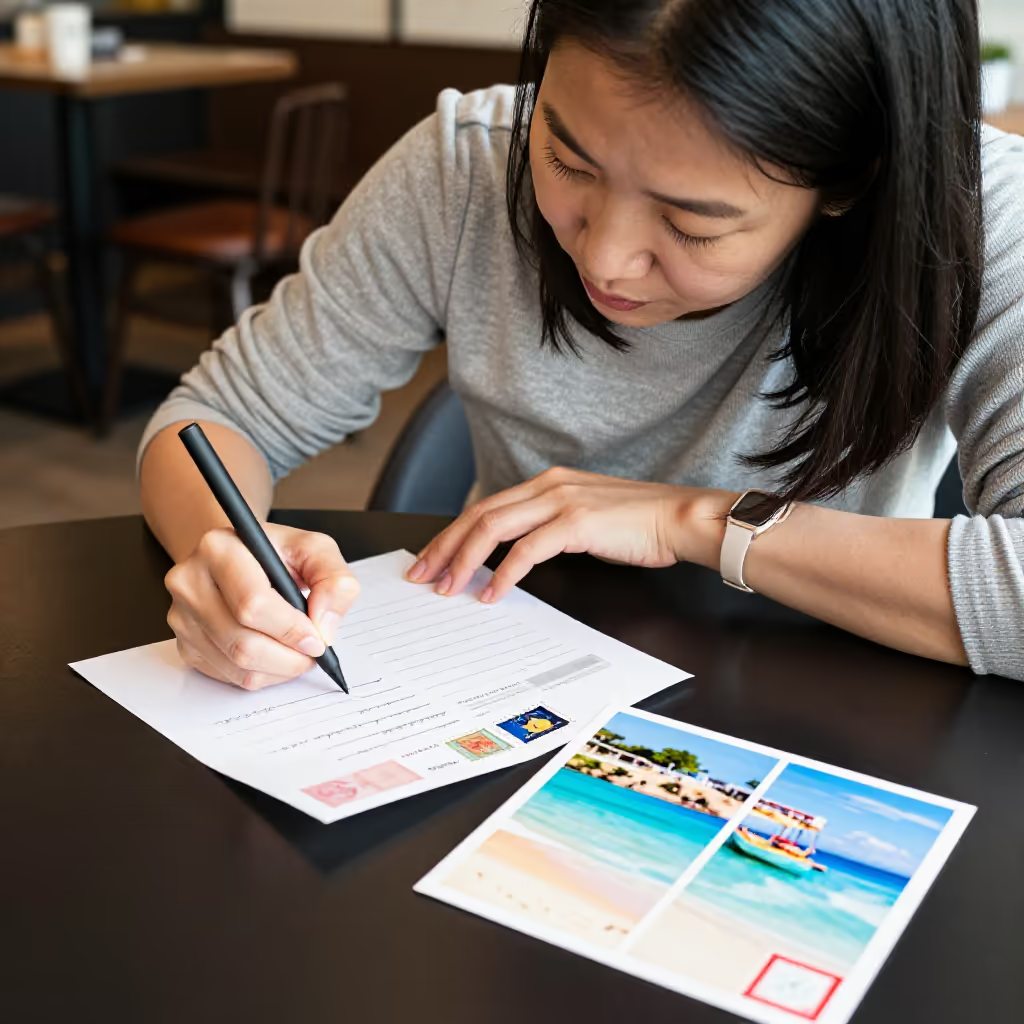
die Postkarte
postcard
A card made of cardboard, usually with a picture on the front, that is sent by mail without an envelope to convey a short message.
Ich habe dir aus dem Urlaub eine Postkarte geschrieben.
I wrote you a postcard from vacation.
postcard
die Postkarte, die Postkarten
Loading your saved state.

postcard
A card made of cardboard, usually with a picture on the front, that is sent by mail without an envelope to convey a short message.
Ich habe dir aus dem Urlaub eine Postkarte geschrieben.
I wrote you a postcard from vacation.
| gender | feminine die |
|---|---|
| plural | die Postkarten |
| genitive | der Postkarte |
| singular | plural | |
|---|---|---|
| nominative | die Postkarte | die Postkarten |
| accusative | die Postkarte | die Postkarten |
| dative | der Postkarte | den Postkarten |
| genitive | der Postkarte | der Postkarten |
The article changes with the case; it is shown in colour.
The word is easy to understand if you break it down into its parts: 'die Post' (the mail/post office) and 'die Karte' (the card). So it is literally a card that you send by mail.
Früher hat man viel öfter Postkarten verschickt als heute.
In the past, people sent postcards much more often than they do today.
The most common verbs in connection with 'Postkarte' (postcard) are 'schreiben' (to write), 'schicken' (to send), 'bekommen' (to get), and 'erhalten' (to receive). The context 'aus dem Urlaub' (from vacation) is also often mentioned.
Hast du die Postkarte bekommen, die ich dir aus Spanien geschickt habe?
Did you get the postcard that I sent you from Spain?
A typical sentence follows this pattern: subject + verb + dative object (recipient) + accusative object ('die Postkarte'). You send 'jemandem' (to someone, dative) 'eine Postkarte' (a postcard, accusative).
Meine Oma schickt mir jedes Jahr zum Geburtstag eine Postkarte.
My grandma sends me a postcard every year for my birthday.