
A strong impulse, stimulus, or support that moves something forward. Often used in the context of motivation, marketing, or technology.
example
Die neue Werbekampagne soll dem Verkauf einen kräftigen Push geben.
The new advertising campaign is meant to give sales a strong push.
Usage tips
Modern Anglicism
'Push' is a loanword from English. It is used especially in modern colloquial language and in the fields of marketing, business, and technology.
EXAMPLE
Manchmal braucht man einen kleinen Push, um mit einem Projekt anzufangen.
Sometimes you need a little push to start a project.
Context clue
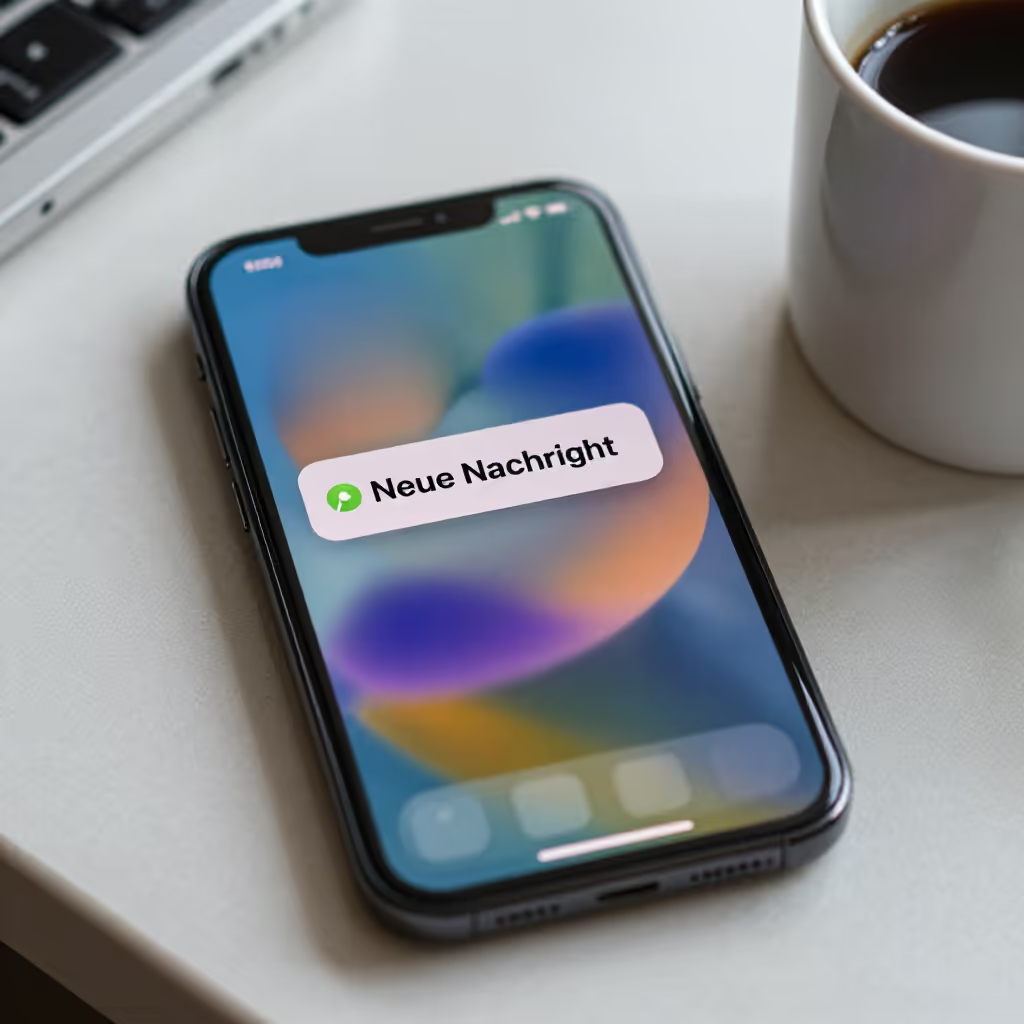
You can recognize the meaning from the context. If it is about motivation, career, or sales, it means an impulse or boost. If it is about a smartphone or an app, it means a notification.
EXAMPLE
Der neue Trainer gab dem Team den nötigen Push.
The new coach gave the team the push it needed.
Typical collocations (impulse)
In the meaning 'Impuls' (impulse/boost), 'Push' is often used with the verb 'geben' (to give). The phrase 'jemandem/etwas einen Push geben' means to support or drive someone or something forward.
EXAMPLE
Die positive Kritik hat seiner Karriere einen echten Push gegeben.
The positive review gave his career a real push.
Short form
In a technical context, 'Push' is a short form of 'Push-Benachrichtigung' (push notification) or 'Push-Nachricht' (push message). In spoken language, almost only the short form is used.
EXAMPLE
Stell bitte die Pushes für diese App aus, sie sind nervig.
Please turn off the push notifications for this app; they're annoying.
Typical collocations (message)
When a notification is meant, typical verbs are 'bekommen' (to get), 'erhalten' (to receive), 'senden' (to send), or 'schicken' (to send). You can also 'aktivieren' (activate) or 'deaktivieren' (deactivate) push notifications.
EXAMPLE
Die Bank schickt bei jeder Transaktion einen Push.
The bank sends a push notification for every transaction.
Compare with
near_synonym · confusable
Push vs Nachricht
message / news
'die Nachricht' and 'der Push' can both mean a piece of information that someone receives on a device. 'Nachricht' is the general word: it can come by phone, email, letter, or even orally. 'Push' is much more specific and usually means a push notification from an app that appears automatically on the screen. Learners may confuse the words because a 'Push' often contains a 'Nachricht'. In practical terms: the content is a 'Nachricht' (message), while the type of delivery can be a 'Push' (push notification).
Push
Nach dem Unterricht bekommt sie einen Push von der Reise-App.
After class, she gets a push notification from the travel app.
Nachricht
In der Pause liest die Lehrerin eine Nachricht von den Eltern.
During the break, the teacher reads a message from the parents.