


rauskommen
to come out
To leave an enclosed place, such as a house, room, or vehicle, and go outside.
EXAMPLE
Kommst du später noch raus auf ein Eis?
Are you coming out later for ice cream?
to come out
Loading your saved state.
to come out
To leave an enclosed place, such as a house, room, or vehicle, and go outside.
Kommst du später noch raus auf ein Eis?
Are you coming out later for ice cream?

to come out
To be released or published; to be made available to the public.
Nächsten Monat kommt der neue Film von meinem Lieblingsregisseur raus.
The new film by my favorite director comes out next month.

to turn out
To result from a calculation, consideration, or investigation.
Bei der Umfrage ist rausgekommen, dass die meisten Leute mit dem Service zufrieden sind.
The survey turned out to show that most people are satisfied with the service.

to come out
To become known or revealed; to come to light, often with secrets or hidden information.
Am Ende ist immer rausgekommen, wer den Kuchen heimlich gegessen hat.
In the end, it always came out who had secretly eaten the cake.

to get out
To free oneself from or avoid an obligation or an unpleasant situation.
Aus diesem Vertrag kommt man nicht so einfach wieder raus.
You can't get out of this contract again that easily.
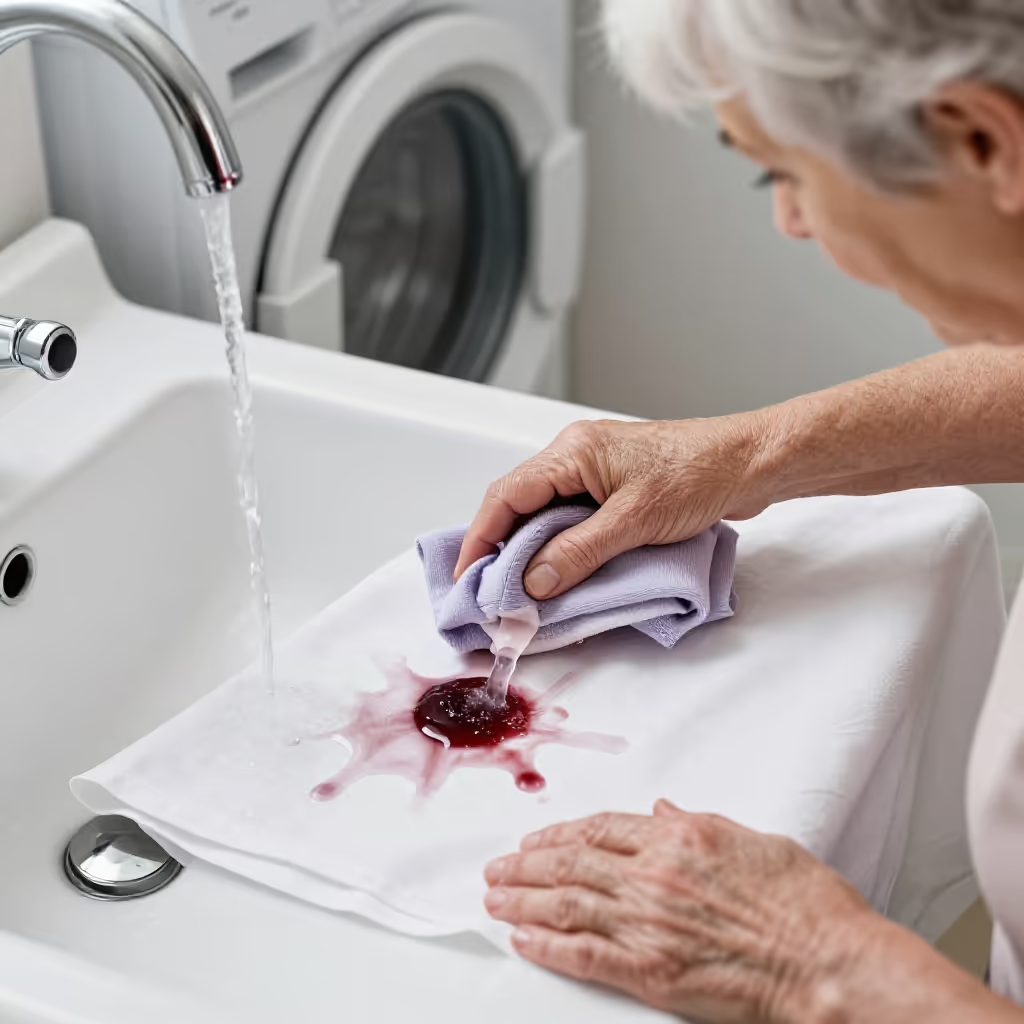
to come out
To be removable from a material or fabric, especially when talking about stains.
Ich hoffe, der Rotweinfleck kommt beim Waschen wieder aus dem Hemd raus.
I hope the red wine stain comes out of the shirt in the wash.
'Rauskommen' is a separable verb. The prefix 'raus' goes at the end of a main clause, the verb stays together in subordinate clauses, and in the infinitive with 'zu', 'zu' comes between 'raus' and 'kommen'.
Heute Abend komme ich nicht mehr raus.
I'm not going out anymore tonight.
The word consists of 'raus' and 'kommen' (to come). 'Raus' is the colloquial short form of 'heraus' and means a movement from inside to outside.
Kommst du bitte aus dem Zimmer raus?
Could you please come out of the room?
Because 'rauskommen' describes movement or a change of state, the perfect tense is always formed with the auxiliary verb 'sein' (to be).
Gestern Abend sind wir noch spontan rausgekommen.
Yesterday evening we spontaneously went out after all.
'Rauskommen' is mainly used in spoken language and informal contexts. The form 'herauskommen' is more formal and typical of written language.
Lass uns am Wochenende mal wieder rauskommen und etwas unternehmen.
Let's get out again this weekend and do something.
When something is being released, the subject is often a form of media. Typical combinations are: 'ein Film kommt raus' (a film comes out), 'ein neues Album kommt raus' (a new album comes out), or 'ein Buch kommt raus' (a book comes out).
Nächste Woche kommt das neue Videospiel endlich raus.
The new video game finally comes out next week.
When 'rauskommen' describes a result, it is often introduced with 'dabei' (in the process/through that) or 'am Ende' (in the end). The result itself often follows in a 'dass' (that) clause.
Bei der Diskussion kam raus, dass wir alle einer Meinung sind.
The discussion turned out to show that we all agree.
In this meaning, the subject of the sentence is the stain. The construction often uses the preposition 'aus' with the dative to name the material.
Der Kaffeefleck ist leider nicht mehr aus dem T-Shirt rausgekommen.
Unfortunately, the coffee stain didn't come out of the T-shirt anymore.
to appear
Both words can say that a book or film becomes publicly available for the first time. Erscheinen is the neutral and usual term, while rauskommen sounds more colloquial. „Erscheinen“ is generally used in factual texts; in casual conversation, „rauskommen“ is also natural.

Der neue Film kommt am Freitag auf DVD raus.
The new film is coming out on DVD on Friday.
Der neue Film erscheint am Freitag auf DVD.
The new film will be released on DVD on Friday.