

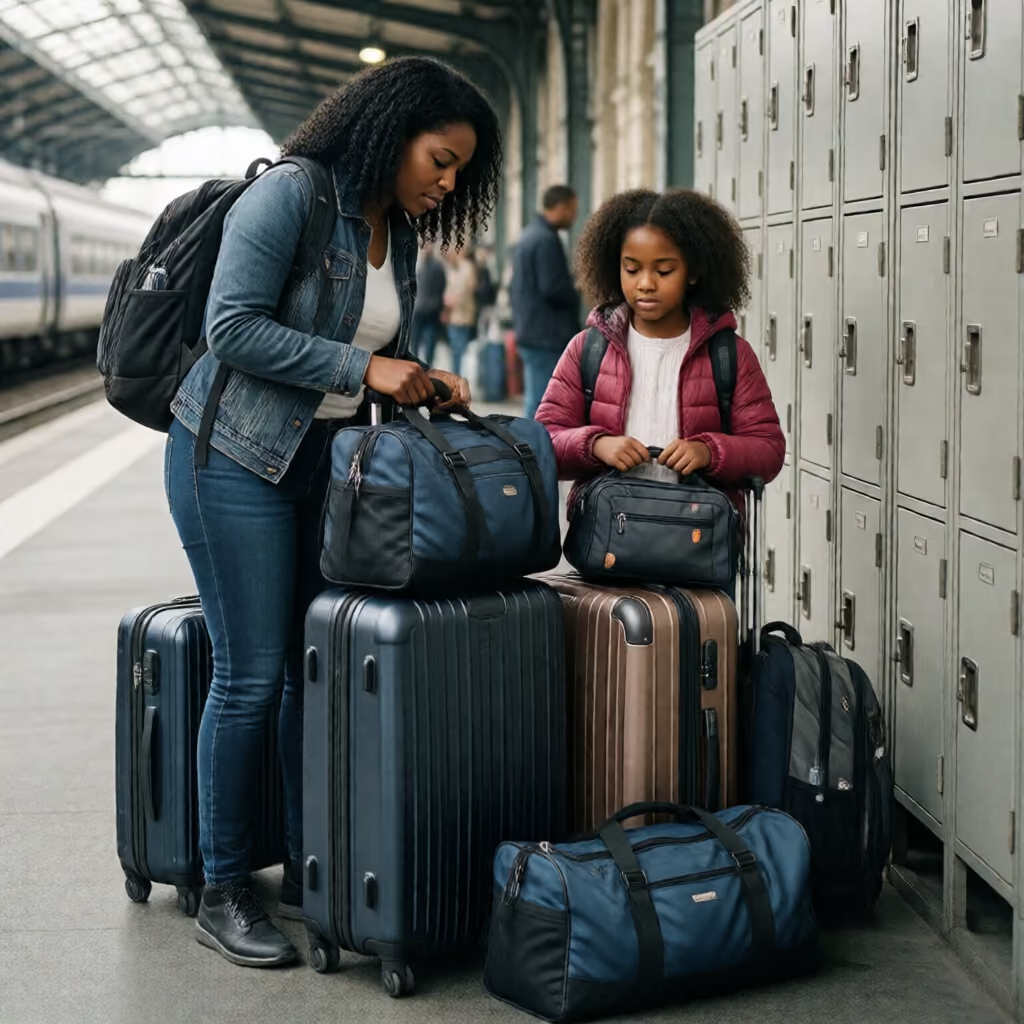
das Reisegepäck
luggage
All the suitcases, bags, and other items that someone takes on a trip.
EXAMPLE
Wir haben unser Reisegepäck am Bahnhof in einem Schließfach verstaut.
We stored our luggage in a locker at the train station.
luggage
das Reisegepäck
Loading your saved state.
luggage
All the suitcases, bags, and other items that someone takes on a trip.
Wir haben unser Reisegepäck am Bahnhof in einem Schließfach verstaut.
We stored our luggage in a locker at the train station.
| gender | neuter das |
|---|---|
| genitive | des Reisegepäckes |
| singular | plural | |
|---|---|---|
| nominative | das Reisegepäck | – |
| accusative | das Reisegepäck | – |
| dative | dem Reisegepäck | – |
| genitive | des Reisegepäckes des Reisegepäcks | – |
The article changes with the case; it is shown in colour.
'Reisegepäck' (luggage) is made up of 'Reise' (trip) and 'Gepäck' (luggage). It therefore refers to the luggage taken on a trip.
Für die lange Reise musste sie ihr Reisegepäck sorgfältig vorbereiten.
She had to prepare her luggage carefully for the long trip.
Common collocations with 'Reisegepäck' (luggage) are 'Reisegepäck packen' (to pack luggage), 'Reisegepäck verstauen' (to stow luggage), and 'Reisegepäck aufgeben' (to check in luggage). These expressions are especially useful for travel by train or plane.
Am Flughafen mussten wir unser Reisegepäck am Schalter aufgeben.
At the airport, we had to check in our luggage at the counter.
'Reisegepäck' (luggage) refers to the entire collection of items and is therefore treated as singular in a sentence. The verb remains singular even when several suitcases and bags are meant.
Das Reisegepäck steht schon im Flur bereit.
The luggage is already in the hallway, ready to go.