

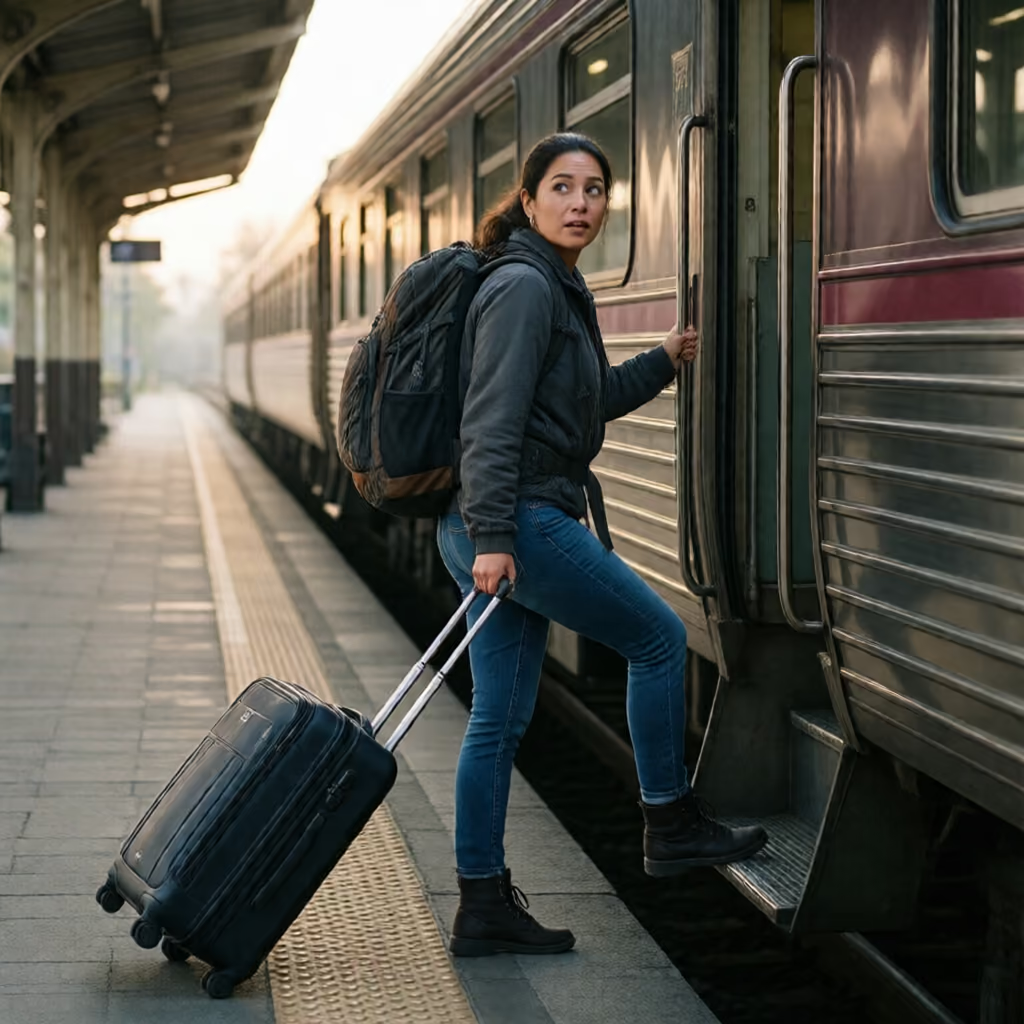
der Reisende
traveler
A person who is on the move or taking a trip.
EXAMPLE
Der Reisende stieg am nächsten Bahnhof aus.
The traveler got off at the next station.
traveler / traveling salesperson
die Reisende, die Reisenden
Loading your saved state.
traveler
A person who is on the move or taking a trip.
Der Reisende stieg am nächsten Bahnhof aus.
The traveler got off at the next station.

traveling salesperson
A sales representative who visits different customers on behalf of a company and offers them goods or services.
Der Reisende stellte dem Geschäftsinhaber die neue Kollektion vor.
The traveling salesperson presented the new collection to the shop owner.
| gender | feminine die |
|---|---|
| plural | die Reisenden |
| genitive | der Reisenden |
| singular | plural | |
|---|---|---|
| nominative | die Reisende | die Reisenden |
| accusative | die Reisende | die Reisenden |
| dative | der Reisenden | den Reisenden |
| genitive | der Reisenden | der Reisenden |
The article changes with the case; it is shown in colour.
'Reisende' (traveler / traveling salesperson) is a nominalized participle of 'reisen' (to travel). The form describes a person through their activity: they are currently on a trip or travel to visit customers for work.
Die Reisende suchte auf dem Stadtplan den Weg zum Hotel.
The traveler looked at the city map to find the way to the hotel.
In travel contexts, words such as 'Bahnhof' (train station), 'Zug' (train), 'Hotel' (hotel), or 'Gepäck' (luggage) usually indicate the general meaning. When the context involves customers, goods, sales visits, or a company, the business meaning is intended.
Am Bahnhof warteten viele Reisende auf den verspäteten Zug.
Many travelers were waiting at the station for the delayed train.
Der Reisende besuchte im Auftrag der Firma mehrere Geschäfte.
The traveling salesperson visited several shops on behalf of the company.
In the sense of a person on a trip, 'Reisende' (traveler) often occurs with verbs related to travel and finding one's way, such as 'ankommen' (to arrive), 'aussteigen' (to get off), 'warten' (to wait), or 'sich verirren' (to get lost).
Die Reisenden kamen erst spät in der Nacht in Hamburg an.
The travelers did not arrive in Hamburg until late at night.
Ein Reisender hatte sich im großen Flughafengebäude verirrt.
A traveler had gotten lost in the large airport terminal.
The second meaning is mainly used in professional sales and business contexts. Typical collocations are 'Kunden besuchen' (to visit customers), 'Waren anbieten' (to offer goods), and 'im Auftrag einer Firma unterwegs sein' (to travel on behalf of a company).
Der Reisende bot den Kunden die neuen Büroartikel an.
The traveling salesperson offered the customers the new office supplies.