

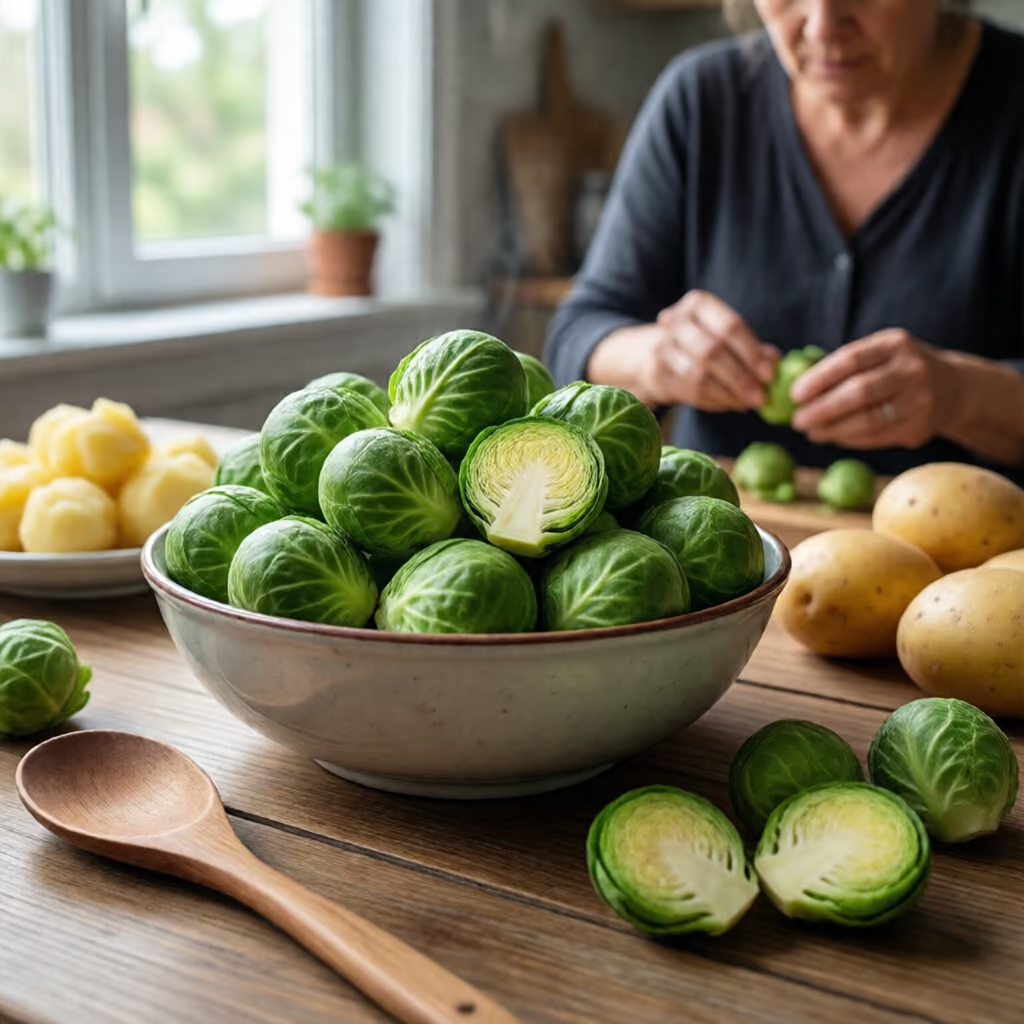
der Rosenkohl
Brussels sprouts
A vegetable from the cabbage family with small, firm green heads that are eaten as a vegetable.
EXAMPLE
Im Winter esse ich gern Rosenkohl mit Kartoffeln.
In winter, I like eating Brussels sprouts with potatoes.
Brussels sprouts
der Rosenkohl
Loading your saved state.
Brussels sprouts
A vegetable from the cabbage family with small, firm green heads that are eaten as a vegetable.
Im Winter esse ich gern Rosenkohl mit Kartoffeln.
In winter, I like eating Brussels sprouts with potatoes.
| gender | masculine der |
|---|---|
| genitive | des Rosenkohls |
| singular | plural | |
|---|---|---|
| nominative | der Rosenkohl | – |
| accusative | den Rosenkohl | – |
| dative | dem Rosenkohl | – |
| genitive | des Rosenkohls des Rosenkohles | – |
The article changes with the case; it is shown in colour.
'Rosenkohl' is made up of 'Rosen' (roses) and 'Kohl' (cabbage). 'Rosen' refers to the small, densely arranged cabbage heads, which can resemble roses.
Auf dem Markt habe ich frischen Rosenkohl gekauft.
I bought fresh Brussels sprouts at the market.
'Rosenkohl' (Brussels sprouts) is often used with verbs such as 'kochen' (to boil), 'dünsten' (to steam), 'braten' (to fry / roast), and 'zubereiten' (to prepare). Combinations with 'Beilage' (side dish) and 'Suppe' (soup) are also common.
Für das Abendessen möchte ich Rosenkohl dünsten.
I would like to steam Brussels sprouts for dinner.
'Rosenkohl' (Brussels sprouts) is often used in recipes as a side dish or as an ingredient in a hot meal. It is frequently served with potatoes, meat, or a sauce.
Der Rosenkohl passt gut als Beilage zu gebratenem Fleisch.
Brussels sprouts go well as a side dish with roast meat.