

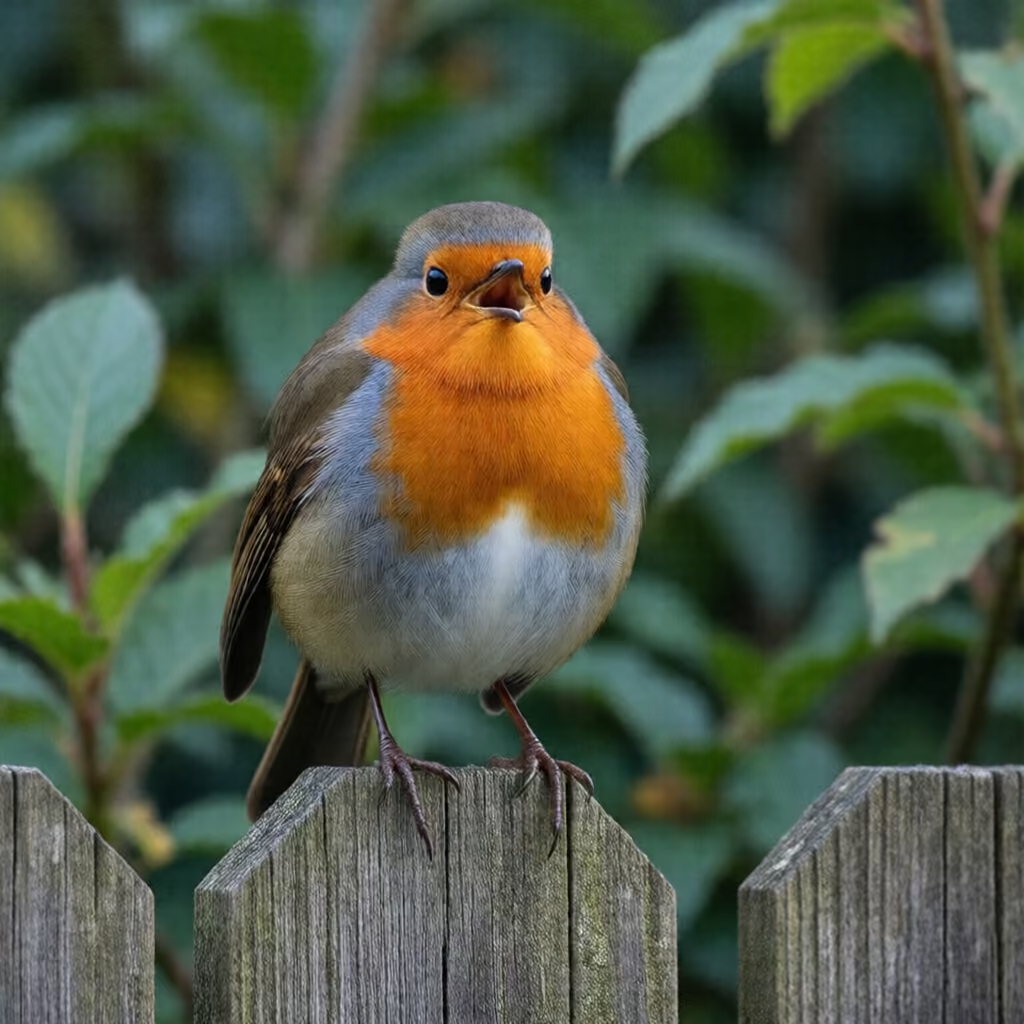
das Rotkehlchen
robin
A small songbird with an orange-red breast, a gray-brown back, and a rounded shape.
EXAMPLE
Ein Rotkehlchen saß auf dem Zaun und sang.
A robin was sitting on the fence and singing.
robin
das Rotkehlchen, die Rotkehlchen
Loading your saved state.
robin
A small songbird with an orange-red breast, a gray-brown back, and a rounded shape.
Ein Rotkehlchen saß auf dem Zaun und sang.
A robin was sitting on the fence and singing.
| gender | neuter das |
|---|---|
| plural | die Rotkehlchen |
| genitive | des Rotkehlchens |
| singular | plural | |
|---|---|---|
| nominative | das Rotkehlchen | die Rotkehlchen |
| accusative | das Rotkehlchen | die Rotkehlchen |
| dative | dem Rotkehlchen | den Rotkehlchen |
| genitive | des Rotkehlchens | der Rotkehlchen |
The article changes with the case; it is shown in colour.
The name contains „rot“ (red) and „Kehl-“ from „Kehle“ (throat): the color on its throat will help you remember the bird's name. The ending „-chen“ indicates its small size.
Auf dem Foto erkennt man das Rotkehlchen an seiner auffälligen Kehle und Brust.
In the photo, you can recognize the robin by its distinctive throat and breast.
The phrases „ein Rotkehlchen singt“ (a robin is singing) and „der Gesang eines Rotkehlchens“ (the song of a robin) are typical when describing the bird's voice. You can use „ein Rotkehlchen singen hören“ (to hear a robin singing) to describe hearing the bird even when you cannot see it.
Beim Frühstück hörten wir ein Rotkehlchen singen.
During breakfast, we heard a robin singing.
When people talk about encounters with the bird, phrases such as „ein Rotkehlchen beobachten“ (to observe a robin) or „ein Rotkehlchen fotografieren“ (to photograph a robin) are useful. The bird is the accusative object in these phrases.
Die Kinder beobachteten ein Rotkehlchen, das unter der Hecke nach Futter suchte.
The children watched a robin searching for food under the hedge.