

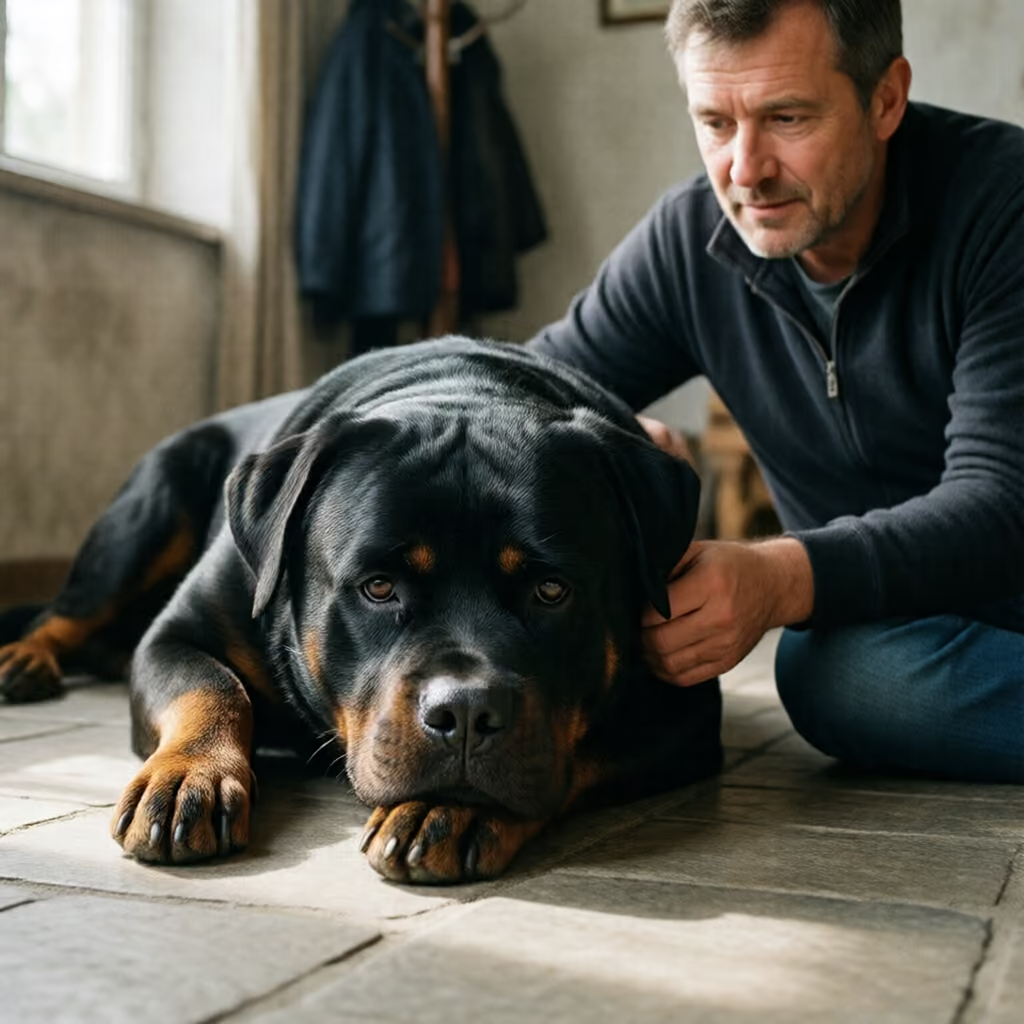
der Rottweiler
Rottweiler
A strong, usually black and brown dog of a German breed that was originally used to drive and guard livestock.
EXAMPLE
Der Rottweiler liegt ruhig neben seinem Besitzer.
The Rottweiler is lying quietly beside its owner.
Rottweiler
der Rottweiler, die Rottweiler
Loading your saved state.
Rottweiler
A strong, usually black and brown dog of a German breed that was originally used to drive and guard livestock.
Der Rottweiler liegt ruhig neben seinem Besitzer.
The Rottweiler is lying quietly beside its owner.
| gender | masculine der |
|---|---|
| plural | die Rottweiler |
| genitive | des Rottweilers |
| singular | plural | |
|---|---|---|
| nominative | der Rottweiler | die Rottweiler |
| accusative | den Rottweiler | die Rottweiler |
| dative | dem Rottweiler | den Rottweilern |
| genitive | des Rottweilers | der Rottweiler |
The article changes with the case; it is shown in colour.
'Rottweiler' is derived from the place name 'Rottweil' and the ending '-er'. The name therefore refers to the breed's origins in the region around Rottweil.
Die Rottweiler wurden früher häufig als Arbeitshunde eingesetzt.
Rottweilers were often used as working dogs in the past.
'Rottweiler' is often used with verbs related to dog ownership: you can keep, walk, train, or adopt a Rottweiler.
Die Familie hat einen Rottweiler aus dem Tierheim adoptiert.
The family adopted a Rottweiler from an animal shelter.
In texts about training and ownership, 'Rottweiler' is often combined with characteristics or training goals, such as 'well trained', 'calm', or 'obedient'. These expressions describe the individual dog and do not automatically apply to the entire breed.
Der gut erzogene Rottweiler wartet geduldig vor der Tür.
The well-trained Rottweiler waits patiently by the door.