

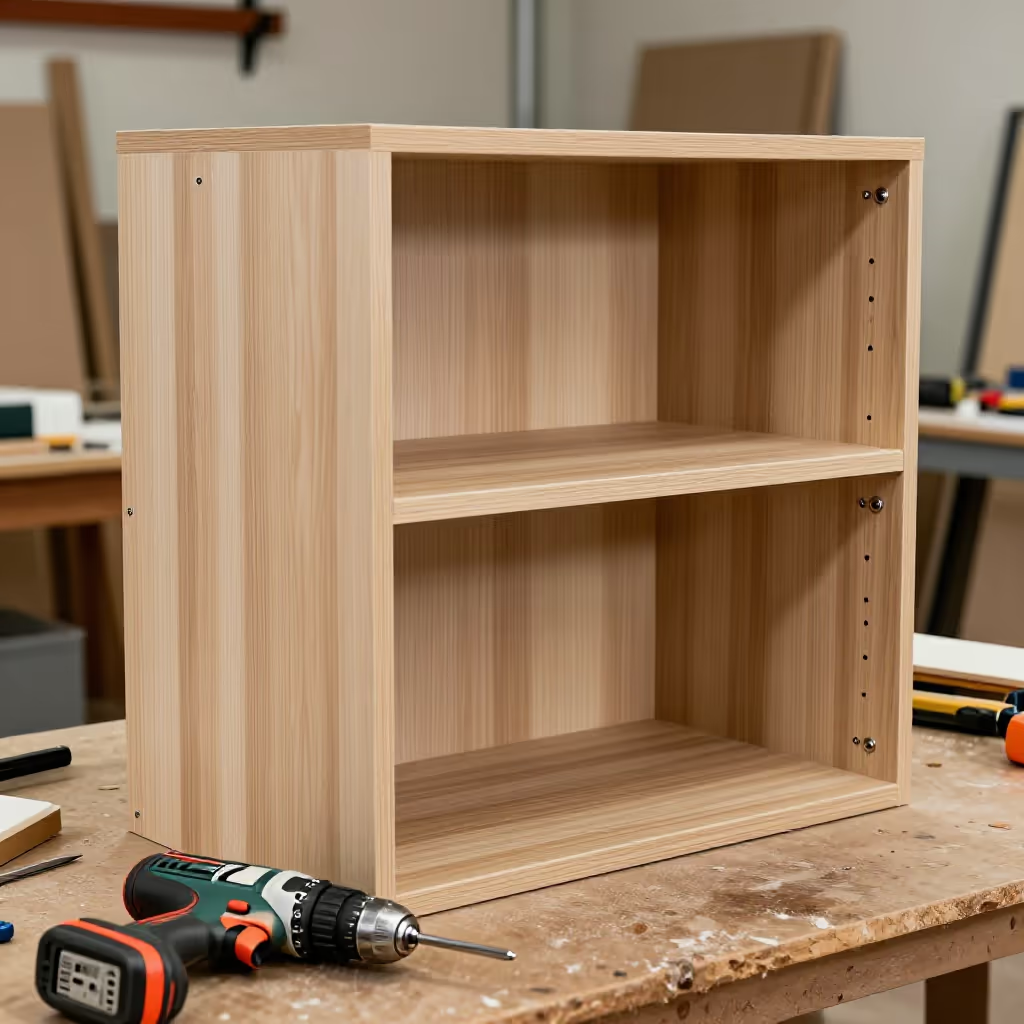
The rear wall of a room, container, or piece of furniture such as a wardrobe or shelf.
example
Die Rückwand des Kleiderschranks war nur aus dünnem Pressspan gefertigt.
The back panel of the wardrobe was made only of thin particleboard.

Usage tips
Word composition
The word is made up of 'rück-' (a short form of 'zurück' (back)) and 'Wand' (wall). So it literally refers to the wall that is located at the back.
EXAMPLE
Die Rückwand des Bücherregals ist aus stabilem Holz.
The back panel of the bookshelf is made of sturdy wood.
Typical contexts
The term 'Rückwand' (back panel / rear wall) is very often used for pieces of furniture such as cabinets and shelves. But people also speak of the rear wall of a room, a stage, or an aquarium.
EXAMPLE
Wir müssen die Rückwand des Schranks noch festschrauben.
We still need to screw the back panel of the cabinet in place.
Use with prepositions
To describe a position, you use the preposition 'an' with the dative. To describe movement toward that place, you use 'an' with the accusative.
EXAMPLE
Das Bild hängt an der Rückwand des Zimmers.
The picture is hanging on the rear wall of the room.
Compare with
confusable
Rückwand vs Rückseite
back / reverse side
'Rückseite' and 'Rückwand' sound similar, but they do not mean the same thing. The 'Rückseite' is generally the back side of an object, for example on a sheet of paper, a photo, or a card. The 'Rückwand' is an actual wall or panel at the back of something, for example in a cupboard, shelf, room, or container. The words can be confused because both describe something at the back. If it is only about a side or surface, 'Rückseite' fits. If it is about a fixed wall or panel at the back of a piece of furniture or a room, 'Rückwand' fits.
Rückwand
Im Schrank ist die Rückwand locker und muss repariert werden.
The back panel in the cupboard is loose and needs to be repaired.