

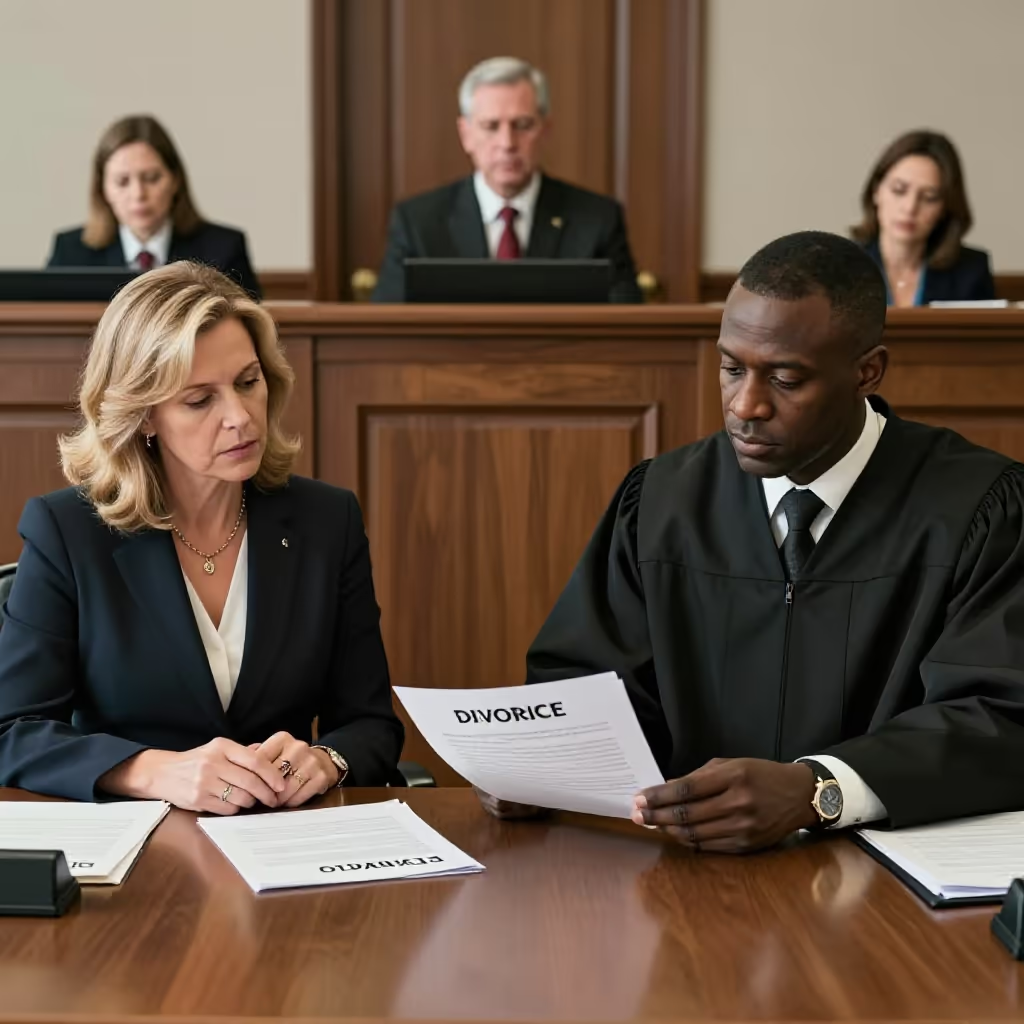
sich scheiden lassen
to get divorced
To officially end a marriage in court.
EXAMPLE
Nach vielen Jahren haben sie beschlossen, sich scheiden zu lassen.
After many years, they decided to get divorced.
to divorce / separate
Loading your saved state.
to get divorced
To officially end a marriage in court.
Nach vielen Jahren haben sie beschlossen, sich scheiden zu lassen.
After many years, they decided to get divorced.

to separate
To separate two or more things, substances, or groups from one another. Often used in a technical or formal context.
Im Chemieunterricht haben wir gelernt, Wasser und Öl zu scheiden.
In chemistry class, we learned how to separate water and oil.

to divide opinions
Used in the expression 'hier scheiden sich die Geister' to say that there are strongly differing opinions on a topic.
Ob Ananas auf Pizza gehört oder nicht – bei dieser Frage scheiden sich die Geister.
Whether pineapple belongs on pizza or not—on this question, opinions are divided.

to depart
To leave a place or a person; to go away. This meaning is archaic or poetic.
Schweren Herzens schied er aus dem Amt.
With a heavy heart, he departed from office.
The verb 'scheiden' carries the basic meaning of 'trennen' (to separate). You can also find this idea in related words such as 'entscheiden' (to decide; literally, to separate one choice from another), 'unterscheiden' (to distinguish), or 'der Abschied' (farewell; the separation from someone).
Es ist schwer, zwischen den beiden fast identischen Produkten zu unterscheiden.
It is difficult to distinguish between the two almost identical products.
The perfect tense is usually formed with 'haben' (to have). The auxiliary verb 'sein' (to be) is used only in the archaic or poetic meaning 'weggehen' (to go away) or 'sterben' (to die).
Das Paar hat sich letztes Jahr scheiden lassen.
The couple got divorced last year.
When talking about a divorce, you use the fixed structure 'sich scheiden lassen von' followed by a person in the dative. The verb 'lassen' (to let/have something done) indicates that it is an official process.
Sie hat sich von ihrem Mann scheiden lassen.
She got divorced from her husband.
In the meaning 'trennen' (to separate), 'scheiden' is used mainly in technical, chemical, or very formal contexts. A well-known idiom is 'die Spreu vom Weizen scheiden' (to separate the wheat from the chaff).
Im Labor wird die Flüssigkeit in ihre Bestandteile geschieden.
In the laboratory, the liquid is separated into its components.
The idiom 'hier scheiden sich die Geister' is very common. It means that there are very different and incompatible opinions on a topic.
Sollte man früh aufstehen oder lange schlafen? Daran scheiden sich die Geister.
Should you get up early or sleep late? Opinions are divided on that.
The meaning 'verlassen' (to leave) or 'weggehen' (to go away) is archaic today and is used almost only in literature, in poems, or in fixed elevated expressions like 'aus dem Leben scheiden' (to die).
Der alte König schied friedlich aus dem Leben.
The old king peacefully departed from life.
to separate
Both expressions can describe the end of a marriage or relationship. „Sich trennen“ generally says that the couple is no longer together, while „sich scheiden lassen“ explicitly refers to the official ending of the marriage. Use „sich trennen“ for the relationship and „sich scheiden lassen“ for the formal divorce.

Nach vielen Gesprächen ließen sich die beiden offiziell scheiden.
After many conversations, the two officially got divorced.
Nach vielen Gesprächen trennten sich die beiden und zogen auseinander.
After many conversations, the two separated and moved apart.