

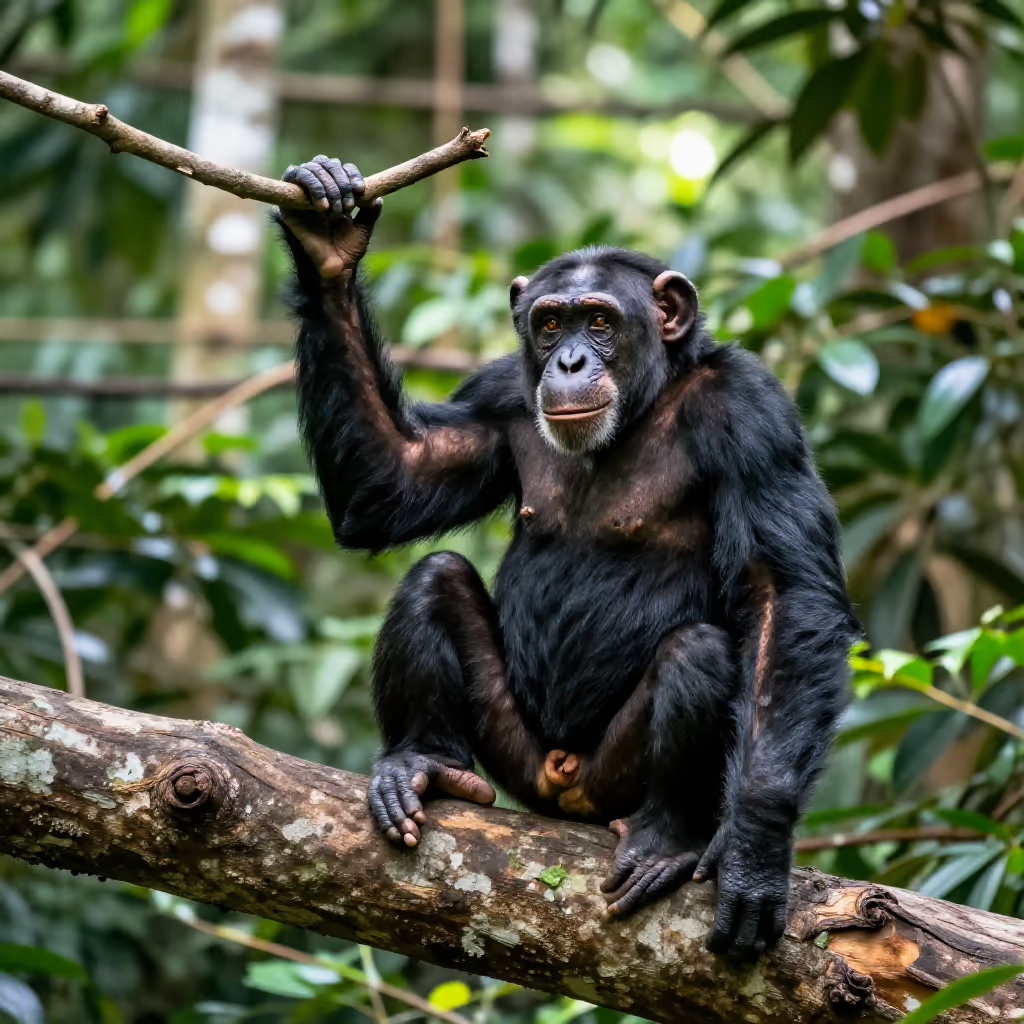
A type of great ape with black fur, native to the forests and savannas of Central and West Africa, and considered one of humans' closest relatives.
example
Im Zoo konnte man beobachten, wie ein Schimpanse geschickt ein Werkzeug benutzte, um an Futter zu gelangen.
At the zoo, you could observe a chimpanzee skillfully using a tool to get food.
Usage tips
Common mistake
'Schimpanse' belongs to the N-declension. This means that the noun takes the ending '-n' in the genitive, dative, and accusative singular. A common mistake is forgetting this ending.
EXAMPLE
Die Forscherin beobachtet den Schimpansen.
The researcher is observing the chimpanzee.
Compound nouns
The word 'Schimpanse' is often used as the first part of compound nouns to describe something related to chimpanzees. The linking element here is '-n'.
EXAMPLE
Die Schimpansengruppe hat ein neues Mitglied.
The chimpanzee group has a new member.
Typical collocations
In connection with chimpanzees, verbs such as 'beobachten' (to observe), 'erforschen' (to research), or 'klettern' (to climb) are often used. Common contexts are the zoo, research, or the wild.
EXAMPLE
Schimpansen können sehr gut auf Bäume klettern.
Chimpanzees can climb trees very well.
Compare with
confusable
Schimpanse vs Affe
monkey / ape
'Affe' and 'Schimpanse' can easily be confused because both refer to animals from the group of primates. 'Affe' is the more general word and can refer to many different species. 'Schimpanse' is a specific type of great ape. If you do not know exactly which species it is, 'Affe' is often appropriate. If you mean exactly this animal with black fur, you use 'Schimpanse'.
Schimpanse
Die Familie beobachtet im Zoo einen Schimpansen, der mit einem Stock spielt.
At the zoo, the family watches a chimpanzee playing with a stick.
Affe
Auf dem Bild sieht man einen Affen mit einem langen Schwanz.
In the picture, you can see a monkey with a long tail.